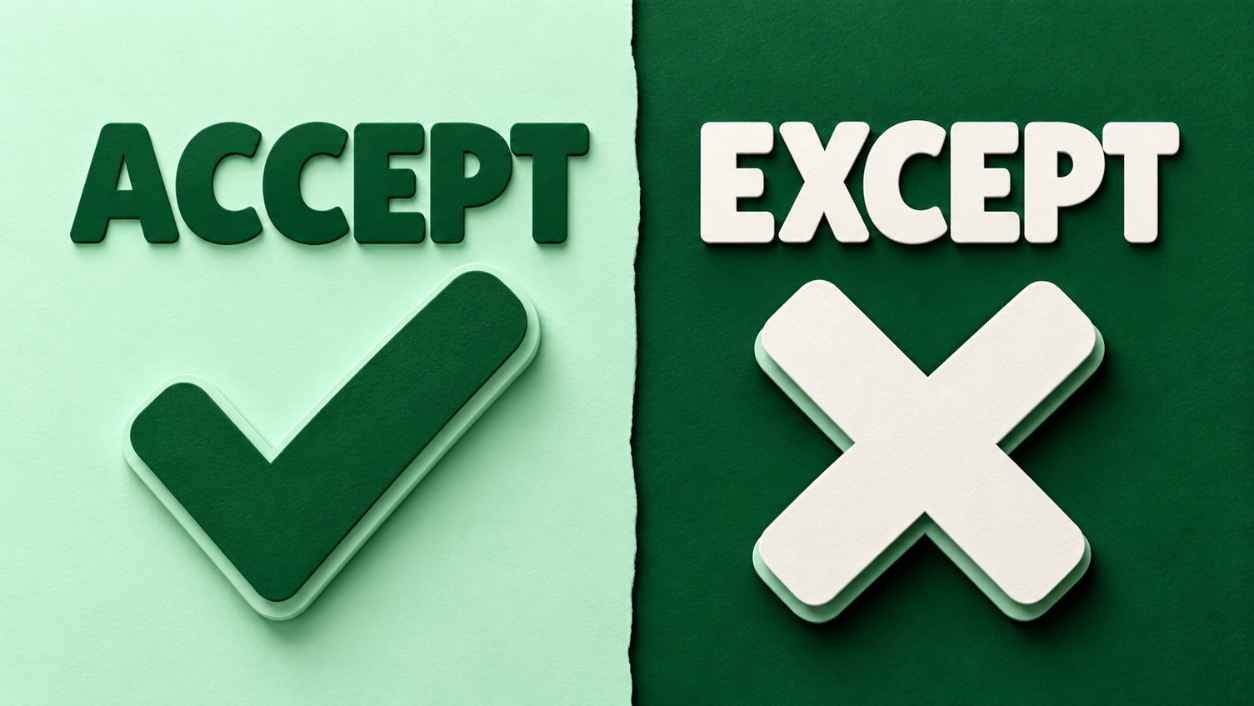

You hit send on an email, and then you spot it. One tiny wrong letter changed the whole sentence. Mixing up accept vs except happens to smart writers every single day, and it stings every time.
This guide gives you clear definitions, real examples, and quick memory tricks. You will see the accept and except meaning side by side, plus common mistakes and a simple rule for accept vs except in any sentence. Keep reading, it gets easy fast.
Accept vs Except: Why These Words Get Confused
Both words start with a short vowel sound and end the same way, so accept vs except trips up readers. Many people search accept or except just to feel sure.
Why Do People Mix Up Accept and Except?
- Similar spelling: Both words end in the same four letters, c-e-p-t.
- Fast typing: Speed and autocorrect often swap the first letters without you noticing.
- Quick speech: Unstressed first syllables sound almost identical in casual talk.
- Different jobs: One word is an action, the other marks exclusion, so errors change meaning.
- Spell checkers: Both are real words, so tools rarely flag the wrong one.
Example in texting:
Friend 1: I wrote “everyone accept Dan” in the group chat. Oops.
Friend 2: You meant except. Now Dan thinks you picked him.
Word Origin and Etymology

Words carry history, and this pair is no different at all. Knowing where accept and except come from, and how Latin shaped them, makes accept vs except easier to remember.
Where Do Accept and Except Come From?
- Accept comes from Latin accipere, meaning “to take to oneself.”
- Except comes from Latin excipere, meaning “to take out.”
- Both share the Latin root capere, which means “to take.”
- The prefix ad- (becoming ac-) means “toward,” so accept means taking something toward you.
- The prefix ex- means “out,” so except means taking something out.
- Both reached English through Old French in the late 1300s.
| Word | Latin source | Prefix meaning | Literal sense |
| accept | accipere | toward | take toward you |
| except | excipere | out | take out |
Example in chat:
Friend 1: So accept means “take toward you,” right?
Friend 2: Yes, and except means “take out.” Easy.
What Does Accept Mean?

Start with the friendlier word in accept vs except. When you say yes to a gift or an offer, you accept it, which shapes the whole accept and except meaning.
Definition of Accept
To accept is to receive something willingly, to agree to it, or to believe it is true. Dictionaries list nearly a dozen senses, but they all point toward taking something in.
Accept as a Verb
Accept is a verb. It takes an object: you accept a gift, an invitation, or responsibility. Its forms are accept, accepts, accepted, and accepting.
How Do You Use Accept in a Sentence?
- Receive: She will accept the package at the front desk.
- Agree: I accept your terms and the deadline.
- Believe: Scientists accept that the data is reliable.
- Admit: He had to accept the blame for the mistake.
- Allow in: The college accepts students from many countries.
Example in texting:
Friend 1: Did you accept the job offer?
Friend 2: Yes! I accepted this morning, and I start Monday.
Common Uses and Collocations of Accept
Certain words travel together with accept, and spotting them helps you settle accept vs except fast. These accept and except collocations show up in real emails, exams, and everyday chats.
Which Words Often Follow Accept?
- Accept an offer: Candidates accept an offer after reviewing the salary.
- Accept responsibility: Good leaders accept responsibility when a project fails.
- Accept an invitation: Guests accept an invitation by replying yes.
- Accept payment: Shops accept payment by card or cash.
- Accept the fact: Sooner or later, we accept the fact that plans change.
Example in chat:
Friend 1: Do they accept cards?
Friend 2: Cards yes, checks no.
What Does Except Mean?

Now the trickier word. Except points to the one thing left out of a group, and that exclusion decides the accept and except meaning inside any accept vs except choice.
Definition of Except
Except means excluding, apart from, or other than. It marks the person, thing, or fact that does not fit the rule you just stated.
Except as a Preposition
Most of the time, except is a preposition. It sits before a noun or pronoun: “Everyone except Maria passed the quiz.”
Except as a Conjunction
Sometimes except works as a conjunction that joins two clauses: “I would go, except it is raining.” This use is informal and less common. Except can also be a rare formal verb meaning “to leave out.”
How Do You Use Except in a Sentence?
- Exclusion: Everyone left except Tom.
- Exception to a rule: Every shop was open except the bakery.
- Except for: Except for the last question, the quiz was easy.
- Except that: The trip went well, except that we missed lunch.
- Formal verb: Judges may except certain evidence from the trial.
Example in texting:
Friend 1: Who is coming tonight?
Friend 2: Everyone except Sam. He has a late shift.
Common Uses and Collocations of Except
Just like its twin, except has favorite partners. Learn them once, and except or accept stops being a guessing game, even when accept vs. except shows up in a rush.
Which Phrases Pair With Except?
- Except for: Except for rain, the weekend was perfect.
- Except that: She agreed, except that she wanted a later date.
- Except when: I walk to work except when it snows.
- Except if: We open daily, except if a storm hits.
- Nothing except: Nothing except coffee keeps him awake.
Example in chat:
Friend 1: Are you free this week?
Friend 2: Every day except Thursday.
Accept vs Except: Key Difference Explained
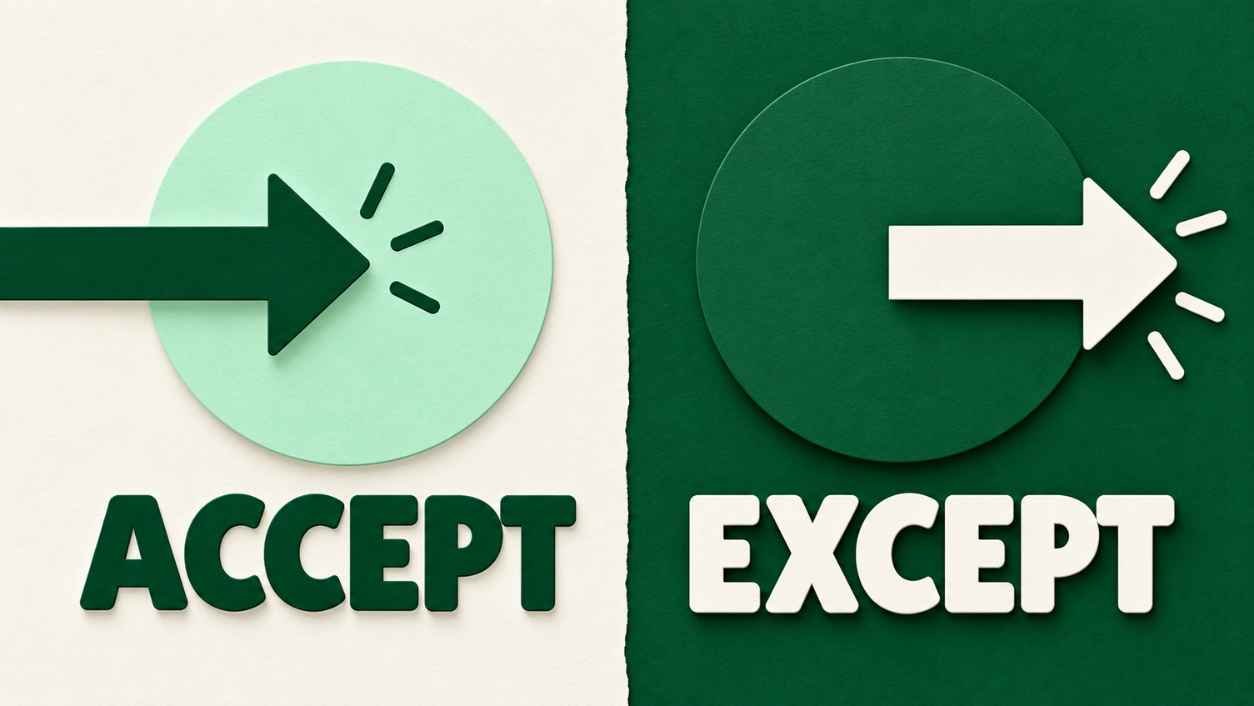
Accept means to take in, while except means to leave out. That single contrast settles accept and except every time, and it is the very heart of accept vs except.
What Is the Quick Difference Between Accept and Except?
- Accept is a verb that means to receive or agree.
- Except is mostly a preposition that means excluding.
- First test: Replace the word with “receive.” If it fits, use accept.
- Second test: Replace the word with “excluding.” If it fits, use except.
- Sound clue: Accept starts with “ak,” and except starts with “ik.”
| Feature | Accept | Except |
| Part of speech | verb | preposition, conjunction |
| Core idea | receive or agree | exclude |
| Swap word | receive | excluding |
| Example | I accept your offer. | Everyone except me. |
Example in texting:
Friend 1: I accept all the rules except the curfew.
Friend 2: Both words, used correctly. Nice.
Sentence Structure Comparison
Seeing the patterns side by side makes accept vs except click. Notice where each word sits, because accept except mix-ups usually break the sentence shape before they break the meaning.
How Does Sentence Structure Show the Right Word?
- Subject + accept + object: She accepts the gift.
- Group + except + exclusion: All the kids except Leo came.
- Accept changes tense: accepted, accepting.
- Except keeps one form when it works as a preposition.
- Position: Except usually follows a group word like all, every, or nobody.
| Word | Pattern | Example |
| accept | subject + verb + object | They accept credit cards. |
| except | group + except + exclusion | All except one passed. |
| except for | except for + noun | Except for you, nobody knew. |
Example in chat:
Friend 1: He accepted the prize.
Friend 2: Everyone except him was surprised.
When to Use Accept and When to Use Except
Pick accept when something is received, approved, or believed. Pick except when something is left out. This quick rule keeps accept and except straight in everyday accept vs except decisions.
When Should You Use Accept and When Should You Use Except?
- Gifts, offers, invitations: use accept.
- Agreement and belief: use accept.
- Blame or defeat: use accept.
- Leaving someone out: use except.
- Exceptions to rules: use except.
- Everyone but one: use except before the name that does not fit.
Example in texting:
Friend 1: They offered me a spot on the team.
Friend 2: Accept it! You earned it.
Context-Based Usage Guide
Different settings call for different phrasing. Whether you write an email or text a friend, accept vs except follows the same logic, and accept or except gets easier with context.
How Do You Choose Accept or Except at Work and School?
- Job offers: You accept an offer or a position.
- Rules and policies: Except introduces who or what the rule skips.
- School tasks: Instructions often say “all except” to skip an item.
- Shops: Signs say “we accept” for payment methods.
- Schedules: Hours often list “except” followed by a closed day.
| Context | Correct word | Example |
| Job offer email | accept | I am happy to accept the position. |
| Meeting invite | accept | Please accept the calendar invite. |
| Policy rule | except | All staff attend except interns. |
| Exam instructions | except | Answer all questions except question 5. |
| Shop sign | accept | We accept cash only. |
| Opening hours | except | Open daily except Sunday. |
Example in chat:
Friend 1: Is the cafe open Sunday?
Friend 2: Open daily except Sunday, and they accept cards.
Grammar Difference Between Accept and Except
Grammar explains everything here. One word is a verb, the other is mostly a preposition, and that simple grammar gap defines accept vs except and the accept and except meaning.
Part of Speech
Accept is a transitive verb, so it needs something to receive. Except is a preposition most of the time, a conjunction sometimes, and a formal verb rarely.
Verb vs Exclusion Function
The verb accept performs an action. The word except performs an exclusion, pointing to the item outside the group.
What Grammar Rules Separate Accept From Except?
- Verb forms: accept, accepts, accepted, accepting.
- Preposition: Except keeps one form before nouns.
- Object needed: Accept needs a direct object.
- Group needed: Except needs a group it removes something from.
- Past tense: Only accept forms it naturally, as accepted.
| Word | Part of speech | Forms | Role |
| accept | verb | accepts, accepted, accepting | action |
| except | preposition, conjunction, rare verb | except | exclusion |
Example in texting:
Friend 1: Which one is the verb in “she accepted everyone except Tim”?
Friend 2: Accepted is the verb. Except is the preposition.
Can You Use Accept and Except in the Same Sentence?
Absolutely, and it happens more often than you might think. Using accept and except together shows exactly how accept vs except works inside one clear, natural line of everyday writing.
What Does a Sentence With Both Words Look Like?
- Example one: I accept all terms except clause four.
- Example two: They accepted every candidate except one.
- Example three: She will accept any role except manager.
- Order: Accept names the action, then except names what stays out.
- Check: Ask what is received, then ask what is left out.
Example in chat:
Friend 1: I accept the plan except the budget.
Friend 2: Good, both words in one line.
Pronunciation Difference Between Accept and Except

Sound matters, especially in everyday speech. The first syllable shifts slightly, so accept vs except can sound surprisingly close, and accept except pairs often get confused when people talk quickly.
How Do You Pronounce Accept and Except?
- Accept sounds like “ak-SEPT” with stress on the second syllable.
- Except sounds like “ik-SEPT” with the same second-syllable stress.
- Vowel clue: The first sound is “a” in accept and “i” in except.
- Stress is identical, so listen closely to the first syllable.
- Practice: Say “accept the gift, except the card” slowly.
| Word | Phonetic | Sounds like | First vowel |
| accept | /əkˈsɛpt/ | ak-SEPT | short a |
| except | /ɪkˈsɛpt/ | ik-SEPT | short i |
Example in texting:
Friend 1: Say accept and except out loud.
Friend 2: ak-SEPT and ik-SEPT. I can hear it now.
Common Mistakes With Accept and Except

Everyone slips sometimes, honestly. Spotting patterns in these common errors helps you fix accept vs except quickly, and it stops accept and except slips from sneaking into your final draft.
What Are the Most Common Accept vs Except Mistakes?
- Swapping letters: Typing accept when you mean exclusion.
- Using except as an everyday verb: “I except the gift” is wrong in normal English.
- Trusting spell check: Both words pass, so read each sentence aloud.
- Mixing accepted and excepted: Accepted is the common past form.
- Forgetting the swap test: Try “receive” or “excluding” before you publish.
| Wrong | Correct | Reason |
| Everyone accept Tom came. | Everyone except Tom came. | Exclusion needs except. |
| I except your offer. | I accept your offer. | Receiving needs accept. |
| We don’t except cash. | We don’t accept cash. | Payment is received. |
| All accept the last one. | All except the last one. | Something is left out. |
Misspellings slip past readers easily, as the guide on suger vs sugar meaning explained shows.
Example in texting:
Friend 1: I except your apology.
Friend 2: You mean accept. Apology received.
Accepted vs Excepted: Which Past Form Is Correct?
Past tense adds a tricky twist. Accepted vs excepted confuses many writers because the endings match, yet the same accept or except logic decides which form fits your sentence correctly.
What Is the Difference Between Accepted and Excepted?
- Accepted is the past tense of accept: She accepted the offer.
- Accepted also works as an adjective: an accepted practice.
- Excepted is the past form of the rare verb except.
- Excepted appears in formal or legal writing: “present company excepted.”
- Everyday rule: In casual writing, choose accepted almost every time.
- Spelling check: Past tense spellings vary elsewhere too, as leveled or levelled shows.
| Form | Meaning | Example |
| accepted | received or agreed | Her offer was accepted. |
| excepted | excluded (formal) | Children are excepted from the fee. |
Example in texting:
Friend 1: Was your application accepted?
Friend 2: Yes, this morning!
Exceptable vs Acceptable: Is Exceptable a Real Word?
Searchers often wonder about this one. Exceptable vs acceptable shows how the accept vs except habit spills into adjectives, and modern English uses just one of the two common forms.
Which Is Correct: Acceptable or Exceptable?
- Acceptable is the standard adjective meaning good enough or allowed.
- Exceptable is rare and mostly outdated, meaning able to be excluded.
- Exceptionable is the real cousin, meaning open to objection.
- Unacceptable is the common opposite of acceptable.
- Typing slip: Autocorrect may turn acceptable into exceptable, so check twice.
| Word | Status | Meaning |
| acceptable | standard | good enough |
| exceptable | rare, outdated | able to be excluded |
| exceptionable | formal | open to objection |
Example in chat:
Friend 1: Is this draft exceptable?
Friend 2: You mean acceptable. Yes, it is.
Is Except For Correct in English?
Many writers often wonder about this phrase. Except for is correct, and knowing when to use it removes doubt in every accept vs except decision, even tricky accept except ones.
When Should You Add For After Except?
- Start of a sentence: Except for rain, it was perfect.
- After a group word: “Everyone except Sam” needs no “for.”
- Both forms work before nouns: “all except him” or “all except for him.”
- Formal writing usually prefers the shorter form.
- Meaning stays the same: Except and except for both exclude.
Example in texting:
Friend 1: Great day except for the traffic.
Friend 2: Yes, everything except the traffic.
Accept vs Except Examples: Real Sentences You Can Copy
Examples teach faster than rules ever do. These real sentences show accept vs except at work, and each one proves the accept and except split in clear, plain, everyday English.
What Are Good Examples of Accept and Except?
- Accept: I accept your apology.
- Accept: The airline will accept one carry-on bag.
- Accept: She learned to accept feedback calmly.
- Except: Everyone except Priya brought lunch.
- Except: The store opens daily except holidays.
- Except: I like all fruit except mango.
- Both: I accept every rule except that one.
- Both: They accepted everyone except two late applicants.
Example in texting:
Friend 1: Will you accept the invite?
Friend 2: I accept, except I can’t stay late.
Why Do Native Speakers Still Mix Up Accept and Except?
Even lifelong English speakers slip here. The cause is sound, speed, and habit, and understanding it makes accept vs except and the accept and except meaning much easier to master.
What Causes the Accept vs Except Mix-Up?
- Sound overlap: The two words differ only by a short first vowel.
- Autopilot typing: Fingers write familiar letters before the brain checks meaning.
- Spell check gaps: Both are valid, so software misses the error.
- Tricky spellings: English has many, such as hallowe’en or halloween.
- Learners: Ordinals confuse people too, like 22th or 22nd and 13th or 13rd.
Example in texting:
Friend 1: I typed except instead of accept again.
Friend 2: Happens to everyone. Read it aloud once before sending.
How to Remember Accept vs Except: Easy Memory Tricks
Memory tricks save time under pressure, especially during exams. Use these quick, simple hooks to lock in accept vs except, and your accept or except doubt will fade for good.
What Are the Best Tricks to Remember Accept vs Except?
- A for agree: Accept and agree both start with “a.”
- X for exclude: Except and exclude both contain the letter x.
- Swap test: Replace the word with “receive” or “excluding” and see what fits.
- Say it aloud: Listen for “ak” or “ik” at the start.
- Write three sentences with each word before your next email.
| Word | Memory hook | Swap word |
| accept | A for agree | receive |
| except | X for exclude | excluding |
Other word pairs, like cancellation or cancelation, also reward one quick check before you publish.
Example in chat:
Friend 1: How do you remember except?
Friend 2: X for exclude, and A for agree with accept.
FAQs
What is the difference between accept and except?
The accept vs except difference is simple. Accept means to receive or agree, while except means to exclude.
Can you discuss the difference between these two words: accept and except?
The accept vs except gap is action versus exclusion. Accept is something you do, and except names what stays outside the group.
Can except be a verb?
Yes, but rarely. In accept vs except choices, treat except as a formal verb meaning to exclude, and use accept for everyday receiving.
Which is correct: accepted or excepted?
In accept vs except past forms, accepted is the everyday choice. Excepted is formal and appears mostly in legal writing.
How do I remember accept vs except?
Link accept to agree and except to exclude. That small trick settles accept vs except quickly.
Is exceptable a word?
Exceptable is rare and outdated within the accept vs except word family. Use acceptable instead.
Do accept and except sound the same?
They sound close, but the accept vs except gap sits in the first vowel: “ak” versus “ik.”
Final Summary
Mixing up accept vs except is normal, and now you know the fix. Accept is a verb for receiving, agreeing, or believing. Except is a preposition that leaves something out.
Whenever you doubt accept vs except, swap in “receive” or “excluding” and see which fits. Remember the accept and except meaning with two hooks: A for agree, X for exclude.
Practice with the examples above, read your sentences aloud, and double check emails before you press send. With a little repetition, accept vs except will feel automatic, and your writing will read cleaner and more confident. Try writing three sentences with each word today, then share them with a friend.

Daniel Parker is an English language writer sharing clear grammar lessons, practical tips, and helpful examples for learners.










2 thoughts on “Accept vs Except Meaning: Easy Rules You Won’t Forget”