You typed it fast, hit send, and then that little itch of doubt crept in wait, is it “suger” or “sugar”? Almost everyone has stared at this word mid-sentence and felt a flicker of second-guessing, because the sound of the word just doesn’t match the way it’s written.
That tiny pause is exactly why this guide exists. Here you’ll get a clear, no-fuss breakdown of suger vs sugar, the real suger vs sugar meaning, memory tricks, sentence examples, and the small habits that keep your writing looking sharp. Keep reading, because by the end you won’t ever second-guess this word again.
Quick Answer
“Sugar” is the correct spelling it’s the only version recognized in every English dictionary, from Oxford to Merriam-Webster. “Suger” is incorrect and does not exist as a real word in standard English, no matter how natural it looks on the page. When people search suger vs sugar which is correct, the answer is always the same: sugar wins, every time, in every context.
| Quick Check | Sugar ✅ | Suger ❌ |
| Dictionary listed | Yes | No |
| Grammatically correct | Yes | No |
| Common spelling mistake | Rarely written this way | Frequently misspelled this way |
| Safe for formal writing | Always | Never |
What Does “Sugar” Mean?
Ever wondered what does sugar mean beyond the stuff in your coffee cup? The word carries more warmth and history than most people realize, and understanding it makes the correct spelling stick in your memory for good.
At its core, sugar is a sweet, crystalline substance used in food, drinks, and baking. It’s naturally found in sugarcane, sugar beets, fruits, and honey, and chemically it belongs to a family of carbohydrates called saccharides.
- Sweetener sugar is the world’s most common natural sweetening agent.
- Ingredient it’s a staple in baking, candy-making, and beverages.
- Endearment people use “sugar” as an affectionate nickname.
- Idiom phrases like “sweet as sugar” describe kindness or charm.
- Chemistry term glucose, fructose, and sucrose are all technically sugars.
How Is “Sugar” Used in Everyday Conversations?
- People say “pass the sugar” at breakfast tables worldwide.
- Bakers measure sugar in cups, grams, or tablespoons.
- Coffee lovers ask for “one sugar, please.”
- Parents call kids “sugar” as a term of endearment.
- Health articles discuss sugar intake and daily limits.
Example in chat: Friend 1: Can you grab some sugar for my tea? Friend 2: Yep, brown or white sugar?
Why “Suger” Is Incorrect
Why is suger incorrect if it feels so natural to type? The honest answer is pronunciation the word “sugar” sounds like “shug-er,” and our brains often try to spell things the way they sound rather than the way they’re actually written.
This is one of the most common sugar misspellings online, and it shows up constantly in texts, social captions, and even resumes. Understanding why is suger incorrect helps you catch the mistake before it slips into something important.
- Mispronunciation the “su” sound misleads people into guessing “e” instead of “a.”
- Phonetic spelling writers spell based on sound, not structure.
- Autocorrect gaps some fast typers skip proofreading entirely.
- Non-native confusion English learners often mix vowel patterns.
- Visual similarity “suger” looks plausible next to words like “eager” or “finger.”
Example in texting: Friend 1: I need suger for the cake lol Friend 2: *sugar 😂 but yes, I have some!
Sugar Spelling Mistake: How to Avoid It for Good
A single sugar spelling mistake can quietly undercut how polished your writing looks, even when the rest of your message is flawless and thoughtful. Small slips like this add up fast in emails and posts.
The good news is that this particular error is one of the easiest to permanently fix once you understand the pattern behind it.
- Slow down typing quickly is the number one cause of this slip.
- Sound it out say “sugar” and notice the “a” sound in the middle.
- Use spellcheck most tools flag “suger” instantly.
- Read aloud catching errors by ear works better than skimming.
- Practice writing it repetition builds permanent muscle memory.
| Habit | Helps Prevent Mistake? |
| Proofreading before sending | Yes |
| Relying only on autocorrect | Sometimes |
| Typing quickly without review | No |
| Using a grammar checker app | Yes |
Example in chat: Friend 1: Autocorrect keeps letting suger through Friend 2: Mine too, gotta manually check that one
Understanding the Correct Spelling
Understanding the correct spelling of this everyday word takes less effort than most people assume, and once it clicks, it genuinely never leaves your memory again.
Break the word into two simple chunks: su + gar. There’s no “e” hiding in the middle it’s an “a,” and that single letter is the entire difference between right and wrong.
- Su-gar the correct two-part breakdown.
- No “e” sound despite pronunciation, the spelling uses “a.”
- Memory phrase “a spoonful of sugar” reinforces the “a.”
- Visual anchor picture the word next to a sugar bowl.
- Repetition write it three times and it locks in.
Example in texting: Friend 1: su-gar, su-gar, su-gar… okay got it now Friend 2: See, that memory trick actually works!
Examples in Sentences
Seeing a word used in real sentences teaches your brain the correct pattern faster than any rule ever could, especially with a word people misspell out of habit rather than ignorance.
Below are clean, practical examples showing both the right and wrong versions side by side so the contrast is impossible to miss.
- Coffee talk “He takes his coffee without sugar.”
- Baking context “The recipe needs two cups of sugar.”
- Health advice “Too much sugar isn’t good for you.”
- Casual affection “She calls her daughter sugar.”
- Grocery list “Don’t forget to buy sugar.”
Correct Usage (Sugar)
- He takes his coffee without sugar.
- The recipe calls for two cups of sugar.
- Too much sugar isn’t good for your health.
- She added a pinch of sugar to the sauce.
- My grandmother always kept sugar in a glass jar.
Incorrect Usage (Suger)
- He takes his coffee without suger. ❌
- The recipe calls for two cups of suger. ❌
- Too much suger isn’t good for your health. ❌
Example in chat: Friend 1: The recipe says one cup of suger Friend 2: *sugar, but same thing lol let’s bake
Sugar in a Sentence: Real-Life Examples
Learning sugar in a sentence through everyday scenarios is one of the fastest ways to make the correct spelling feel completely automatic in your own writing.
Context matters more than memorizing a rule, because your brain naturally remembers patterns tied to real situations rather than abstract instructions.
- Breakfast scene “I like sugar in my oatmeal.”
- Recipe card “Whisk the sugar and butter together.”
- Doctor’s note “Reduce your sugar intake this month.”
- Kids’ story “The candy was made of pure sugar.”
- Text message “Grab sugar on your way home.”
Example in texting: Friend 1: sugar or honey for the tea? Friend 2: Sugar please, just one spoon
Comparison Table: Suger vs Sugar
A side-by-side comparison often settles the debate faster than paragraphs of explanation, especially for a word pair where the difference comes down to a single letter.
Use this table as a quick, shareable reference whenever the doubt creeps back in.
| Feature | Sugar ✅ | Suger ❌ |
| Correct spelling | Yes | No |
| Recognized word | Yes | No |
| Meaning | Sweet substance | No meaning |
| Dictionary presence | Included | Not listed |
| Usage in writing | Formal and informal | Incorrect everywhere |
| Search intent | People confirming spelling | Common typo pattern |
Example in chat: Friend 1: Wait which one is it again, suger or sugar? Friend 2: Sugar, always sugar, save this table lol
What Does Sugar Mean in Everyday English?
People search what does sugar mean far more often than you’d expect, mostly because the word carries several layers beyond its dictionary definition.
In everyday English, sugar shifts meaning depending on tone, setting, and who’s speaking which makes it a genuinely flexible little word.
- Literal meaning a sweet substance used in food.
- Term of endearment a warm nickname between loved ones.
- Slang expression “sugar” can soften a mild curse (“oh, sugar!”).
- Descriptive word “sugary” describes taste or overly sweet tone.
- Cultural reference sugar appears in countless idioms and songs.
Example in texting: Friend 1: Thanks, sugar! You’re the best Friend 2: Anytime, that’s what friends are for
Common Mistakes to Avoid
Even confident writers slip into the same handful of common mistakes with this word, usually without noticing until someone else points it out.
Spotting the pattern ahead of time saves you from repeating it in emails, captions, or school assignments.
- Writing “suger” instead of the correct spelling.
- Trusting pronunciation over the actual written form.
- Skipping proofreading during quick, casual typing.
- Ignoring spellcheck warnings when they pop up.
- Assuming autocorrect will always catch the error.
Helpful Tip
- Sugar has an “a” for “add sweetness.” That one phrase locks the spelling in permanently, because it pairs the correct letter with the word’s actual meaning.
Example in chat: Friend 1: I still typo this word constantly Friend 2: Try “add sweetness” trick, it actually helps
Why Is Suger Incorrect in the English Language?
If you’re still wondering why is suger incorrect across every English-speaking country, the reason isn’t regional it’s structural, rooted in how the word was standardized centuries ago.
English spelling doesn’t always match pronunciation, and “sugar” is a textbook example of that mismatch, which is exactly why the mistake feels so natural.
- Standardized spelling dictionaries fixed “sugar” long ago.
- Etymology the word traces back through French and Arabic roots.
- No regional exception no dialect spells it “suger.”
- Consistent across contexts formal, informal, and technical writing all agree.
- Zero dictionary entries no major dictionary lists “suger” at all.
Example in texting: Friend 1: Is suger correct anywhere, like British English? Friend 2: Nope, sugar everywhere, no exceptions
American vs British English
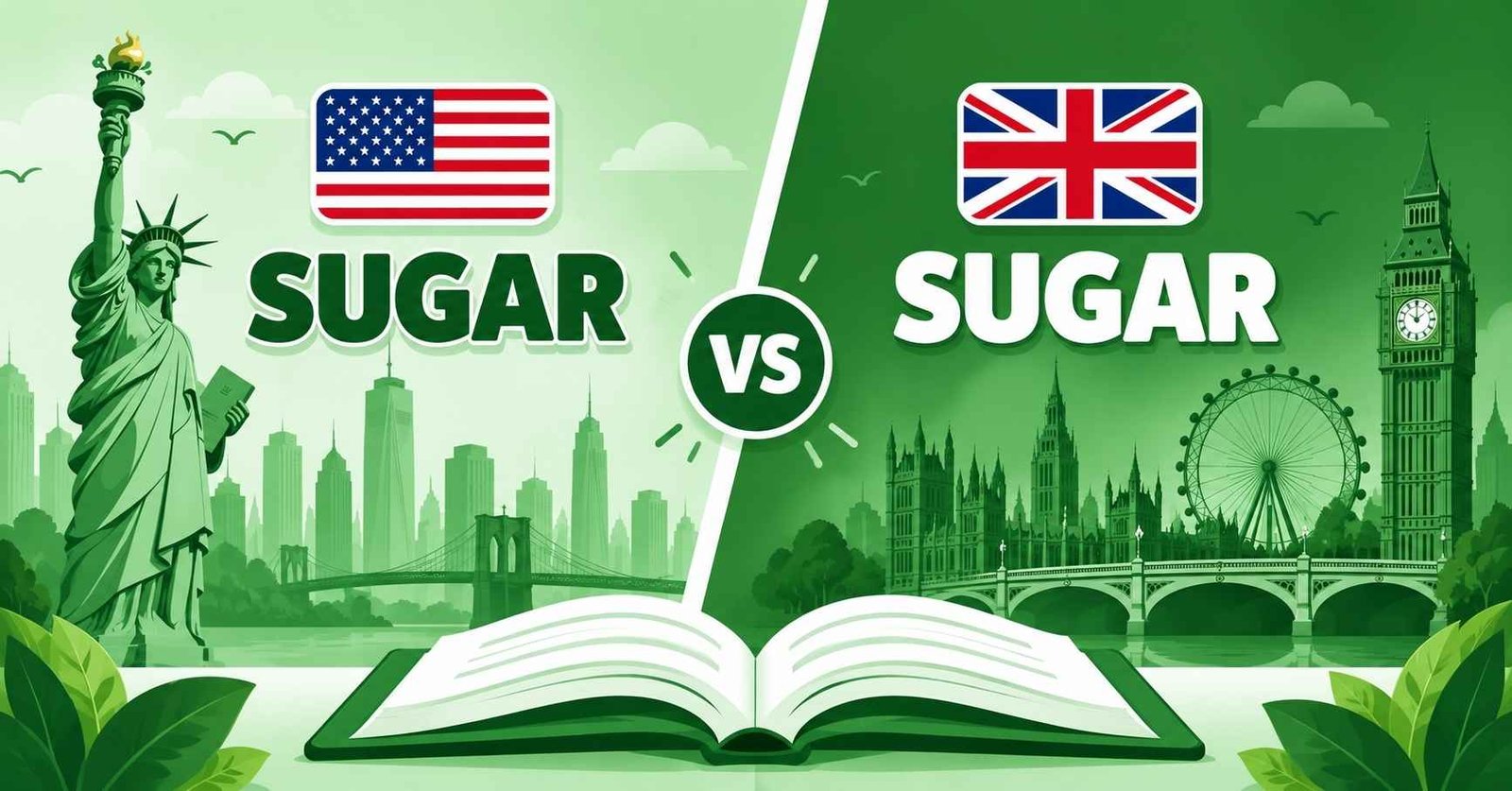
When it comes to sugar american vs british english, there’s genuinely no spelling battle here unlike “color” versus “colour,” this word stays identical on both sides of the Atlantic.
That consistency actually makes it easier to remember, since you don’t need to track two different accepted spellings.
- American English uses “sugar,” no variation.
- British English also uses “sugar,” no variation.
- Pronunciation difference slight accent shifts, not spelling changes.
- Other sweet words “sugary” and “sugar-free” also stay the same.
- No dialect exception Australian and Canadian English match too.
| Region | Accepted Spelling |
| United States | Sugar |
| United Kingdom | Sugar |
| Australia | Sugar |
| Canada | Sugar |
Example in chat: Friend 1: Is it spelled differently in British English? Friend 2: Nope, sugar stays the same everywhere
Is Sugar Spelled Differently in American and British English?
This question comes up constantly because so many other words genuinely do change between American and British English, so people assume this one might too.
But sugar breaks that pattern entirely, staying fixed and unchanged no matter which side of the ocean you’re writing from.
- No American variant exists for this particular word.
- No British variant exists either, unlike “flavour” or “colour.”
- Consistent globally across every major English dialect.
- Only pronunciation shifts, never the written form.
- Safe to use anywhere without adjusting your spelling.
Example in texting: Friend 1: My British friend spells it the same way? Friend 2: Yep, sugar is sugar, no matter the accent
Related Words and Forms
Learning the family of words connected to sugar strengthens your grip on spelling patterns and helps you avoid similar slips in related terms.
These forms show up constantly in recipes, marketing, and casual conversation, so knowing them well pays off quickly.
- Sugary containing or tasting like sugar.
- Sugar-free made without any added sugar.
- Sugars the plural form, used in nutrition labels.
- Sugarcane the plant sugar is commonly extracted from.
- Sugarcoat to make something unpleasant sound more pleasant.
Example in chat: Friend 1: This drink is way too sugary for me Friend 2: Try the sugar-free version instead
Sugary Meaning and Other Related Words
Understanding sugary meaning alongside its sibling words rounds out your vocabulary and prevents a whole cluster of related spelling errors before they start.
Each related form follows the same core spelling, so once “sugar” is locked in, the rest naturally falls into place.
- Sugary describes overly sweet food, drinks, or tone.
- Sugar-coated softened or made to seem nicer than reality.
- Sugar rush a burst of energy after eating sweets.
- Sugar daddy informal slang for a wealthy older partner.
- Sugar-free spelling always keeps the base word intact.
Example in texting: Friend 1: That cereal is way too sugary for breakfast Friend 2: Same, switching to the sugar-free brand
Sugar-Free Spelling: Getting Compound Words Right
Compound terms like this one trip people up in a slightly different way, because now there’s a hyphen decision layered on top of the original spelling question.
Getting sugar-free spelling right means remembering both the correct base word and the hyphen that connects it to “free.”
- Hyphenated form “sugar-free” always uses a hyphen.
- No space version never write it as two separate words informally without the hyphen in formal writing.
- Label language food packaging consistently uses this exact format.
- Marketing copy brands rely on “sugar-free” as a selling point.
- Common error dropping the hyphen or misspelling the base word.
Example in chat: Friend 1: Is it sugar free or sugar-free with a dash? Friend 2: Sugar-free, always with the hyphen
Why Correct Spelling Matters
It’s easy to dismiss a single misspelled word as harmless, but small details like this quietly shape how readers judge your credibility within seconds.
Getting suger vs sugar right isn’t about perfectionism it’s about respecting your reader enough to communicate clearly.
- Builds trust accurate spelling signals attention to detail.
- Improves clarity readers process correct words faster.
- Boosts professionalism resumes and emails look more polished.
- Prevents confusion misspellings can distract from your message.
- Strengthens credibility especially in business or academic writing.
Example in texting: Friend 1: Does one typo really matter that much? Friend 2: Not one, but patterns definitely add up
FAQs
Is “suger” ever correct in English?
No, “suger” is never correct. Every dictionary confirms sugar as the only accepted spelling in English.
What does “sugar” mean?
Sugar is a sweet substance used in food and drinks, typically sourced from sugarcane or sugar beets.
Why do people spell sugar as suger?
Mostly pronunciation the “shug-er” sound tempts people into guessing an “e” instead of the correct “a” in sugar.
Is sugar spelled differently in British and American English?
No, both dialects use sugar identically, unlike other words with regional spelling differences.
Can I use sugar in formal writing?
Yes, sugar fits naturally into both formal and casual writing without any restrictions.
How can I remember the correct spelling of sugar?
Picture “a spoonful of sugar” that familiar phrase reinforces the “a” every single time.
Does “suger” have any meaning at all?
No, “suger” carries no meaning whatsoever; it’s simply a misspelling of sugar.
Final Summary
At the end of the day, the debate around suger vs sugar comes down to one simple fact: sugar is correct, and suger simply isn’t a real word. Understanding the full suger vs sugar meaning from its sweet, literal definition to its warm, affectionate uses makes the correct spelling far easier to remember for good.
Whether you’re writing a recipe, a quick text, or a professional email, using sugar correctly shows care and consistency in your writing. The next time your fingers hesitate over that middle letter, remember the simple trick: sugar has an “a” for “add sweetness,” and suger has no place in proper English at all. Small fixes like this one quietly sharpen everything else you write.

Daniel Parker is an English language writer sharing clear grammar lessons, practical tips, and helpful examples for learners.










4 thoughts on “Suger vs Sugar: The Shocking Meaning Explained”