13th or 13rd: The Meaning Behind English’s Sneaky Rule

You’re mid-sentence, typing out a date or a ranking, and your fingers just stop moving. 13th or 13rdwhich one is actually right? It feels like such a tiny detail, but getting it wrong can make an otherwise polished email or resume look rushed, and honestly, almost everyone has made this exact slip at least once.
This guide settles the 13th or 13rd debate for good, using clear rules, real-life examples, and a memory trick that actually sticks. Whether you write 13rd or 13th out of habit or genuine doubt, you’ll find a plain-English answer here, backed by the actual grammar behind it. Keep reading, and you’ll never second-guess this number again.
Quick Answer: 13rd vs 13th
Here’s the short version before we get into the “why”: only one of these forms exists in standard English, and it’s not the one that follows the pattern most people expect.
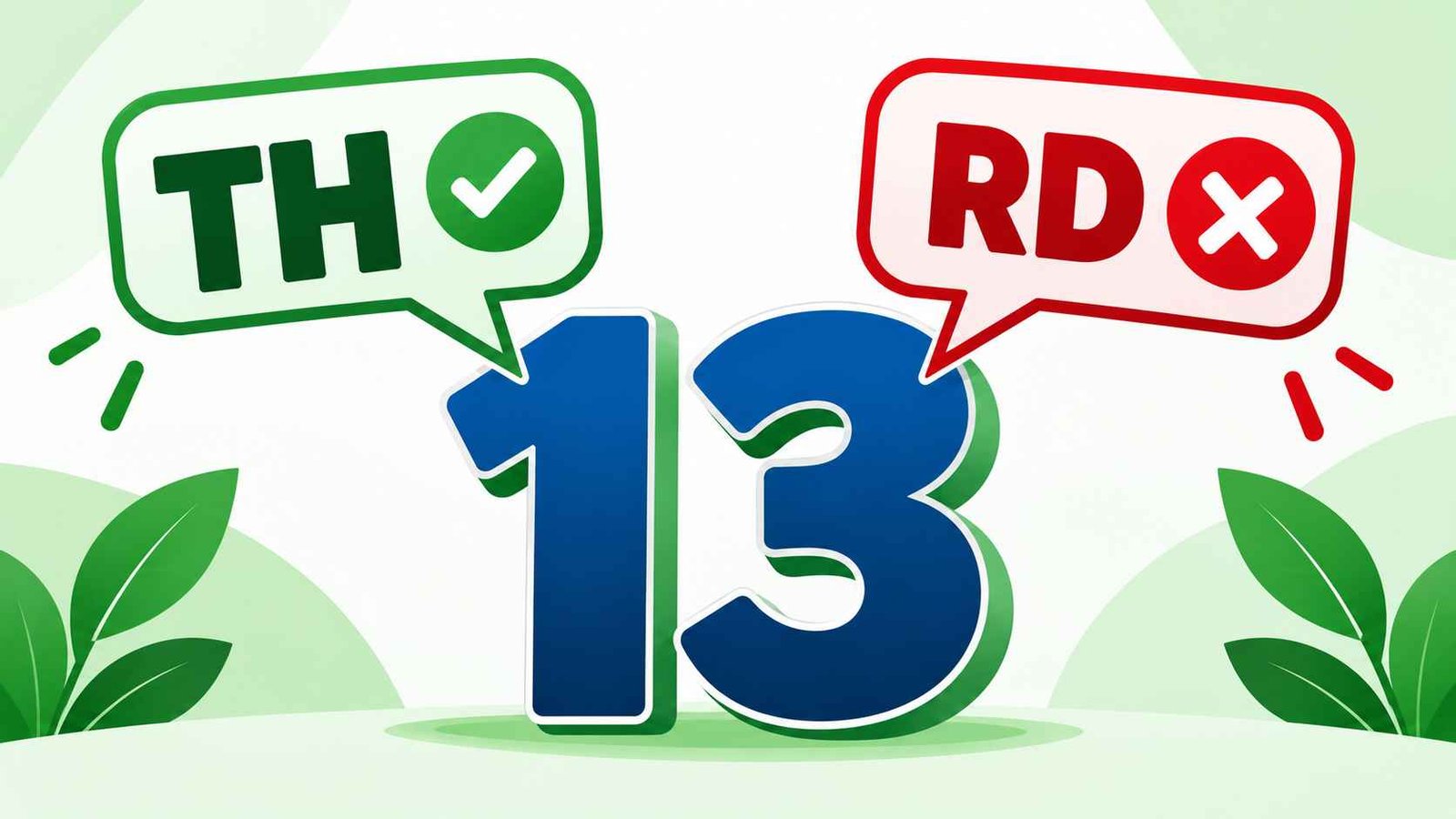
- ✅ Correct spelling: 13th
- ❌ Incorrect spelling: 13rd
- Ordinal number meaning: shows position, not quantity
- Suffix rule: teen numbers always take “th”
- Used in: dates, rankings, floors, chapters, anniversaries
| Question | Answer |
| Which is correct, 13th or 13rd? | 13th |
| Is 13rd a word? | No, it isn’t a recognized form |
| Does this change in British English? | No, the rule is identical |
| Is “thirteenth” also acceptable? | Yes, spelled out is always fine |
If you only remember one thing from this article, remember this: 13th is the only correct choice, and the “rd” ending belongs to a completely different family of numbers.
What Does “13th” Mean?
13th is an ordinal number, a word that shows order rather than amount. Instead of telling you how many of something exist, it tells you where something sits in a sequence, a date, or a ranking.
Simple Definitions:
- Position marker that comes after 12th and before 14th
- A way to describe rank in a list, race, or competition
- A common part of writing dates on calendars and invitations
- Used for floor numbers, chapters, and anniversaries
- An ordinal suffix form of the cardinal number 13
Examples in Sentences:
- My birthday falls on the 13th of June this year.
- She finished in 13th place after a strong final lap.
- The meeting was moved to the 13th floor of the building.
- This is the 13th time he’s mentioned that same story.
Example in writing: Friend 1: “Are we still doing dinner on the 13th?” Friend 2: “Yep, 13th works perfectly for me.”
Why Does 13 Use “th” Instead of “rd”?
This is the exact question most people are really asking when they type 13th or 13rd into a search bar, hoping for a quick, satisfying answer.
The short reason: numbers ending in 11, 12, and 13 are treated as a special group in English grammar, no matter what digit comes before them. It doesn’t matter if you’re talking about 13, 113, or 2,013the same teen number exception applies every single time. English ordinal suffixes are based on the last two digits, not just the last one, and that detail is exactly where the confusion around 13rd or 13th usually starts.
- The “th” rule always overrides “st,” “nd,” and “rd” for teens
- This applies to 11th, 12th, and 13th specifically
- The rule stays fixed across 1,013th, 2,113th, and beyond
- It’s one of the few truly fixed exceptions in English ordinal numbers
- Knowing this one exception solves the entire 13th or 13rd confusion
Why Do People Write “13rd”?
The incorrect form 13rd almost always comes from a very human shortcut: pattern-matching. Our brains love shortcuts, and this particular one just happens to be wrong.
Common Reasons:
- Mixing it up with 3rd, 23rd, or 33rd
- Forgetting the special exception for teen numbers
- Typing fast and applying the wrong ordinal suffix
- Assuming every number ending in 3 needs “rd”
- Relying on memory instead of the actual grammar rule
The Key Issue:
People naturally assume that since 3 becomes 3rd, then 13 should logically become 13rd. But English doesn’t apply that logic to numbers in the 11–13 range, and that single gap in the pattern is the entire reason this mix-up between 13rd or 13th keeps happening, year after year, across emails, texts, and forms.
Example in writing: Friend 1: “Wait, is it the 13rd or 13th of the month?” Friend 2: “It’s 13th13 always breaks the normal pattern.”
Understanding the Correct Rule

Ordinal numbers follow a fairly predictable suffix system, right up until they hit the teens, where the pattern intentionally breaks.
Basic Pattern:
| Cardinal Number | Ordinal Form | Suffix Used |
| 1 | 1st | st |
| 2 | 2nd | nd |
| 3 | 3rd | rd |
| 4 | 4th | th |
| 5 | 5th | th |
Special Rule for 11, 12, 13:
👉 Numbers ending in 11, 12, or 13 always take “th,” never “st,” “nd,” or “rd,” regardless of the surrounding pattern.
- 11 becomes 11th, not “11st”
- 12 becomes 12th, not “12nd”
- 13 becomes 13th, not “13rd”
- This exception repeats at every hundred (113th, 213th, 313th)
- It applies in dates, addresses, and rankings alike
Key Insight:
👉 Even though 13 technically ends in the digit 3, it still takes “th” because it belongs to the teen number family, not the regular single-digit pattern. This is the single most useful fact for settling any 13th or 13rd debate once and for all.
13rd vs 13th: Comparison Table
| Feature | 13th ✅ | 13rd ❌ |
| Correct form | Yes | No |
| Meaning | Position number thirteen | No recognized meaning |
| Grammar rule | Follows the teen number exception | Breaks the ordinal suffix rule |
| Common usage | Dates, rankings, floors, anniversaries | Not used in any standard writing |
| Clarity | Clear and professional | Confusing and distracting |
| Spelled-out form | Thirteenth | N/A |
This table is really the entire argument in one glance: 13th checks every box, while 13rd doesn’t check any of them.
13th vs Thirteenth: Is There Any Difference?
Plenty of writers wonder whether 13th and “thirteenth” are interchangeable, or whether one is somehow more formal or more correct than the other.
The truth is, both refer to the exact same ordinal numberthey’re just two different ways of writing it. 13th is the numeral-plus-suffix version, while “thirteenth” spells the word out in full. Style guides generally treat both as equally correct, though many formal documents, like legal papers or academic writing, lean toward spelling numbers out, especially at the start of a sentence.
- 13th is shorter and works well for dates, lists, and headings
- “Thirteenth” reads more formally in essays and reports
- Both forms follow the same suffix rule underneath
- Never mix the two forms within a single sentence
- Choose based on your document’s overall tone and style
Is “13rd” Ever Grammatically Acceptable?
No, and this deserves a direct answer because so many people quietly hope there’s some obscure exception that makes 13rd okay in certain contexts.
There isn’t one. No major English style guide, dictionary, or grammar authority recognizes 13rd as a valid spelling, in any dialect, in any context, formal or casual. It’s simply a typo born from the natural pull of the “3rd” pattern, not an alternate spelling with its own use case.
- 13rd is not listed in any standard dictionary
- No style guide (AP, Chicago, MLA) treats it as valid
- It doesn’t appear in British or American English rules
- Autocorrect tools typically flag or fix it automatically
- The safest rule is simple: always default to 13th
Common Mistakes to Avoid
Even a rule this small trips people up constantly, usually in the same handful of predictable ways.
1. Applying the “3rd” Rule to 13
❌ Today is the 13rd of May. ✅ Today is the 13th of May.
2. Forgetting Teen Number Exceptions
Numbers from 11 to 13 always break the usual “last digit” pattern, and forgetting that single detail is where most 13rd or 13th mistakes begin.
3. Relying on Last Digit Only
Looking only at the final digit “3” in 13, instead of the whole number, is the most common root cause of this specific error.
4. Typing Quickly Without Checking
Ordinal mistakes tend to happen in fast, casual writing, like texts or quick emails, where nobody stops to double-check the spelling.
- Slow down when writing any date involving 11, 12, or 13
- Double-check ordinal numbers in formal documents before sending
- Trust the teen rule instead of the last-digit shortcut
- Read it aloud, since “thirteenth” rarely gets said wrong
- Use spellcheck as a backup, not your only safety net
“Even a rule this small trips people up constantly, the same way simple word mix-ups like sugar vs suger trip up otherwise careful writers.”
How to Write Ordinal Numbers Correctly Every Time
If ordinal numbers trip you up in general, not just with 13, a couple of simple habits can fix that permanently.
Start by memorizing the teen number exception as its own separate rule, rather than trying to force it into the normal 1st/2nd/3rd pattern. Then, whenever you’re unsure, mentally say the number out loud in full. Nobody naturally says “thirteen-rd,” which makes the spoken word a surprisingly reliable check for the written ordinal suffix.
- Memorize the 11th, 12th, 13th exception as one unit
- Say the number aloud before writing the short form
- Check compound numbers like 113th and 1,213th the same way
- Keep a mental list of tricky ordinals you personally forget
- Proofread dates specifically, since they’re the most common trap
More Examples of “13th” in Context
Seeing 13th used correctly across different everyday situations makes the rule much easier to remember than a definition alone ever could.
In Dates:
- The event will take place on the 13th of the month.
- Her contract officially began on March 13th.
In Rankings:
- He secured 13th position in the national competition.
- The team dropped to 13th in this week’s standings.
In Addresses:

- The office is located on the 13th floor of the tower.
- Their apartment sits on 13th Street downtown.
In History or Events:
- The 13th chapter explains the concept in full detail.
- This marks the 13th anniversary of the company’s founding.
| Context | Correct Example |
| Dates | “The invoice is due on the 13th.” |
| Rankings | “She placed 13th out of fifty runners.” |
| Addresses | “Meet me on 13th Avenue at noon.” |
| Events | “It’s their 13th wedding anniversary.” |
13th in Formal Writing vs Casual Writing
Context changes how strict you need to be, even though the correct spelling of 13th itself never actually changes.
In formal writing, like contracts, resumes, or academic papers, precision matters more, and a stray 13rd can genuinely hurt your credibility with a reader who notices these details. In casual writing, like texts or quick notes, the same typo is far more forgivable, but it’s still worth fixing simply because good habits in casual writing tend to carry over into formal writing without you even realizing it.
- Formal documents demand exact, error-free ordinal spelling
- Casual texting allows more slack, but habits still matter
- Resumes and cover letters are especially unforgiving of typos
- Academic papers often prefer “thirteenth” spelled out in full
- Consistency across a single document matters more than people think
Example in writing: Friend 1: “Quick q, is the deadline the 13rd or 13th?” Friend 2: “13th! Let’s not send that typo to the client.”
American vs British English Differences
Good news here: there’s genuinely no difference between American and British English on this particular rule.
- 🇺🇸 American English: 13th
- 🇬🇧 British English: 13th
| Region | Correct Form | Notes |
| American English | 13th | Standard in all style guides |
| British English | 13th | Identical rule, no exceptions |
| Australian English | 13th | Follows the same convention |
| Canadian English | 13th | No regional variation exists |
Both dialects follow the exact same ordinal suffix system, including the same teen number exception. This is actually one of the rare grammar points where you can stop worrying about regional differences entirely and just focus on the rule itself.
What’s the Easiest Way to Remember the 13th Rule?
If you only take one shortcut away from this entire article, make it this simple mental trick, because it genuinely works in the moment you need it.
Picture the numbers 11, 12, and 13 standing together as a trio that refuses to follow the crowd. Every other number checks its last digit to pick “st,” “nd,” “rd,” or “th,” but this trio always answers “th,” no matter what. That single mental image resolves the 13th or 13rd question faster than trying to recall a formal grammar rule under pressure.
- Group 11, 12, 13 together as one exception in your mind
- Picture a “th club” that these three numbers always join
- Say it aloud whenever you’re genuinely unsure while typing
- Notice the pattern repeats at 111th, 112th, 113th, and beyond
- Trust the exception, since it never changes across any number range
Why Correct Usage Matters
Using the correct form, 13th, keeps your writing accurate, credible, and easy to read, which matters more than most people initially assume.
Key Benefits:
- Improves clarity so readers never pause to reread a sentence
- Avoids confusion in dates, contracts, and scheduling documents
- Builds credibility with clients, employers, and readers generally
- Shows attention to detail in resumes and professional writing
- Prevents miscommunication around important dates and deadlines
Even a tiny error like 13rd can quietly make otherwise strong writing look less polished, especially in a first impression like an email, application, or proposal.
Tools and Tricks to Never Misspell 13th Again
A few small habits make this mistake essentially impossible to repeat, once they become part of your normal writing routine.
Turning on autocorrect and spellcheck in your writing apps catches most instances of 13rd automatically, though it’s still smart to know the rule yourself rather than relying entirely on software. Keeping a quick mental note of the teen number exception, and reading dates aloud before hitting send, rounds out a simple, reliable system.
- Enable spellcheck across your email, docs, and messaging apps
- Bookmark this rule somewhere you’ll actually see it again
- Read dates aloud before finalizing important documents
- Ask a second reader to review high-stakes formal writing
- Practice the trio rule until it becomes automatic memory
Synonyms and Related Terms
Numbers themselves don’t have true synonyms, but there are still a few natural ways to express the same ordinal position.
- Thirteenth (fully spelled-out form)
- Position number thirteen
- Ranked thirteenth
- 13th in order or 13th in sequence
- Number thirteen, ordinal form
Each of these phrases communicates the same idea as 13th, just with slightly different tone or formality, useful depending on whether you’re writing a casual note or a formal report.
Easy Memory Trick
Here’s the single easiest way to lock this rule into memory for good, without needing to reread this entire guide next time you’re unsure.
👉 “All teen numbers, 11 through 13, always use ‘th’no exceptions, no matter what.”
This one rule quietly resolves nearly every version of the 13th or 13rd confusion you’ll ever run into, whether it shows up in a date, a ranking, or a casual text message.
Example in writing: Friend 1: “I always forget, is it 13rd or 13th?” Friend 2: “13th, always. Teen numbers are the exception, remember?”
FAQs About 13th or 13rd
Is “13rd” ever correct to use?
No, 13rd is never correct in standard English, regardless of context, tone, or region.
What is the correct ordinal form of 13?
The correct form is 13th, following the fixed teen number exception rule.
Why doesn’t 13 use “rd” like 3rd does?
Because numbers ending in 11, 12, and 13 always use “th” instead, settling the 13th or 13rd question.
Is this rule the same in British English?
Yes, British and American English apply the identical 13th or 13rd rule with zero variation.
What about numbers like 23 or 33?
Those follow the normal pattern, becoming 23rd and 33rd, unlike the 13th or 13rd exception.
Can I write “thirteenth” instead of 13th?
Yes, spelling it out fully is always acceptable and avoids the 13th or 13rd mix-up entirely.
Why do people keep confusing 13rd or 13th?
Most people focus on the last digit alone, which is exactly why the 13th or 13rd error keeps repeating.
Conclusion: 13th or 13rd
The difference between 13th or 13rd really comes down to one small, fixed exception: teen numbers always take “th,” no matter what digit comes before them. 13th is correct, professional, and universally recognized, while 13rd is simply a common typo born from a natural but incorrect pattern match. Once you understand the 13rd or 13th rule, the mistake becomes almost impossible to repeat.
Small details like this genuinely shape how polished and trustworthy your writing feels to other people, whether it’s a resume, a text, or a client email. Next time your fingers hesitate over a date or a ranking, picture the teen-number trio, trust the exception, and type 13th with confidence.

Daniel Parker is an English language writer sharing clear grammar lessons, practical tips, and helpful examples for learners.










1 thought on “13th or 13rd: The Meaning Behind English’s Sneaky Rule”