In biennial vs biannual, biennial means once every two years. Biannual usually means twice a year, and Merriam-Webster also lists every two years as a second sense. When the meaning must be clear, write semiannual for twice a year and biennial for every two years.

Biennial is the only one of the pair that never means twice a year.
What biennial and biannual mean

Biennial describes something that happens once every two years. A conference held in 2024 and 2026 is biennial. Merriam-Webster and Oxford Learner’s Dictionaries both give this meaning. Merriam-Webster adds a second sense, lasting two years, which is the one botanists use for plants that grow leaves in year one and flower and fruit in year two. Carrots are a common example.
Biannual is defined by Oxford Learner’s Dictionaries as happening twice a year. Merriam-Webster’s first sense says the same. Its second sense points to biennial, and that is where the trouble starts.
Weeks and months split the same way: biweekly and bimonthly each have two readings. Plenty of other look-alike words trip readers up too, including a slang word with two spellings.
Why biannual is the risky word
Merriam-Webster’s usage note says biannual and biennial are usually kept apart. The same entry says biannual can mean either, and that some writers use semiannual for twice a year and save biannual for every two years. It calls that habit far from universal. Oxford Learner’s lists only the twice-a-year meaning.
So twice a year is the more common reading, and it is a tendency, not a rule. A reader can take your biannual the other way. Dates remove the doubt: “biannual inspections in April and October” can only mean twice a year.
Which word to use
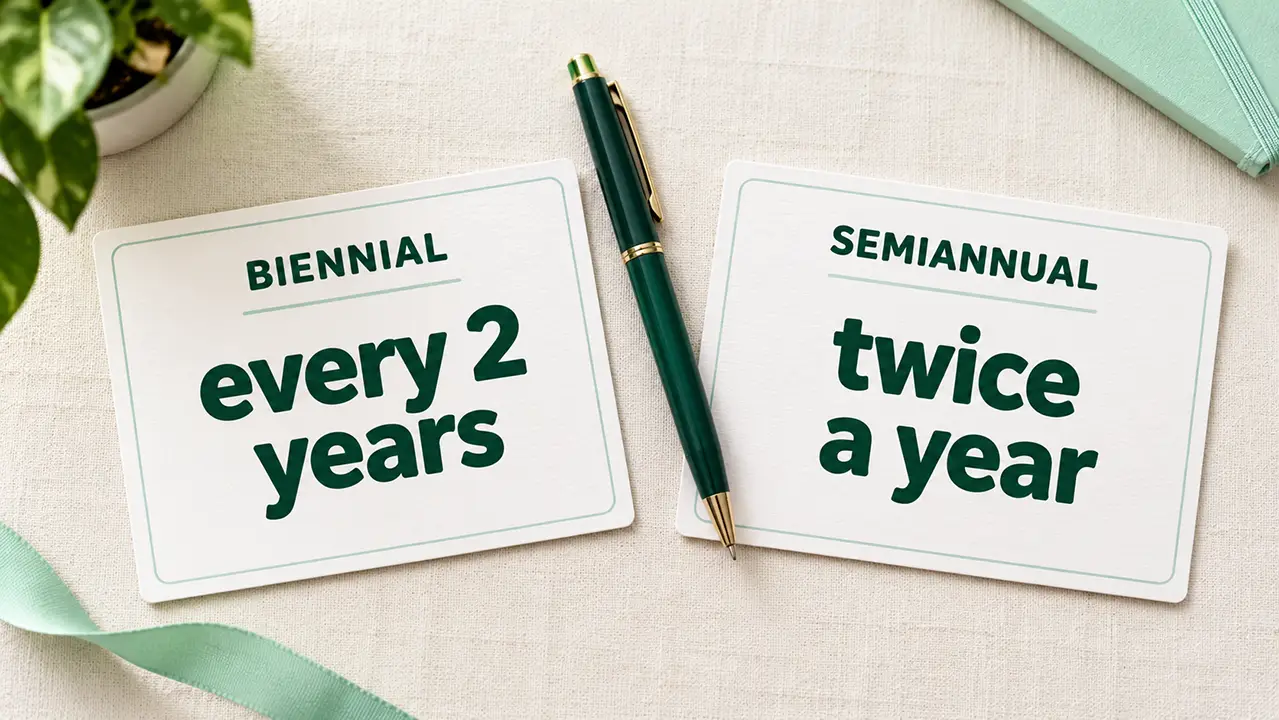
| What you mean | Clearest word | Note |
| Once every two years | biennial | Both dictionaries agree |
| Twice a year | semiannual | Or write “twice a year” |
| Twice a year, with months or dates given | biannual | Context carries the meaning |
| Lasting two years | biennial | Merriam-Webster’s second sense |
How to tell them apart
Biannual is bi- plus annual, so it reads as annual twice over. Biennial comes from the Latin biennis, built from bi- and annus, “year” (Oxford Learner’s). One memory aid, which is a mnemonic and not etymology: the E in biennial can stand for “every other year.”
How to say them
Both stress the second syllable. Oxford Learner’s gives /baɪˈænjuəl/ for biannual and /baɪˈeniəl/ for biennial. In plain respelling: by-AN-yoo-ul and by-EN-ee-ul.
Example sentences
• The society’s biennial conference was last held in 2024, so members meet again in 2026.
• Carrots are biennial, so they flower in their second year if left in the ground.
• The dentist sends biannual reminders, one in March and one in September.
• Our biannual sale runs in January and July.
Example:
Friend 1: “The audit is biannual, so we skip it this year?”
Friend 2: “Ask first. It could mean twice a year or every two years. Semiannual or biennial would settle it.”
Common mistakes

• Reading biannual as always every two years. Oxford Learner’s does not list that sense, and Merriam-Webster calls it only one of two.
• Reading biennial as twice a year. Neither dictionary lists that meaning.
• Leaving frequency undated in contracts and schedules. “Biannual payments” with no months invites a dispute.
• Hyphenating. Merriam-Webster and Oxford Learner’s both list biannual as one word.
Quick practice
1. A festival held in 2024, 2026 and 2028 is: biannual or biennial?
2. A shop sends coupons in March and September. Which word is clearest?
3. A plant flowers in its second year. Which word describes it?
4. What does Oxford Learner’s say biannual means?
5. A contract says “biannual payments” with no dates. What is the fix?
Answers: 1) biennial. 2) semiannual. 3) biennial. 4) Twice a year. 5) Replace it with “twice a year” or “every two years,” or add the months.
Quick answers
Is semiannual the same as biannual?
Semiannual means twice a year. That matches biannual’s first sense, which is why some writers prefer semiannual when they want no doubt.
What are the adverb forms?
Biannually and biennially. Oxford Learner’s gives biennially as once every two years. Biannually follows biannual and carries the same ambiguity.
Can biennial be a noun?
Yes. Merriam-Webster and Oxford Learner’s both list a noun sense for a plant that lives two years and flowers in the second.
What about biweekly and bimonthly?
Merriam-Webster calls both inherently ambiguous because bi- can mean “every two” or “two times.” It suggests adding context or using semi- for “twice a.”

Daniel Parker is an English language writer sharing clear grammar lessons, practical tips, and helpful examples for learners.










1 thought on “Biennial vs biannual: which means every two years?”