
You typed an email, hit backspace three times, and stared at the word again. Cancellation or cancelation? Both look right. Both look slightly wrong. That tiny flicker of doubt is annoying, especially when the email is already late.
Here’s the good news: this guide settles it for good. You’ll get a clear answer, the real reason both spellings exist, and simple rules for cancelation or cancellation so you never second-guess yourself again. By the time you reach the FAQs, you’ll spell it with total confidence, whether you’re writing to a client, a professor, or a friend. Keep reading.
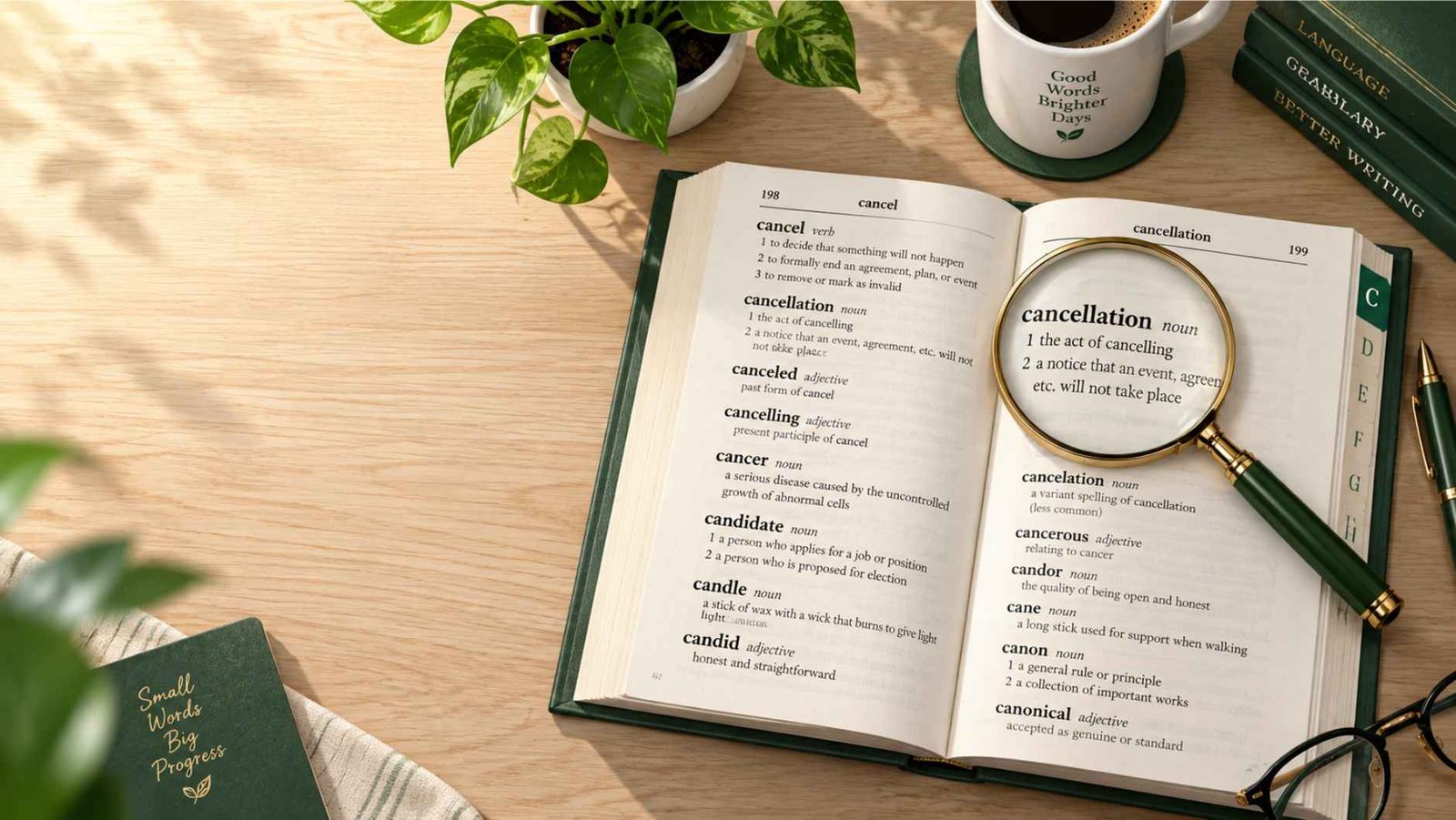
Cancellation or Cancelation – Quick Answer
Both spellings pass in a dictionary check, but only one wins in everyday, professional English almost everywhere. Cancellation is correct and standard worldwide, while cancelation is a narrower, mostly American variant.
Which One Should You Actually Type Right Now?
If you need one rule to remember before your next email, meeting, or assignment, this is the one that settles the debate instantly.
- Cancellation is accepted in British, American, and global English.
- Cancelation is only accepted informally in American English.
- Dictionaries list both, but usage frequency is not equal.
- Style guides for news, academic, and business writing favor cancellation.
- Spellcheck tools rarely flag cancellation, but often flag cancelation.
- Safest choice: use cancellation when you’re unsure of your audience.
| Question | Quick Answer |
| Is cancelation a word? | Yes, but rare and mostly US-only |
| Is cancellation correct everywhere? | Yes, globally accepted |
| Which spelling looks more professional? | Cancellation |
| Which spelling should beginners use? | Cancellation |
Example in texting: Friend 1: did u get a cancellation email from the airline? Friend 2: yes, full refund too lol
The Origin of Cancellation or Cancelation
Behind this spelling confusion sits a real story about language history, one that explains why even native speakers argue over cancellation or cancelation today.
The root word cancel traces back to the Latin cancellare, meaning to cross out with lattice-like marks. English borrowed the concept, then built its own suffix rules on top of it, and that’s exactly where the split began.
Why Does English Have Two Versions of the Same Word?
- The base verb is cancel, borrowed through French from Latin.
- English adds -ation to form the noun, as with many verbs.
- British spelling doubles the final l before a suffix.
- American spelling often skips that doubling, giving a shorter form.
- Over decades, cancellation became dominant even in the US.
- Publishers and editors gradually standardized around one spelling.
- Dictionaries kept both to reflect real historical usage.
Example in chat: Friend 1: why does British English double the L in cancellation? Friend 2: just an old spelling rule, nothing deeper than that
British English vs American English Spelling

The British-American divide explains most of the confusion around cancellation or cancelation, and understanding it makes every future spelling decision much easier.
British English almost always doubles the l before adding -ing or -ation, while American English historically simplified many of these doubled letters, though usage has drifted closer together over time.
Does American English Ever Prefer the Double L Too?
- British English: always writes cancellation, never cancelation.
- American English: technically accepts cancelation, though it’s uncommon.
- News outlets in the US mostly print cancellation anyway.
- Academic journals almost universally use cancellation.
- Legal documents default to cancellation for consistency.
- Everyday texting shows more flexibility than formal writing.
| Region | Preferred Spelling | Accepts the Other? |
| United Kingdom | Cancellation | No |
| United States | Cancellation | Yes, rarely |
| Canada | Cancellation | No |
| Australia | Cancellation | No |
| India | Cancellation | No |
Example in texting: Friend 1: my American teacher marked cancelation as correct Friend 2: yeah it’s technically allowed there, just uncommon
Is Cancelation Grammatically Incorrect?
No, it isn’t wrong, but plenty of readers assume it’s a typo the moment they see it, which creates a real credibility problem for writers.
Cancelation follows an accepted American spelling pattern, so grammar checkers built on US dictionaries usually accept it without complaint, yet it still looks unfamiliar to a majority of English readers around the world.
What Do Grammar Checkers Actually Say About It?
- Grammarly and similar tools flag it less than people expect.
- Microsoft Word accepts cancelation under a US English dictionary.
- UK-based tools almost always underline it as an error.
- Search engines still show far more results for cancellation.
- Human readers often assume it’s a mistake, correct or not.
Example in chat: Friend 1: is cancelation wrong or just less common? Friend 2: less common, not technically incorrect
Which Spelling Should You Use?
Your audience decides this answer more than any dictionary rule ever will, so the smartest move is to think about who’s actually reading your words.
For US readers, UK readers, students, professionals, and international audiences, cancellation works safely in every context, while cancelation only fits casual American writing where a slightly shorter spelling won’t raise eyebrows.
Should Your Choice Change Based on Where You Publish?
- US audience: cancellation still reads as professional and expected.
- UK audience: cancellation is the only accepted standard form.
- Commonwealth countries: always default to cancellation.
- Global blogs and SEO content: cancellation performs better in search.
- Casual texting among Americans: cancelation is acceptable but rare.
- Formal resumes and cover letters: never risk cancelation.
Example in texting: Friend 1: which one should I use for my cover letter? Friend 2: cancellation, always, don’t risk the short version
Cancellation or Cancelation in Formal Business Writing
Business writing has zero tolerance for spelling doubt, because a single inconsistent word can quietly undercut a client’s trust in your professionalism.
Contracts, invoices, policy documents, and customer emails almost always use cancellation, and switching to cancelation mid-document can look like a typo rather than an intentional stylistic choice.
Why Do Companies Avoid the Shorter Spelling?
- Brand consistency matters more than either spelling being “correct.”
- Legal teams prefer the widely recognized cancellation form.
- Customer service scripts almost never use cancelation.
- Style guides at major companies standardize on cancellation.
- International clients expect the more familiar spelling.
- Proofreaders flag cancelation as inconsistent, even if valid.
| Document Type | Preferred Spelling |
| Contracts | Cancellation |
| Invoices | Cancellation |
| Customer emails | Cancellation |
| Internal memos | Either, usually Cancellation |
Example in chat: Friend 1: our contract template says cancellation, can I change it? Friend 2: no, keep it consistent with company style
Common Mistakes with Cancellation or Cancelation
Even confident writers slip up here, mostly because both spellings feel plausible in the moment and spellcheck doesn’t always catch the inconsistency.
Most errors involve mixing spellings within the same document, assuming one form is flatly wrong, or forgetting that cancelled and canceled follow the exact same British-American pattern as their noun forms.
What Are the Most Repeated Spelling Errors?
- Mixing spellings in one document is the top mistake.
- Assuming cancelation is always wrong misleads many writers.
- Forgetting the verb forms canceled and cancelled follow the same rule.
- Copy-pasting from mixed sources creates accidental inconsistency.
- Auto-correct sometimes swaps one form for another mid-edit.
- Ignoring house style guides causes repeated corrections later.
- Overcorrecting by adding an extra l where it doesn’t belong.
Example in texting: Friend 1: I wrote cancellation once and cancelation twice in one email Friend 2: pick one and stick with it, that’s the real rule
Why Do Americans Spell It Differently Than the British?
Noah Webster, the American lexicographer, intentionally simplified many British spellings in the 1800s to create a distinct national identity for American English.
His reforms shortened words like colour to color and theatre to theater, and that same simplifying instinct influenced how some Americans treat doubled consonants before suffixes, including in cancelation.
Did One Person Really Change American Spelling?
- Noah Webster pushed simplified spelling reforms across American English.
- His dictionary became the foundation for US spelling conventions.
- Not every reform stuck, which is why usage stayed mixed.
- Cancellation never fully lost ground, even in the US.
- Modern usage data shows the reform only partly succeeded here.
Example in chat: Friend 1: so cancelation is basically a Webster thing? Friend 2: kind of, but it never really caught on fully
Cancellation or Cancelation in Everyday Examples
Seeing real examples makes the rule stick far better than memorizing it in the abstract, so here’s how each spelling actually shows up day to day.
From airline notices to social media captions, the pattern is consistent: cancellation dominates formal and semi-formal writing, while cancelation occasionally appears in casual American posts and texts.
Seeing real examples makes the rule stick far better than memorizing it in the abstract, so here’s how each spelling actually shows up day to day. Casual cancellation texts often lean on a quick symbol too, like the apple logo emoji, to soften an otherwise disappointing message.
Where Do You See Each Spelling Most Often?
- Airline emails: almost always say flight cancellation.
- Subscription services: confirm your cancellation in the same wording.
- News headlines: report event cancellation using the double-l form.
- Social media captions: sometimes use cancelation casually.
- Customer support chats: default to cancellation for clarity.
- Text messages between friends: either spelling appears informally.
Example in texting: Friend 1: got the cancellation confirmation for the concert Friend 2: ugh finally, refund coming through?
Cancellation or Cancelation: Dictionary Definitions Explained
Dictionaries settle disputes for most words, but here they quietly reveal just how much cancellation and cancelation overlap in accepted meaning.
Merriam-Webster lists cancellation as the primary entry and cancelation as a valid variant, while British dictionaries like Oxford list only cancellation, with no variant spelling offered at all.
What Do Major Dictionaries Actually Say?
- Merriam-Webster: lists cancellation first, cancelation as a variant.
- Oxford English Dictionary: only recognizes cancellation.
- Cambridge Dictionary: primarily lists cancellation for global learners.
- Collins Dictionary: treats cancellation as the standard form.
- American Heritage Dictionary: notes cancelation as less frequent.
| Dictionary | Primary Entry | Lists Variant? |
| Merriam-Webster | Cancellation | Yes, cancelation |
| Oxford | Cancellation | No |
| Cambridge | Cancellation | No |
| Collins | Cancellation | No |
Example in chat: Friend 1: does the dictionary even list cancelation? Friend 2: only Merriam-Webster does, as a secondary spelling
Cancellation or Cancelation – Google Trends & Usage Data
Search behavior tells a story that dictionaries can’t, and the numbers here are surprisingly one-sided once you actually look at them.
Search volume for cancellation consistently outpaces cancelation across nearly every English-speaking country, and most searches for the shorter form come from people trying to confirm whether it’s correct, not people intentionally using it.
How Big Is the Gap Between the Two Spellings?
- Global search volume favors cancellation by a wide margin.
- UK, Canada, Australia: searches for cancelation are minimal.
- US search data: still leans toward cancellation overall.
- Published books and articles: use cancellation far more often.
- Cancelation searches are mostly spelling-check queries, not intent to use it.
Example in texting: Friend 1: apparently cancellation gets searched way more than cancelation Friend 2: makes sense, it just looks more “official”
How to Remember the Correct Spelling of Cancellation

A simple memory trick beats memorizing dictionary entries, especially when you’re typing fast and don’t have time to second-guess yourself.
Picture the double l in cancellation as two lines crossing out a mistake, mirroring the Latin root cancellare, and that small mental image is often enough to lock the spelling in for good.
Is There a Trick That Actually Works Long-Term?
- Visualize two l’s as crossed-out lines, matching the word’s Latin root.
- Compare it to “travelling”, which British English also doubles.
- Remember: when unsure, the longer spelling is almost always safer.
- Use spellcheck set to UK English if you write internationally often.
- Keep a personal style note if your workplace has a preference.
- Practice writing it in full sentences, not just isolated words.
Example in chat: Friend 1: any trick for remembering the double l? Friend 2: think of it crossing something out, like the Latin meaning
Which Spelling Will Spellcheck Accept?
Spellcheck tools aren’t as consistent as people assume, and that inconsistency is exactly why so many writers stay unsure about this word.
Tools set to US English typically accept both cancellation and cancelation, while tools set to UK, Canadian, or Australian English will usually underline cancelation as an error, regardless of context.
Why Does Your Spellcheck Setting Matter So Much?
- US English mode: accepts both spellings without a warning.
- UK English mode: flags cancelation every time.
- Browser spellcheckers: often default to US settings automatically.
- Word processors: let you switch dictionaries in language settings.
- Mismatched settings: explain why coworkers see different results.
Example in texting: Friend 1: my spellcheck isn’t flagging cancelation at all Friend 2: you’re probably on US English, switch it and see
Cancellation or Cancelation in Academic and Legal Writing
Academic and legal writing leave almost no room for spelling flexibility, since consistency and precision matter more here than in any casual context.
Universities, journals, and law firms overwhelmingly require cancellation, treating cancelation as a deviation from standard style guides like APA, MLA, and Chicago, all of which default to the double-l form.
Do Style Guides Officially Prefer One Spelling?
- APA style: uses cancellation consistently across guidance.
- MLA style: follows the same standard, double-l spelling.
- Chicago Manual of Style: defaults to cancellation as well.
- Law firms: standardize on cancellation for contract language.
- Universities: mark cancelation as inconsistent, even if technically valid.
Example in chat: Friend 1: professor marked cancelation wrong on my paper Friend 2: APA style wants cancellation, that’s probably why
Cancellation vs Cancelation – Comparison Table
Sometimes a side-by-side view says more than paragraphs of explanation ever could, especially when you just need a fast, visual answer.
This table pulls together everything covered so far, giving you one place to check whenever doubt creeps back in about cancellation or cancelation.
Which Spelling Wins in a Direct Comparison?
- Correctness: both are technically valid spellings.
- Global acceptance: cancellation wins by a wide margin.
- Formal writing: cancellation is the safer, expected choice.
- Casual texting: either spelling passes without much notice.
- Search performance: cancellation ranks and searches far higher.
| Feature | Cancellation | Cancelation |
| Correct spelling | Yes | Yes (US only) |
| British English | Yes | No |
| American English | Yes | Yes |
| Common in writing | Very common | Rare |
| Safe for formal use | Yes | Not ideal |
| Seen as standard form | Yes | No |
Example in texting: Friend 1: honestly just use cancellation and you’re safe everywhere Friend 2: yeah that’s the takeaway I’m keeping
FAQs About Cancellation or Cancelation
1. Is cancelation a real word?
Yes, cancelation is a real, dictionary-listed word in American English, though it’s used far less than cancellation in practice.
2. Which spelling is correct in British English?
Cancellation is the only correct spelling in British English, and cancelation is not recognized there at all.
3. Which spelling is better for exams and formal writing?
Always choose cancellation for exams, since it’s the standard, widely accepted spelling across every major style guide.
4. Why do some Americans write cancelation?
Some Americans follow simplified spelling reforms that skip doubling the final l, making cancelation technically valid there.
5. Is cancellation wrong in American English?
No, cancellation is fully correct and actually preferred in American English, despite cancelation also being accepted.
6. Which spelling do most websites use?
Most websites, including major news and business sites, consistently use cancellation rather than the shorter variant.
7. What is the safest spelling to use globally?
Cancellation is the safest global choice, since it’s accepted and expected across British, American, and international English.
Conclusion
The debate over cancellation or cancelation really comes down to one simple truth: both spellings are technically valid, but they are not equally common. Cancellation dominates British English, American publishing, academic writing, and business communication, while cancelation survives mostly as a casual American variant that many readers still mistake for an error.
If you remember nothing else from this guide, remember this: choosing cancellation is never a wrong move, no matter who’s reading. It works in emails, contracts, essays, and everyday conversation without raising a single eyebrow. Next time you pause over cancellation vs cancelation, skip the hesitation and type the double l. Your writing will look more polished, and you’ll never have to second-guess that word again.

Daniel Parker is an English language writer sharing clear grammar lessons, practical tips, and helpful examples for learners.










2 thoughts on “Cancellation or Cancelation: Which Spelling Is Correct?”