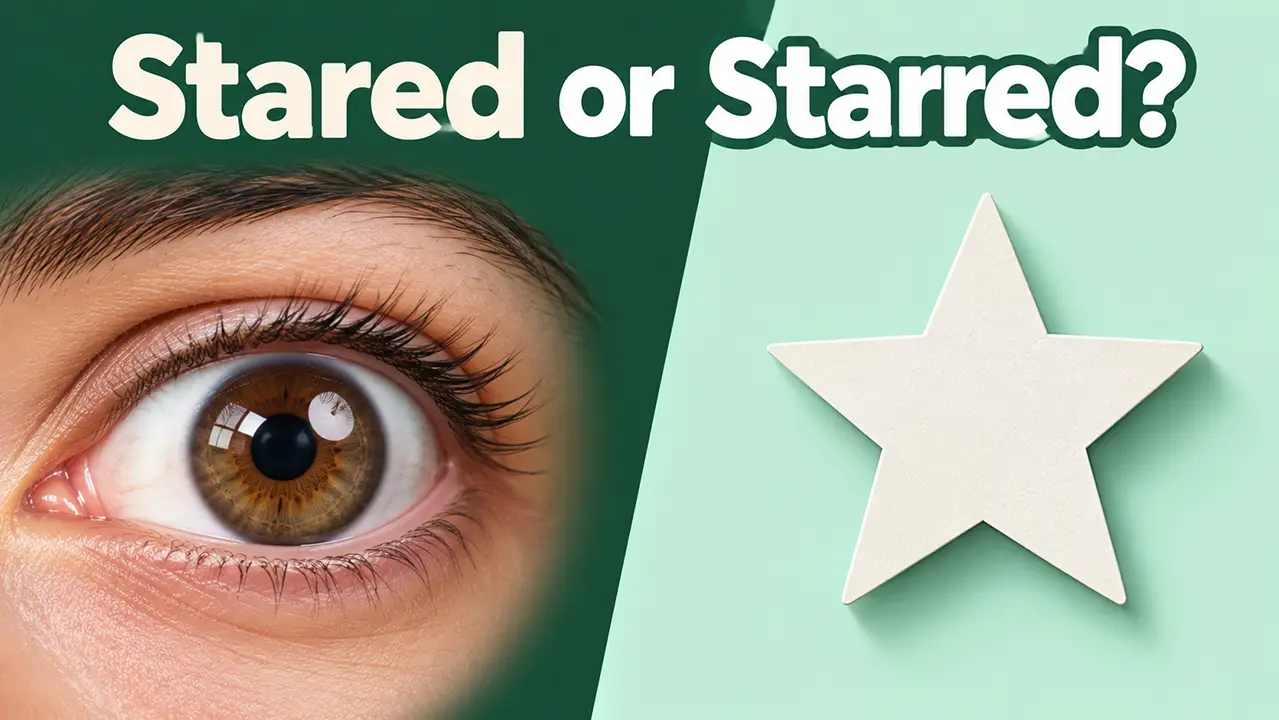
You type a sentence, pause, and wonder if it should be “stared” or “starred.” Everyone has done it, and the two words really do look and sound alike.
This guide settles starring or staring and stared or starred with plain rules, real examples, and a few memory tricks. Keep reading and you’ll have the answer in seconds.

Quick Answer
Short version: stared means looked at something for a long time. Starred means played a lead role or marked something with a star. Same sound, different jobs.
Spelling slips like this are common, much like the one covered in this guide to the meaning of absence and its confusing spelling.
What is the fastest way to choose between them?
- Look at the action: eyes, or a movie and a mark?
- Use stared when someone gazes at something.
- Use starred for acting roles or star symbols.
- Both are past tense forms of different verbs.
- Check the base verb: stare or star.
Example in texting:
Friend 1: He starred at me all night.
Friend 2: Stared. Unless he was in a movie, haha.
Stared vs Starred: Side-by-Side Comparison

Seeing both words in one place clears things up fast. Here is a simple starred vs stared table you can screenshot and keep handy.
| Feature | Stared | Starred |
| Base verb | stare | star |
| Core meaning | looked fixedly | acted or marked |
| Typical use | people, eyes | movies, emails |
| Present participle | staring | starring |
| Example | She stared at the clock. | She starred in the film. |
How do the two words differ in practice?
- Stared always involves eyes and attention.
- Starred involves roles, ratings, or symbols.
- Both end in “-ed” because both are regular verbs.
- Only starred doubles the final consonant.
- Neither word changes meaning in the past tense.
Example in chat:
Friend 1: Did you see how she stared at the menu?
Friend 2: Yeah, then she starred the best dish in her notes.
Staring vs. Starring
The -ing forms trip people up the same way. Staring is looking hard at something, and starring is playing the lead. This staring vs starring pair follows the same logic as the past tense.
People often ask, “is it starring or staring?” Ask yourself whether eyes or a cast list are involved. Small ending changes can shift meaning, as with afterward versus afterwards.
How do you tell staring and starring apart?
- Staring needs a person looking at something.
- Starring needs a film, show, or play.
- Staring has one R; starring has two.
- Say it aloud: “stair-ing” versus “star-ring.”
- Both come from verbs that mean very different things.
Example in texting:
Friend 1: Why are you starring at me?
Friend 2: Staring. I’m not in a movie, I’m just curious.
What Does “Stared” Mean?

Stared is the past tense of “stare.” It means looking at someone or something for a long time with your eyes wide open, often from surprise, interest, or confusion.
You can find what is stared in most dictionaries as “to look fixedly.” The word often pairs with “at.” For example: “He stared at the screen for ten minutes.”
The plural of a noun like “journey” works by its own rules, which this explanation of the plural of journey covers well, and verbs have their own patterns too.
What does “stared” look like in everyday sentences?
- Stared at is the most common pairing.
- A child stared at the fireworks in wonder.
- Shock can make people stare without blinking.
- It can sound rude if done at strangers.
- It never describes acting or marking something.
Example in chat:
Friend 1: Why did that guy stare at us?
Friend 2: He stared because you wore the giant hat.
Synonyms for “stared”
If you want more variety, several words carry a similar meaning with slightly different shades.
| Synonym | Shade of meaning |
| gazed | calm, long look |
| glared | angry look |
| gawked | rude, open-mouthed look |
| gaped | stunned look |
| peered | careful, close look |
Which synonym fits which mood?
- Gazed suits dreamy or loving looks.
- Glared shows anger or annoyance.
- Gawked feels impolite or clumsy.
- Peered suggests squinting to see.
- Use stared when no extra mood is needed.
Example in texting:
Friend 1: She gazed at the sunset.
Friend 2: Nice, I’d say she stared at her phone instead.
What Does “Starred” Mean?
Starred has two main meanings. It means played a leading role in a film, show, or play, and it also means marked with a star symbol.
You’ll see starred meaning questions pop up with email, restaurants, and book reviews too. Context tells you which sense is in play. “She starred in a hit comedy” is acting, and “I starred that email” is marking.
When you pair words like “as well,” spacing changes meaning too, as this post on as well or aswell explains.
What are the main senses of “starred”?
- Acted as the lead in a production.
- Marked an item with a star symbol.
- Described something featuring a famous performer.
- Rated a hotel or restaurant with stars.
- Flagged an important message or contact.
Example in texting:
Friend 1: Did you star that email from HR?
Friend 2: Yep, I starred it so I won’t forget.
Starred as marked with a star
Many apps use a star to flag things you want to find fast. In Gmail, a starred message sits in its own folder. People also say “starred question” in exams to mark a harder item.
- Starred emails stay easy to find later.
- Teachers mark starred questions as important.
- Chat apps let you star a message to save it.
- Review sites use starred ratings for quality.
- The term works as both verb and adjective.
Example in chat:
Friend 1: Where is the address?
Friend 2: I starred it in our group chat.
“Starred In” or “Stared In”?

The correct phrase is “starred in” when talking about acting. Use “stared in” only if someone looked into something, like “she stared in the mirror,” which is rare.
This is the version people search most: stared in or starred in. A film credit always uses “starred in.” The preposition matters, just as it does with words like those in this guide to immigrate versus emigrate.
When is “starred in” the right choice?
- Use it for movies, shows, and plays.
- It works for commercials and music videos too.
- “Stared in” is correct only for looking.
- A cast list always means starred.
- Pair it with a person’s name and a title.
Example in texting:
Friend 1: Who stared in that new thriller?
Friend 2: Starred. And it was Emma Stone.
Why Is “Starred” Spelled With Two Rs?
English has a doubling rule for short verbs. When a one-syllable verb ends in a single vowel plus a single consonant, you double the consonant before adding “-ed” or “-ing.” That is why star becomes starred and starring.
Verbs that already end in “e,” like stare, simply add a “d.” So stare becomes stared. Tricky forms like this are also the reason people ask whether the past form is “ate” or “eaten,” which this short grammar guide breaks down.
Why does one word double its letter?
- Short verbs with one vowel double the final consonant.
- Verbs ending in “e” only add d.
- This keeps the vowel sound short in star.
- Without it, you might read “stared” as “stair-ed.”
- The rule applies to many verbs, like plan and planned.
Example in chat:
Friend 1: Why two Rs in starred?
Friend 2: Short verbs double the last letter. Like plan and planned.
Stare → stared
Stare already ends in “e,” so you only add “d.” No doubling, no extra letters. The “a” stays long, which matches how you say it.
- Stare plus d gives stared.
- The final “e” disappears into the ending.
- Present participle drops the e: staring.
- Pronunciation: rhymes with “cared.”
- The vowel sound stays long.
Example in texting:
Friend 1: Did he stare at you?
Friend 2: He stared the whole time.
Star → starred
Star has no final “e.” It is a short word with one vowel followed by one consonant, so the “r” doubles before “-ed.”
- Star plus red gives starred.
- The “r” doubles to keep the vowel short.
- Present participle becomes starring.
- Pronunciation: rhymes with “barred.”
- Both forms follow regular spelling logic.
Example in chat:
Friend 1: How do you spell the past tense of star?
Friend 2: S-t-a-r-r-e-d. Two Rs.
Common Mistakes and Examples
Most errors happen because the two words sound the same when spoken. Writing quickly makes it worse, and spell check rarely flags either one since both are real words.
| Wrong | Right | Why |
| She starred at him. | She stared at him. | Looking, not acting |
| He stared in the movie. | He starred in the movie. | Acting role |
| I stared the email. | I starred the email. | Marking with a star |
| The film is staring Tom. | The film is starring Tom. | Cast member |
| They starred out the window. | They stared out the window. | Eyes |
Mix-ups like these resemble the pair in forgive versus forget, where similar words pull in different directions.
What are the most frequent slips?
- Using starred at instead of “stared at.”
- Writing stared in for a film role.
- Forgetting the double R in starring.
- Trusting spell check to catch both.
- Typing fast and picking the wrong ending.
Example in texting:
Friend 1: He starred at me.
Friend 2: Stared! Unless he’s a famous actor.
How to Remember Stared vs. Starred
A good memory trick saves you every time. Think about the letters. Stared has “e” for eyes, and starred has “rr” for roles and ratings.
Another trick is to swap in “looked” or “acted.” If “looked” fits, use stared. If “acted” fits, use starred. Small habits like this are the same kind you’d use for due to versus do to.
Which tricks work best?
- E for eyes: stared goes with looking.
- RR for roles: starred goes with acting.
- Swap in looked and see if it fits.
- Swap in acted to test starred.
- Read the sentence aloud once before sending.
Example in chat:
Friend 1: Stared or starred? I always freeze.
Friend 2: E for eyes, RR for roles.
Why Do People Confuse Stared and Starred?
The main reason is sound. Both words are pronounced almost the same in many accents, so your ear can’t help you. Only meaning decides which spelling is right.
Fast typing and autocorrect add to the problem. Words that differ by one or two letters get mixed up all the time, like the pair explained in biennial versus biannual.
| Cause | What happens |
| Similar sound | Ear gives no clue |
| Real words | Spell check stays silent |
| Fast typing | Wrong ending slips in |
| Rare context | Little practice with each |
What makes this pair so slippery?
- They are homophone-like in casual speech.
- Both are valid English words.
- Autocorrect may swap one for the other.
- Few writers use both daily.
- Nobody rereads a quick text.
Example in texting:
Friend 1: Autocorrect changed stared to starred again.
Friend 2: Classic. Always proofread before sending.
Is “Starred” a Verb or an Adjective?
Both. As a verb, it describes an action: “She starred in the show.” As an adjective, it describes a thing marked with a star: “a starred item.”
This answers is starred a verb and is starred an adjective. The word can also describe quality, such as a “five-starred hotel,” though “five-star” is more common. Spelling variants matter in slang too, as with boujee versus bougie.
How can you tell which role it plays?
- A verb takes a subject and an action.
- An adjective sits before a noun.
- “A starred email” is an adjective use.
- “He starred in it” is a verb use.
- Both senses share the same spelling.
Example in chat:
Friend 1: Is starred a verb?
Friend 2: Sometimes. In “starred emails” it’s an adjective.
Starred Meaning in Email and Apps

Outside movies, starred shows up daily in apps. A starred email in Gmail is saved for later, a starred message in WhatsApp is bookmarked, and a starred repository on code sites is a favorite.
People type what does star mean in text all the time. A star usually means “save this” or “important.”
| App | What starred does |
| Gmail | Flags the message |
| Saves a message | |
| Google Drive | Pins a file |
| Code sites | Bookmarks a project |
Where will you see starred items?
- Email apps use it for priority messages.
- Chat apps save key messages.
- Cloud storage pins common files.
- Reviews mark top-rated entries.
- Contacts can be starred as favorites.
Example in texting:
Friend 1: Send me the link again?
Friend 2: Check your starred messages, I saved it.
What Does “Starring” Mean in a Movie Credit?
“Starring” introduces the lead actors. You’ll see it on posters: “Starring Anna Lee and Mark Cole.” It is the present participle of “star” and always has two Rs.
If you wondered what does starring mean or what does also starring mean, “also starring” lists supporting names after the leads. Guest stars appear as “guest starring.”
How do credits use these terms?
- Starring names the main cast.
- Also starring adds supporting actors.
- Guest starring marks one-time appearances.
- Co-starring shows shared lead billing.
- The word always involves a production.
Example in chat:
Friend 1: What does “also starring” mean?
Friend 2: Supporting actors listed after the leads.
Is It “Staring at Me” or “Starring at Me”?
Always “staring at me.” Someone looking at you is staring. “Starring at me” makes no sense unless you’re in a film with them, and even then you’d say “starring with me.”
This answers is it starring or staring for looking situations. Use staring with “at,” “into,” or “down.”
| Phrase | Correct? |
| staring at me | Yes |
| starring at me | No |
| staring into space | Yes |
| starring in a film | Yes |
How do you pick the right form?
- Use staring for eyes and attention.
- Use starring for lead roles.
- “At me” always signals looking.
- “In a film” signals acting.
- Check the preposition before you decide.
Example in texting:
Friend 1: Why are you starring at me?
Friend 2: Staring. And I’m just spacing out.
When Should You Use “Stared” or “Starred” in a Sentence?
Use stared when your subject looks at something. Use starred when your subject acts or marks something. Test it by asking: eyes, or stage?
A sentence can contain both, like “She starred in the play, and the crowd stared in awe.” That kind of sentence shows how closely related the two forms are, even though the meanings are far apart.
What does a clear sentence look like?
- “He stared at the sky for an hour.”
- “She starred in three films last year.”
- “I starred the file so I’d see it first.”
- “They stared at the strange painting.”
- Write one of each to lock it in.
Example in chat:
Friend 1: Give me one of each.
Friend 2: He stared at the poster. She starred in the movie.
Starred Restaurants and Reviews

Search for starred restaurants near me and you’ll find places with ratings or Michelin stars. In this sense, starred means awarded or marked with stars as a quality sign.
Book reviewers also use it. A “starred review” in a trade magazine signals an outstanding book, which many readers treat as a strong recommendation.
Where does this meaning show up?
- Michelin guides award stars to restaurants.
- Hotels use star ratings for service level.
- Magazines give starred reviews to top books.
- Online maps display starred places you saved.
- Cambridge uses a starred first for top degrees.
Example in texting:
Friend 1: Is that place any good?
Friend 2: It’s Michelin starred, so yes.
FAQs
Is “stared” a real word?
Yes, stared or starred both exist. “Stared” is the past tense of “stare,” meaning looked fixedly at something or someone.
Is it correct to say “starred in” or “stared in”?
Say “starred in” for acting roles. Starred or stared only gets tricky here, and “stared in” would mean looking inside something.
What is the difference between “starring” and “staring”?
Starring or staring depends on meaning. Staring is looking hard, and starring is playing a lead role.
What is the meaning of “starred”?
Starred meaning covers two ideas: played a lead role, or marked with a star symbol. Both uses are common.
How do you spell “starred” or “stared”?
Spell them S-T-A-R-R-E-D and S-T-A-R-E-D. Starred vs stared differs by one extra R.
Is it “staring at me” or “starring at me”?
“Staring at me” is right. Starring or staring here always points to staring, since someone is looking.
What is another word for “starred”?
Try “led,” “headlined,” or “featured.” Pick one that matches how starred or stared is being used in your sentence.
Conclusion
Here is the whole thing in one breath. Stared is about eyes, and starred is about roles and marks. The same split applies to starring or staring in the present tense.
Pick the right word by testing “looked” or “acted” in your sentence. When you’re asking stared or starred, remember: E for eyes, RR for roles. That single habit settles most cases.
Next time you write a quick text or caption, pause for one second and check the verb. It takes almost no effort, and your writing will look more careful because of it.

Daniel Parker is an English language writer sharing clear grammar lessons, practical tips, and helpful examples for learners.







3 thoughts on “Stared or Starred Meaning: Easy Rules to Never Mix Up”