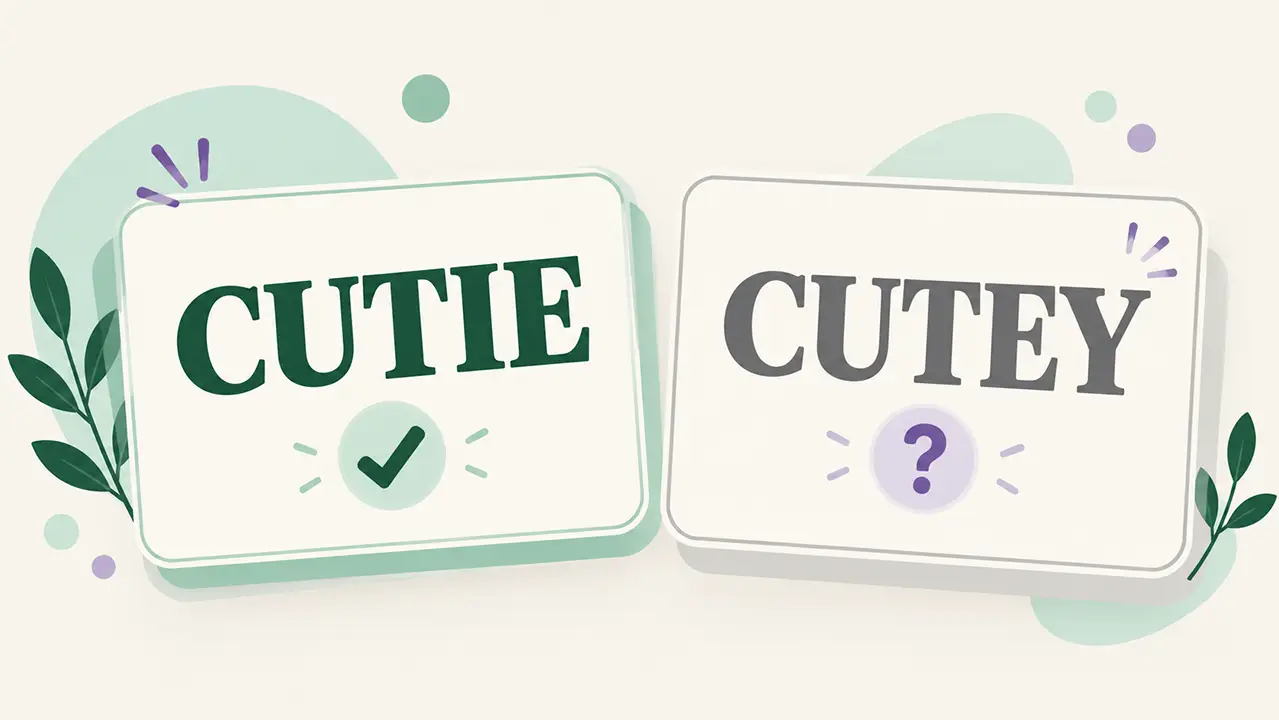
You’re typing a message, and suddenly a tiny spelling question gets in the way. Is it cutey or cutie? Both look believable, so it’s easy to see why people get stuck on this one.
The spelling you’ll want most of the time is cutie. You might still come across cutey in usernames, nicknames, or playful messages, but it’s much less common in standard English.
Let’s look at what the word means, how people use it, and why that little ending causes so much confusion.
Cutey or Cutie: Quick Answer
Cutie is the standard spelling. It describes someone who’s sweet, attractive, charming, or simply adorable.
For example, you might text a friend, “You’re such a cutie.” It sounds natural and works well as a friendly compliment or an affectionate remark.
You may also see someone write, “You’re such a cutey.” That spelling does appear in informal use, so it isn’t necessarily a random typo. Still, most readers are more familiar with cutie, making it the better choice for everyday writing.
If you’re unsure which one to use, stick with cutie. It’s the spelling people generally expect.
What Does Cutey or Cutie Mean?
A cutie is someone you find lovable, charming, or attractive. It’s an affectionate word, and it often feels a little warmer than simply calling someone cute.
You can use it for all sorts of things. A child with a cheeky smile might be a cutie. So might a puppy stumbling around in oversized paws. And, of course, you can call someone you have a crush on a cutie.
The tone depends on the situation. When you use it with a friend, it may sound playful. When you say it to someone you’re interested in, it can feel flirty.
What about cutey? It generally carries the same meaning. The difference is that cutie is the established spelling, while cutey is a less common alternative.
Cutey vs Cutie at a Glance
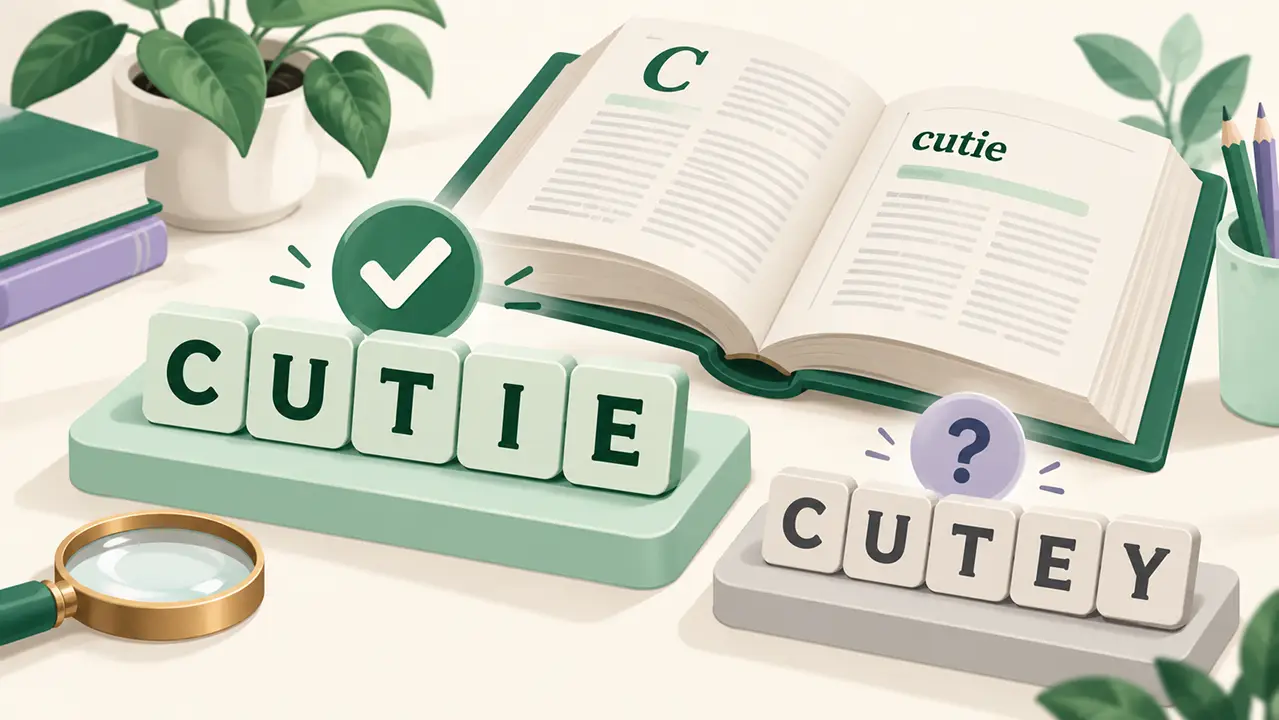
Here’s the difference without getting lost in the details.
| Feature | Cutie | Cutey |
|---|---|---|
| Spelling | Standard | Less common variant |
| Meaning | Someone charming or lovable | Generally the same |
| Everyday use | Common | Relatively uncommon |
| Best choice for standard writing | Yes | Usually avoid |
The two spellings are generally understood to mean the same thing. If you’re writing an article, a caption, or a message and want to avoid distracting readers, choose cutie.
The Origin of Cutey or Cutie
The word cute has an interesting history. It developed as a shortened form of acute, which was associated with sharpness or cleverness. Over time, cute took on the familiar meaning we use today: attractive, charming, or endearing.
Cutie grew from that modern sense of cute and became a familiar affectionate term, particularly in American English during the early 20th century.
So how did cutey enter the picture? English spelling gives us plenty of reasons to second-guess ourselves. Words such as honey and money end in -ey, while names like Katie and Debbie use -ie. Both patterns look familiar, which makes the confusion understandable.
Similar spelling doubts occur with other English words, too. For example, our guide to stared or starred explains another pair that can trip up writers because of a small difference in spelling.
In this case, remembering the standard form is easier than trying to find a universal rule for the ending.
British English vs American English
Some English words have different spellings in the United States and the United Kingdom. Think of color and colour, for example. Cutie isn’t one of those cases.
Cutie is the preferred spelling in both American and British English. The same general preference applies in Canadian and Australian English.
| Region | Preferred spelling |
|---|---|
| United States | Cutie |
| United Kingdom | Cutie |
| Canada | Cutie |
| Australia | Cutie |
You don’t need to switch to cutey when writing for a British audience. If your readers are from different English-speaking countries, cutie is still the straightforward choice.
Regional spelling differences can be confusing, though. If you’re curious about another example, see our comparison of afterward vs afterwards.
Cutey or Cutie vs Other Variations
Once you start looking at informal spelling, you’ll find plenty of creative versions online. Some are deliberate, while others are just mistakes.
| Spelling | How it’s used |
|---|---|
| Cutie | Standard spelling |
| Cutey | Less common informal variant |
| Cuttie | Nonstandard spelling |
| Cuty | Nonstandard spelling |
| Cutiee | Informal exaggeration sometimes used in messages |
| Cutie pie | Standard two-word expression |
| Cutiepie | Informal closed form, often seen in names |
The main thing to watch is the ending. Cuttie has an extra t, while cuty leaves out the i. You might see cutiee in a playful message, but that extra letter is usually there for emphasis rather than correct spelling.
Then there’s cutie pie. The two-word version is the safest choice in ordinary writing, although cutiepie also appears in usernames and informal contexts.
Which Spelling Should You Use?
For most situations, the answer is simple: use cutie.
If you’re writing for American or British readers, cutie is the expected form. The same goes for international content, where a familiar spelling helps readers understand you without stopping to think about it.
Social media is a little different. People often bend spelling rules to create a particular style or make a username stand out. If someone deliberately chooses cutey for a nickname or brand name, that’s a personal choice. Just don’t assume it’s the standard spelling.
In academic or professional writing, the word itself may be too informal, depending on the subject. If you’re discussing language or quoting a conversation, cutie is the better form to use.
Common Mistakes with Cutey or Cutie
Most mistakes happen when people change the ending or add letters that aren’t needed.
For example:
- “She’s a cutey” becomes “She’s a cutie” in standard writing.
- “Such a cuttie!” becomes “Such a cutie!”
- “What a cuty!” becomes “What a cutie!”
- “My cutiee” becomes “My cutie” when standard spelling is intended.
There’s a small distinction worth remembering here. Writing cutiee in a text to exaggerate affection is a stylistic choice. Using it in an article where you’re expected to follow standard spelling is a different matter.
Spell-checkers can catch some of these errors, but they don’t always flag every unusual spelling. A quick reread is still useful, especially before you publish something.
Small changes can cause confusion in other parts of English, too. Our guide to the plural of journey explains how a word changes when you make it plural.
Cutie in Everyday Examples

Cutie tends to feel most natural in casual writing. You’ll see it in messages, captions, and conversations where a little affection fits the tone.
Here are a few examples:
In a friendly email: “Thanks for the puppy photos. What a cutie!”
On social media: “Date night with my favorite cutie.”
In a personal story: “My teacher called our class pet a cutie.”
The word can also appear in lifestyle articles or pet adoption stories. It’s less common in formal news reporting, where a more neutral description may fit better.
At work, think about your audience before using it. A playful pet brand might happily call an animal a cutie in its marketing. A formal email to a new client is another story. There, the word could sound too familiar.
Google Trends & Usage Data
Why do people search for cutey or cutie in the first place? Usually, they just want to settle the spelling question before sending a message or posting a caption. Others are curious about the meaning, especially when someone has used the word in a conversation.
The keyword research figures provided for this topic estimate around 7,500 monthly searches for cutie and around 150 for cutey or cutie. These numbers are estimates, so they can vary by keyword tool, market, and date.
The United States, United Kingdom, Canada, Australia, and India are relevant markets to investigate for this topic. However, exact country rankings should be checked against current Google Trends data rather than assumed.
The takeaway is straightforward: people want to know which spelling is right and what the word means. Answering those questions clearly is more useful than repeating the same explanation throughout the article.
Related Grammar Rules
If you often pause over spelling choices, you’re certainly not alone. English has plenty of words that look similar but follow different conventions.
Take as well, for example. It’s written as two words, not aswell. If you’ve ever hesitated over this expression, our guide to as well or aswell explains which form to use and why.
Other confusing pairs involve words that look similar but have different meanings. The difference between immigrate vs emigrate is a useful example. One refers to entering a country to live there, while the other refers to leaving a country to live elsewhere.
You can also explore forgive vs forget for another comparison of commonly confused verbs.
One practical trick is to keep a short list of words you regularly mix up. Add a quick explanation or example beside each one. Over time, you’ll have a handy reference that’s more useful than guessing whenever a familiar-looking word catches you off guard.
Cutie vs Cute: What Is the Difference?
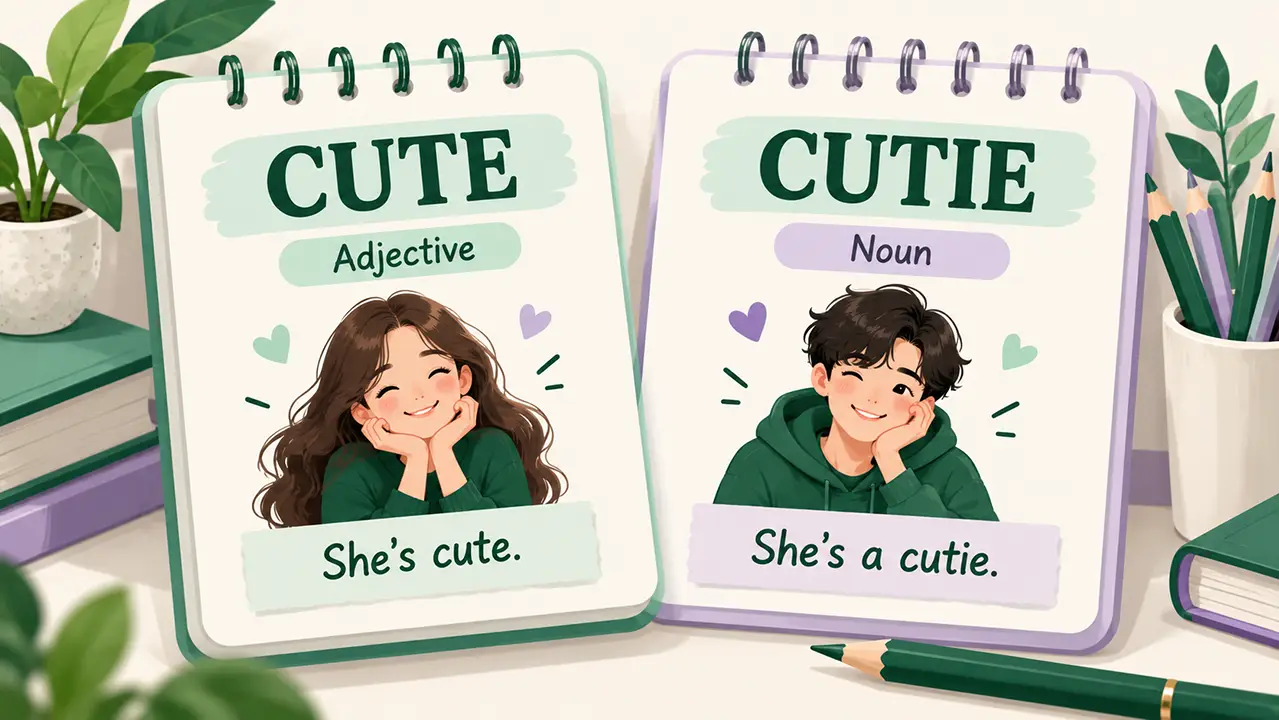
Cute and cutie are related, but they do different jobs in a sentence.
Cute is an adjective. It describes someone or something.
Example: “She’s cute.”
Cutie is a noun. It refers to someone or something considered charming or lovable.
Example: “She’s a cutie.”
Both sentences are correct. The difference becomes clearer when you look at how each word is used. Cute tells you what someone is like; cutie is the word you use to refer to that person affectionately.
Cutie Pie or Cutiepie: Spelling Rules
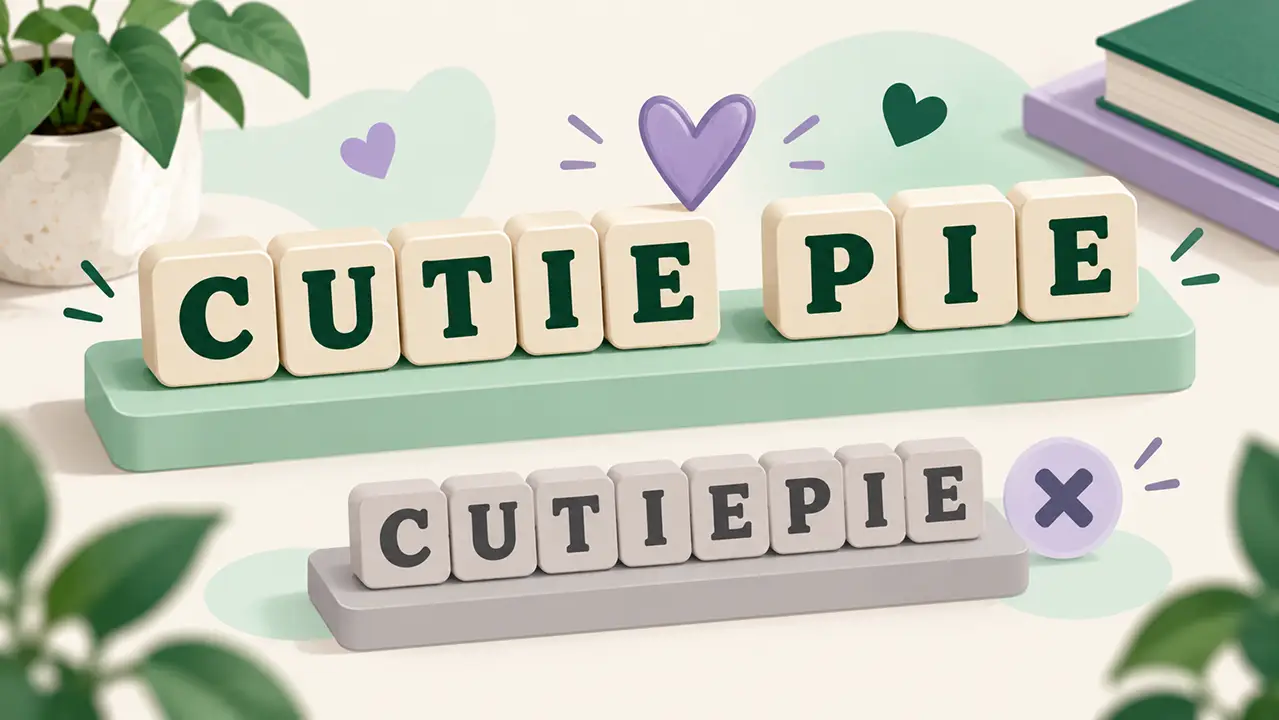
You’ll find both cutie pie and cutiepie in informal writing, but the two-word form is the safer choice when standard spelling matters.
Cutie pie is an affectionate expression used for someone you find adorable. It might be a nickname for a partner, a child, or even a pet.
The closed form cutiepie often appears in usernames, online profiles, and personal nicknames. If you’re writing an article or a regular sentence, though, stick with cutie pie.
Synonyms and Terms of Endearment Like Cutie
Sometimes cutie feels right, and sometimes another word suits the moment better.
Sweetie is a close alternative and usually sounds warm and affectionate. Sweetheart is familiar and works in many personal relationships. Darling can sound romantic or a little old-fashioned, while honey is a common term of affection in everyday conversation.
Then there’s hottie, which has a stronger focus on physical attractiveness and usually sounds more flirtatious.
The best choice depends on who you’re talking to. A word that feels natural between close friends might sound awkward with someone you barely know.
Pronunciation and Plural Forms of Cutie
Cutie is pronounced KYOO-tee, with the emphasis on the first syllable. It rhymes with beauty.
The plural is cuties. Just add an s to the singular form.
For example: “Those puppies are such cuties.”
If you need the possessive form, write cutie’s, as in “That cutie’s smile made my day.”
The plural is cuties, not cutyes. There’s no need to change the ending.
Is Cutey a Valid Scrabble Word?
If you’re playing Scrabble, don’t assume that a spelling used in everyday conversation will automatically be accepted in your game.
Whether cutey is valid depends on the word list your version of Scrabble uses. Cutie may be the safer option, but it’s worth checking the relevant dictionary if a challenge could affect the game.
Different apps and competitions can use different word lists, so the rules for your particular version matter.
What Does Cutie Mean in Texting?
In a text message, cutie is often a friendly compliment or an affectionate way to address someone. It might appear in a greeting, after someone shares a photo, or as a playful nickname.
For instance, “Hey, cutie” could be a flirty message from someone you like. From a close friend, the same words might simply be warm and playful.
Don’t read too much into the word on its own. The relationship between the people texting and the rest of the conversation usually tell you more about what the sender means.
Can You Use Cutie in Professional Writing?
Generally, cutie is too informal for serious business communication. It can sound out of place in a formal report, a contract, or an email to a client you don’t know well.
That doesn’t mean it has no place in professional content. A pet business, a playful lifestyle brand, or a social media campaign might use the word quite naturally.
The deciding factor is tone. If cutie fits the personality of the brand and the expectations of its audience, it can work. Otherwise, a more neutral word is usually the better option.
FAQs
1. What is the correct spelling, cutey or cutie?
Cutie is the standard spelling. Cutey appears occasionally as a less common informal variant.
2. Is cutey a real word?
Cutey is used in informal writing and some names, but cutie is the established standard form.
3. What does cutie mean?
Cutie describes someone or something charming, attractive, sweet, or lovable.
4. Is cutie a slang word?
Cutie is an informal expression commonly used as a compliment or term of endearment. It isn’t exclusively slang.
5. Why do people spell cutie as cutey?
The ending may look familiar because of words such as honey and money. However, cutie is the standard spelling.
6. Is cutie British or American English?
Cutie is the preferred spelling in both British and American English.
7. How do you pronounce cutie?
It’s pronounced KYOO-tee, with the stress on the first syllable.
8. What is the plural of cutie?
The plural is cuties.
9. Can you use cutie for animals?
Yes. People commonly use cutie to describe adorable pets, particularly puppies and kittens.
10. What is the difference between cute and cutie?
Cute is an adjective that describes someone or something. Cutie is a noun referring to a charming or lovable person or thing.
11. Is cutie formal or informal?
Cutie is informal and is best suited to casual conversations, friendly messages, and playful captions.
12. Is cutie pie one word or two?
Cutie pie is the standard two-word form. Cutiepie also appears in informal writing and names.
13. Can I use cutie in a professional email?
Usually, it’s better to avoid it in formal business communication because it can sound too familiar.
14. Can I write cutiee on social media?
You may see cutiee used for playful emphasis, but it isn’t standard spelling. Use cutie when standard English is expected.
15. How can I remember cutie vs cutey?
Think of the expression cutie pie. The -ie ending is a useful reminder of the standard spelling.
Conclusion
If you’ve been going back and forth between cutey and cutie, you can stop second-guessing yourself. Cutie is the standard spelling, and it’s the one to use in most everyday writing.
The word describes someone or something you find charming, sweet, attractive, or lovable. It can sound friendly, affectionate, or flirty, depending on the situation.
You may still see cutey in usernames, nicknames, and playful messages. That’s fine when the spelling is intentional, but cutie remains the safer choice for standard English.
And if you ever mix up cute and cutie, remember the difference: cute describes someone, while cutie refers to them.

Daniel Parker is an English language writer sharing clear grammar lessons, practical tips, and helpful examples for learners.