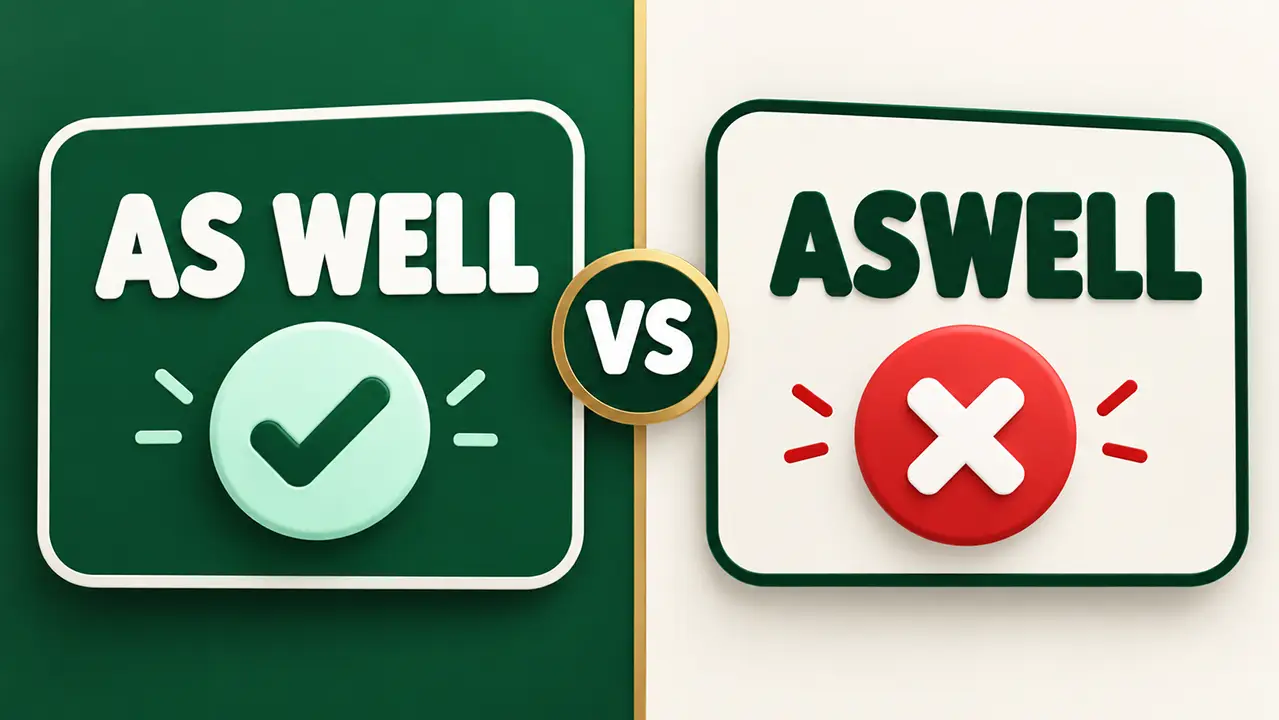

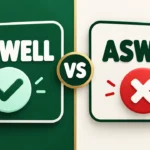
Between aswell or as well, only “as well” is correct, and it is always two words. Merriam-Webster lists as well as a phrase meaning “also” or “in addition.” Aswell is a spelling error. Write “I like tea as well,” with the space.
Aswell vs As Well: The Quick Answer
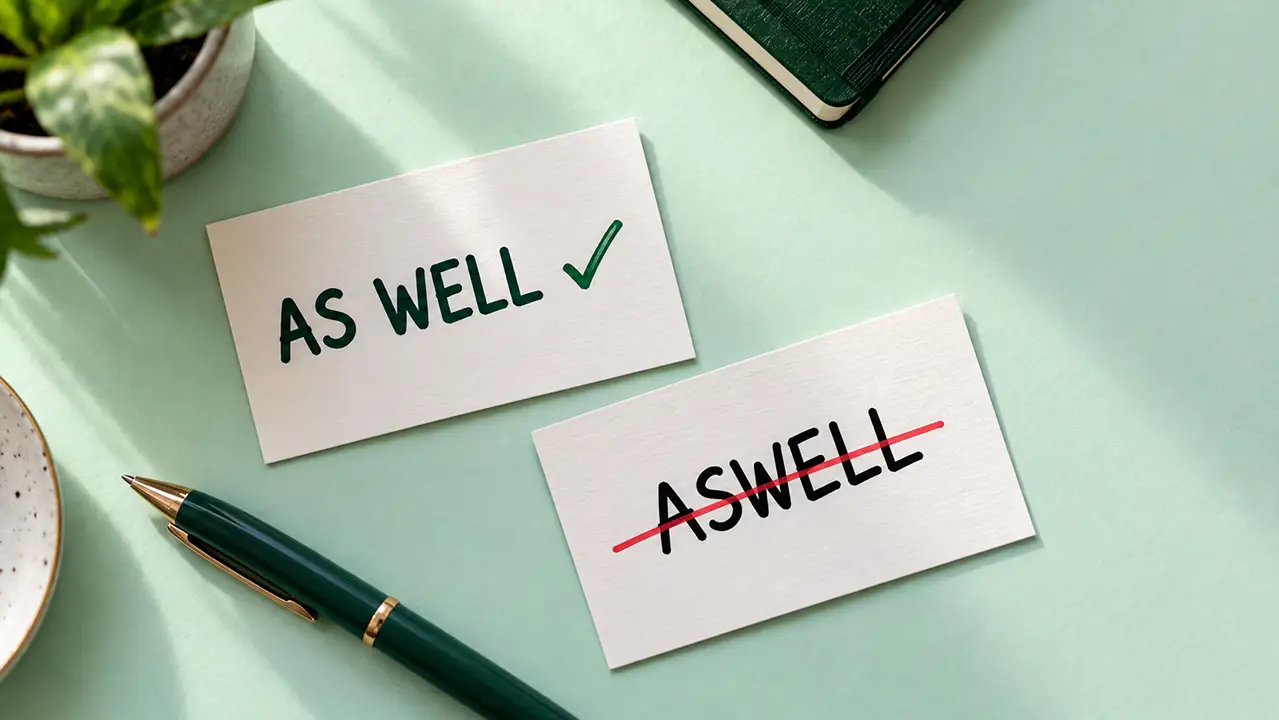
Use “as well” every time. There is no sentence, region, or register where “aswell” is the standard spelling.
| Spelling | Status | Example |
| as well | Correct | She plays guitar as well. |
| aswell | Incorrect | She plays guitar aswell. |
The mistake is easy to make because “as” and “well” sit next to each other and sound like one unit when you say them. It is the same kind of slip people make with another pair people swap by ear, where the sound is right and the spelling is wrong.
Example:
Friend 1: I’m bringing snacks.
Friend 2: Can you bring drinks as well?
The rest of this page covers what the phrase means, where it goes in a sentence, and how it differs from “too” and “also.”
What Does “As Well” Mean?
“As well” is an adverbial phrase. Most of the time it means “also” or “in addition.” Merriam-Webster gives it three senses, and the first is by far the one you will meet most often.
Common meanings of “as well”
In addition, also. This is the everyday meaning. It adds one more thing to what you already said.
Example: The hotel has a pool, and it has a gym as well.
To the same extent or degree. This sense is less common, and it usually appears in the pattern “as well as.” It compares two things of equal level.
Example: He can cook as well as he can bake.
With the same or a better result. This sense appears mostly in the fixed phrases “might as well” and “just as well.” It means the action costs nothing extra or turns out better than the alternative.
Example: The bus is late again, so we might as well walk.
Because the senses are different, “as well” can look confusing in a dictionary entry. In writing you will use the first sense about nine times out of ten. (That is a rough impression, not a counted figure.)
Is “Aswell” a Real Word?
No. A search for “Aswell” on Merriam-Webster leads to the entry for the two-word phrase “as well,” not to a separate one-word entry. The Oxford Learner’s Dictionary also treats “as well” as a phrase that sits alongside “also” and “too.” Neither lists “aswell” as a standard spelling.
That means a spell checker will flag it, a teacher will mark it, and an editor will correct it. The word you want is “as well.”
Why do people write “aswell”?
Nobody has studied this that I can cite, so these are probable causes, not proven ones. The same few reasons show up again and again in the way people type.
Fast typing
When you type quickly, the space bar is the first thing to get skipped. “As well” is two short words in a row, and the gap between them is easy to lose.
Compound word confusion
English has many words that were once two words and are now one: “maybe,” “already,” “altogether,” “cannot.” Writers sense that “as well” could be next in line, so one more fused word feels plausible. It has not happened, and the fused form “alot” for “a lot” is a similar case where the two-word form is still the correct one.
Pairs that look almost identical but mean different things trip people up in the same way, as with look-alike pairs with different meanings. The fix is to check the standard form once and remember it.
Mobile keyboards
On a phone, autocorrect sometimes accepts the merged form, and thumbs often miss the space. If your keyboard has predictive text, it can learn “aswell” if you type it often enough, so the mistake repeats.
Informal texting
In quick chats, nobody proofreads. “Aswell” in a text message is understood perfectly, but it is still not standard spelling. For anything you send to a boss, teacher, client, or customer, use two words.
Why “As Well” Is Written as Two Words
“As” and “well” are two separate words that happen to form a phrase. Each one can do its own job. You can put another word between them (“just as well,” “every bit as well”), and you can add a second “as” after them (“as well as”). A single fused word would block all of that.
Look at how the pieces behave:
- “As” works as an adverb or conjunction in comparisons: as big as, as soon as.
- “Well” is an adverb meaning “in a good way” or “to a good degree.”
- Together, they form a phrase whose meaning (“also”) has drifted away from either word alone. This kind of drift is common in English phrases, but it does not turn them into one word.
Compare these expressions
| Expression | Meaning | Example |
| as well | also, in addition | Bring a coat as well. |
| as well as | and, in addition to | She speaks French as well as Spanish. |
| might as well | there is no good reason not to | We might as well start now. |
| just as well | fortunate, with good effect | It’s just as well you left early. |
| as good as | nearly, or equal in quality | The repair is as good as new. |
The family resemblance is what makes the single-word form tempting. Each of these is a separate phrase, and none of them is written as a single word.
When to Use “As Well”
“As well” belongs in sentences where you add one more item, fact, or person to something already said. Its position is the main thing to get right.
At the End of a Sentence
This is the standard position. Oxford Learner’s Dictionary says “as well” and “too” usually go at the end of a clause.
Example: I finished the report, and I sent the invoice as well.
After Additional Information
Use it right after the item you are adding, even if that item is not the last word. The phrase should stay close to what it adds.
Example: She brought the salad and a dessert as well, which was kind of her.
If the added item is unclear, rewrite the sentence rather than moving the phrase.
In Questions
It works at the end of a question, too.
Example: Are you coming to the meeting as well?
In Negative Sentences
This is where people get stuck. Oxford Learner’s Dictionary says you can use “not… as well” or “not… too” when you are adding a negative point to a positive one.
Example: You can have a burger, but you can’t have fries as well.
When both parts are negative, “either” usually fits better: “I don’t like tea, and I don’t like coffee either.” That is a common rule of thumb, and a style guide may handle it differently, so check yours.
“As Well” vs “Too” vs “Also”

These three words all add something. They differ in position and tone more than in meaning.
| Word | Usual position | Tone |
| also | before the main verb, or after “be” | more formal |
| as well | end of a clause | neutral, common in speech |
| too | end of a clause | neutral, casual |
These points come from the Oxford Learner’s Dictionary entry for “too,” which says “also” is more formal than “as well” and “too,” and usually comes before the main verb or after “be.” It also says “also” is not usually used at the end of a sentence in British English.
Which should you choose?
A simple decision rule works for most writing:
- Do you want to place the word at the end of the sentence? Use “as well” or “too.”
- Do you want to place it before the verb? Use “also.”
- Is the sentence formal? Prefer “also,” or restructure with “and.”
- Is it a short reply? Use “me too” or “me as well,” not “me also.”
Example:
Friend 1: I’m heading to the gym.
Friend 2: Me too.
One more detail: “too” is easy to mix up with “to.” If you write “I’m going to as well,” you probably meant “too” or “as well” and typed the wrong word. The decision rule above only works once you have picked the right spelling of each.
Examples of “As Well” in Everyday English
These are original examples written for this page. They are not quotes from real people.
Everyday Conversation
Example:
Friend 1: I’m getting coffee.
Friend 2: Get me one as well, please.
Example: We’re having pasta tonight, and garlic bread as well.
Business Emails
In emails, “as well” is fine, but it is worth checking whether “and” or “also” reads more smoothly.
Example: Please attach the invoice, and include the delivery note as well.
Example: I will send the draft today. The budget summary will follow as well.
Academic Writing
Academic writing tends toward “also,” “in addition,” or “and.” “As well” is acceptable, but some instructors may mark it as informal. If you are unsure, check the style guide for your course.
Example: The study measured sleep length. It measured stress levels as well.
Social Media
Captions and comments are casual, and “as well” fits easily. You may see “aswell” in casual posts, but the correct form is still two words.
Example: New video is up, and the blog post is live as well.
Common Mistakes Writers Make
Writing “Aswell”
This is the main one. Fix it by adding the space: “as well.”
Incorrect: I’ll have the soup aswell.
Correct: I’ll have the soup as well.
Using Both “Also” and “As Well”
When you use both in one clause, you say “in addition” twice.
Redundant: She also plays piano as well.
Better: She also plays piano. / She plays piano as well.
Using both is usually redundant, though a sentence with two clear additions can occasionally need both. Read it aloud to check.
Putting “As Well” in an Awkward Position
Placed in the middle of a sentence, “as well” can split a phrase that should stay together.
Awkward: She bought as well a new jacket.
Better: She bought a new jacket as well.
Forgetting the Space
This is the same as the first mistake, but it also happens in phrases. “Might aswell” and “just aswell” are wrong for the same reason. Both need the space: “might as well,” “just as well.”
As Well in British vs American English

The spelling is the same everywhere: two words. No region treats “aswell” as the standard form.
What differs is how natural “as well” sounds at the end of a sentence. Oxford Learner’s Dictionary says British English uses “as well” like “too,” while in North American English it sounds formal or old-fashioned. That is one dictionary’s judgment, and some American writers use it freely. If you write for a US audience and want a casual tone, “too” may feel more natural.
Common Phrases That Include “As Well”
As Well As
“As well as” means “in addition to” or “and.” It joins two items of the same kind.
Example: She speaks Urdu as well as English.
Two points come up often. First, when “as well as” joins two subjects, the verb usually agrees with the first one: “The teacher, as well as the students, is ready.” Second, a comma before “as well as” is a style choice, so follow your house style.
Might As Well

“Might as well” means “there is no good reason not to.” Merriam-Webster’s third sense covers this meaning. “May as well” works the same way, and the two are close in meaning.
Example: It’s already raining, so we might as well stay inside.
A related phrase is “just as well,” which means “fortunate.” Example: It’s just as well you brought an umbrella.
Quick practice check
These items are drafts for your review.
- I’ll take a coffee (aswell / as well).
- She likes tea, and I like it (as well / aswell).
- Which is better for a short reply: “me also” or “me too”?
- Fix this: “He also sings as well.”
- Fill in: “We (might as well / might aswell) leave now.”
Answers: 1) as well; 2) as well; 3) “me too”; 4) “He also sings.” or “He sings as well.”; 5) might as well.
FAQs
Is aswell ever correct?
No. In none of the dictionary entries checked for this page is “aswell” a standard spelling. Use two words.
Is as well one word or two words?
Two words: “as well.” The same applies to “as well as” and “might as well.”
Can I use as well instead of also?
Often, yes, but the position changes. “Also” usually goes before the main verb, and “as well” goes at the end. “She also sings” becomes “She sings as well.”
Is as well as the same as and?
Close, but not identical. “As well as” adds something and can change which subject the verb follows. “And” treats both items equally.
Why does my spell checker mark aswell as incorrect?
Because it is not a standard word, so most spell checkers will probably flag it. Add a space and the underline should disappear.
Conclusion
Write “as well” as two words, and put it at the end of the clause. Use “also” before the verb, and “too” when you want a casual tone. Before you hit send, search your draft for “aswell” and fix every hit.

Daniel Parker is an English language writer sharing clear grammar lessons, practical tips, and helpful examples for learners.







3 thoughts on “Aswell vs As Well: Which Is Correct?”