
You reread your sentence three times, and something still feels off. Was it “she sings beautiful” or “she sings beautifully”? That tiny doubt has tripped up students, writers, and native speakers for years.
This guide explains the difference between adverb and adjective in plain English, with examples, tables, and quick tricks. By the end, adjectives and adverbs will feel clear and the difference between adverb and adjective will make sense every time you write. Getting them right makes your emails, essays, and captions easier to trust. Keep reading.
What’s the difference between an adjective and an adverb?
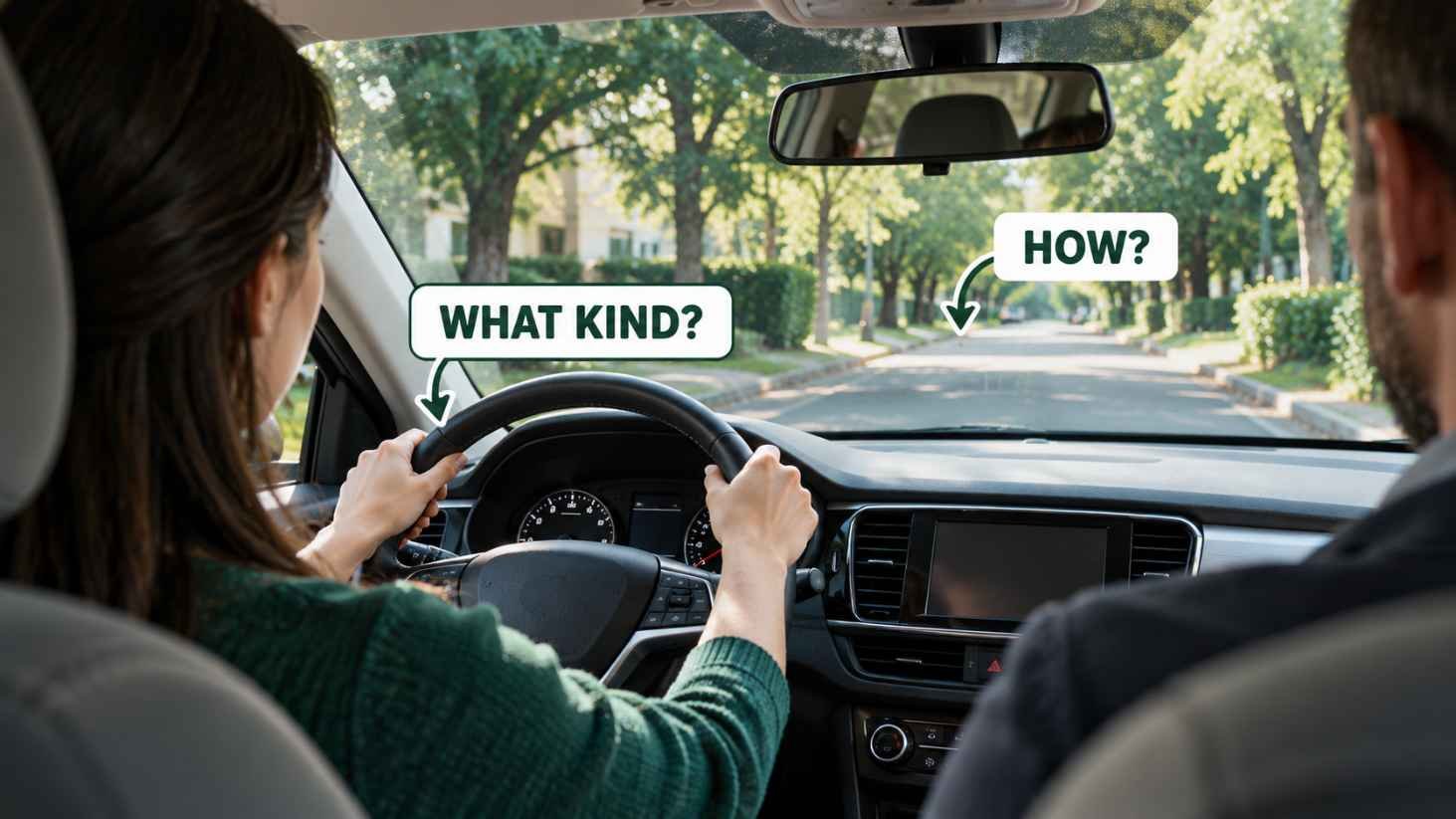
Ever wondered why “quick” and “quickly” feel alike? The difference between adverb and adjective comes down to the word each one describes, and adjective and adverb jobs stay clearly separate.
How to tell adjectives from adverbs
- An adjective describes a noun or pronoun, like “a loud song.”
- An adverb describes a verb, adjective, or another adverb, like “sings loudly.”
- Adjectives answer what kind, which one, or how many.
- Adverbs answer how, when, where, or how often.
- Ask what the word describes first, then pick the label.
| Feature | Adjective | Adverb |
| Describes | Nouns and pronouns | Verbs, adjectives, adverbs |
| Answers | What kind? Which one? | How? When? Where? |
| Example | a careful driver | drives carefully |
A quick check works well here. If the word answers “what kind?”, it is an adjective. If it answers “how?”, it is an adverb. Try it on “a careful driver” and “drives carefully.” Same root, two jobs.
Example in chat:
Friend 1: “She dances beautiful, right?”
Friend 2: “Close. It’s ‘beautifully,’ because it describes the verb ‘dances.'”
What is an adjective?
Adjectives give nouns their color, size, and mood. Before you can master adjective vs adverb, learn first what an adjective does, because adjectives and adverbs split their jobs right here.
What are some examples of adjectives in a sentence?
- Descriptive adjectives name qualities: tall, soft, cheerful, ancient.
- Quantity adjectives count things: three, several, many, few.
- Demonstrative adjectives point: this, that, these, those.
- Possessive adjectives show ownership: my, your, their, our.
- Most adjectives sit before the noun: “a red bicycle.”
Adjectives can also follow linking verbs, as in “The soup smells delicious.” Either way, the word describes a noun. If you can put it in front of a noun and the phrase still makes sense, it is likely an adjective.
Example in chat:
Friend 1: “Is ‘sleepy’ an adjective in ‘the sleepy puppy’?”
Friend 2: “Yes. It describes the noun ‘puppy.'”
What is an adverb?
Adverbs tell you how, when, where, and how often. In adjective vs adverb choices, an adverb describes actions, adjectives, or other adverbs, which keeps adjectives and adverbs easy to separate.
How are adverbs used in a sentence?
- Manner adverbs say how: slowly, carefully, happily.
- Time adverbs say when: yesterday, soon, already, tonight.
- Place adverbs say where: here, outside, nearby, upstairs.
- Frequency adverbs say how often: always, rarely, twice, never.
- Degree adverbs say how much: very, quite, almost, extremely.
Adverbs move around more than adjectives do. “She quickly left,” “She left quickly,” and “Quickly, she left” all work. That flexibility is one reason adverbs feel harder to pin down.
Example in chat:
Friend 1: “Did he run fast or fastly?”
Friend 2: “Fast. It’s an adverb here, and ‘fastly’ isn’t standard English.”
Key differences between adjectives and adverbs
Side by side, the adverb and adjective difference looks small but changes meaning fast. These key differences show what each word describes, where it sits, and what question it answers.
What is the difference between adjective and adverb in one glance?
- Job: adjectives describe nouns; adverbs describe verbs, adjectives, and adverbs.
- Position: adjectives sit near nouns; adverbs move around the sentence.
- Questions: adjectives ask “which one”; adverbs ask “how” or “when.”
- Endings: many adverbs end in -ly, though several adjectives do too.
- Meaning shift: swapping one for the other can change or break a sentence.
| Point | Adjective | Adverb |
| Position | Before a noun or after a linking verb | Near the word it describes |
| Common endings | -ful, -ous, -al, -ive | -ly |
| Comparison | taller, more beautiful | faster, more slowly |
| Example | a gentle touch | touches gently |
Adjectives and adverbs can look nearly identical on the page. “Friendly” ends in -ly and is an adjective. “Lovely” and “lonely” follow the same pattern. Always check the word being described.
Example in chat:
Friend 1: “Is ‘friendly’ an adverb because it ends in -ly?”
Friend 2: “No. It describes a noun in ‘a friendly neighbor,’ so it’s an adjective.”
How to differentiate between adjectives and adverbs
Spotting the right word gets easier with a simple routine. Use these quick checks to master the difference between adjective and adverb and to explain adjectives and adverbs with confidence.
When is a word an adjective and when is it an adverb?
- Find the target word first: what is the word describing?
- If it describes a noun, call it an adjective.
- If it describes a verb, call it an adverb.
- Words before a noun, like “this book,” are usually adjectives.
- Words answering how, when, or where are usually adverbs.
Try the test on “The fast train arrived early.” “Fast” describes “train,” so it is an adjective. “Early” describes “arrived,” so it is an adverb. Same sentence, two different jobs.
Example in chat:
Friend 1: “In ‘a hard exam,’ what’s ‘hard’?”
Friend 2: “An adjective. It describes ‘exam.'”
Adjectives vs. adverbs and linking verbs

Linking verbs cause most mix-ups. Here, the difference between adverb and adjective depends on whether the verb shows an action or a state, which changes which adjective and adverb fits.
Which verbs are linking verbs?
- Be, am, is, are, was, and were link a subject to a description.
- Seem, become, and remain work the same way.
- Sense verbs like look, feel, smell, and taste take adjectives when describing the subject.
- Action versions of those verbs take adverbs.
- Test it: swap the verb with “is.” If it works, use an adjective.
| Sentence | Verb type | Correct word |
| The soup tastes good. | Linking | Adjective |
| She tastes the soup carefully. | Action | Adverb |
| He feels bad. | Linking | Adjective |
| He feels the fabric gently. | Action | Adverb |
That is why many style guides prefer “I feel bad” when you mean sad. “Badly” would describe how you use your fingers to feel. Choose “bad” for your mood.
Example in chat:
Friend 1: “The cake smells deliciously!”
Friend 2: “Say ‘delicious.’ ‘Smells’ links the cake to its description.”
How to turn adjectives into adverbs

Turning adjectives into adverbs usually follows patterns you can learn in minutes. This adjective and adverb shortcut makes the difference between adverb and adjective feel visible right in the spelling.
How do you add -ly to an adjective?
- Most adjectives just add -ly: quick becomes quickly.
- Adjectives ending in -y change to -ily: happy becomes happily.
- Adjectives ending in -le drop the e: gentle becomes gently.
- Adjectives ending in -ic usually add -ally: basic becomes basically.
- A few are irregular: good becomes well.
| Adjective | Rule | Adverb |
| quick | add -ly | quickly |
| happy | change y to ily | happily |
| gentle | drop the e, add y | gently |
| basic | add ally | basically |
| good | irregular | well |
Spelling changes like these are easy to get wrong, the same way look-alike words are. If you like spelling detail, the specs spelling and meaning guide shows how small letter changes affect a word. Not every -ly word is an adverb, so check the job first.
Example in chat:
Friend 1: “Is it ‘happyly’ or ‘happily’?”
Friend 2: “Happily. Change the y to i before -ly.”
Identical adjective and adverb examples

Some words do both jobs. Knowing the difference between adverb and adjective lets you read “fast,” “hard,” and “late” correctly, since adjective and adverb forms sometimes look exactly the same.
Which common words work as both?
- Fast: “a fast car” (adjective), “drives fast” (adverb).
- Hard: “a hard test” (adjective), “works hard” (adverb).
- Late: “a late bus” (adjective), “arrived late” (adverb).
- Early: “an early flight” (adjective), “leaves early” (adverb).
- Daily: “a daily walk” (adjective), “walks daily” (adverb).
| Word pair | Meaning |
| hard / hardly | with effort / barely |
| late / lately | after the expected time / recently |
| near / nearly | close by / almost |
Adding -ly can change the meaning completely. “Hardly” means barely, while “hard” means with effort. Check the meaning as well as the ending.
Example in chat:
Friend 1: “I work hardly every day.”
Friend 2: “Careful. ‘Hardly’ means barely. You mean ‘I work hard.'”
Adjective rules
Clear rules keep adjectives in order. These adjective rules cover placement, order, and agreement, which helps you solve any adjective vs adverb problem before it ever starts in your writing.
What is the correct order of adjectives in English?
- Adjectives usually come before the noun: “a small blue bag.”
- English prefers an order: opinion, size, age, shape, color, origin, material.
- Adjectives stay the same for singular and plural nouns: “tall boy, tall boys.”
- Use a comma between equal adjectives: “a warm, cozy room.”
- Never use an adverb to describe a noun.
Native speakers follow the order without thinking. “A lovely old wooden table” sounds right, and “a wooden old lovely table” sounds strange. Read your sentence aloud when in doubt.
Example in chat:
Friend 1: “Is ‘a red big balloon’ correct?”
Friend 2: “Say ‘a big red balloon.’ Size comes before color.”
Adverbs rules
Adverbs follow rules of their own. These adverbs and adjectives guidelines explain placement, forms, and common traps, and they make the adverb and adjective difference easy to apply every day.
Where do adverbs go in a sentence?
- Manner adverbs usually follow the verb: “She spoke softly.”
- Frequency adverbs sit before the main verb: “He always arrives.”
- Degree adverbs come before the word they strengthen: “very tired.”
- Time adverbs often open or close a sentence: “Yesterday, we met.”
- Put adverbs next to the word they modify to avoid confusion.
Placement can change meaning. “She almost drove ten miles” and “She drove almost ten miles” say different things. In the first, the adverb sits before the wrong word.
Example in chat:
Friend 1: “He only eats pizza on Fridays.”
Friend 2: “Move ‘only’ next to ‘Fridays’ if that’s what you mean.”
Adjective and adverb examples in sentences
Rules stick better with real sentences. These adverb and adjective examples show the difference between adverb and adjective in action, from school essays to quick text messages and work emails.
What are some adjective and adverb examples in sentences?
- “A calm teacher spoke calmly“: adjective first, adverb second.
- “The early bird woke early“: one word, two jobs.
- “He is really tired”: “really” strengthens the adjective “tired.”
- “She sang very beautifully”: “very” describes another adverb.
- “This tasty soup cooked slowly“: adjective, then adverb.
Notice how each pair answers a different question. The adjective tells you which kind of thing you’re dealing with. The adverb tells you how the action happened. That habit is the fastest way to read any sentence correctly.
Example in chat:
Friend 1: “My exam was extremely hard.”
Friend 2: “Nice example: ‘extremely’ is an adverb, and ‘hard’ is an adjective.”
Comparative and superlative forms of adjectives and adverbs
Comparing things adds new forms. Both adjectives and adverbs change form to compare, and the difference between adjective and adverb shows up once again in words like “faster” and “better.”
How do you form comparative and superlative adjectives and adverbs?
- Short adjectives add -er and -est: tall, taller, tallest.
- Long adjectives use more and most: more beautiful, most beautiful.
- Adverbs ending in -ly use more and most: more slowly.
- Short adverbs add -er: fast, faster, fastest.
- Irregular forms include good, better, best and well, better, best.
| Base word | Comparative | Superlative | Type |
| tall | taller | tallest | Adjective |
| careful | more careful | most careful | Adjective |
| slowly | more slowly | most slowly | Adverb |
| well | better | best | Adverb |
“Better” works as both. “She is a better cook” uses an adjective. “She cooks better” uses an adverb. The word changes jobs while the spelling stays the same.
Example in chat:
Friend 1: “Who runs more fast?”
Friend 2: “Say ‘faster.’ Short adverbs take -er.”
Adverbs that describe adjectives and other adverbs
Adverbs do more than describe verbs. In the difference between adverb and adjective debate, this extra job matters, because adverbs can strengthen adjectives like “tired” and other adverbs like “quickly.”
How do adverbs modify adjectives?
- “Very cold” shows an adverb strengthening an adjective.
- “Quite small” softens the adjective it describes.
- “Almost perfect” limits how far the adjective applies.
- “Too quickly” shows an adverb describing another adverb.
- “Really carefully” stacks two adverbs; the first describes the second.
Degree adverbs are the most common helpers here. Use them sparingly. “Very” and “really” often add nothing, and a stronger adjective, like “freezing” instead of “very cold,” usually reads better.
Example in chat:
Friend 1: “It’s extremely cold outside.”
Friend 2: “Yep, ‘extremely’ is an adverb describing the adjective ‘cold.'”
Do adverbs always end in ly?
Many learners lean on one shortcut. The difference between adverb and adjective cannot rest on -ly alone, because adverbs like “soon” skip it and adjectives like “lovely” use it too.
Which adjectives end in -ly?
- Friendly, lovely, lonely, and silly are adjectives that end in -ly.
- Soon, often, here, and very are adverbs without -ly.
- Daily, weekly, and early work as adjectives and adverbs.
- Use “in a friendly way” when you need an adverb form of friendly.
- Check the word described and let the ending play second.
Endings hint at the answer, but the described word decides it. “She is a friendly person” uses an adjective. “She greeted us in a friendly way” turns the idea into an adverbial phrase.
Example in chat:
Friend 1: “Is ‘lonely’ an adverb since it ends in -ly?”
Friend 2: “It’s an adjective. ‘She felt lonely’ describes ‘she.'”
Is “well” an adjective or an adverb?

Few pairs cause more trouble than good and well. Here the difference between adverb and adjective gets tricky, since good is the adjective form and well is the adverb form.
When should you use good and when should you use well?
- Good describes nouns: “a good idea,” “good news.”
- Well describes verbs: “She plays well.”
- After linking verbs, use good for taste, smell, and feelings: “It smells good.”
- Well is also an adjective meaning healthy: “I don’t feel well.”
- Say “I’m doing well” when someone asks how you are.
Yes, “well” can be both, which is why the debate never dies. Ask what the word describes. A noun gets “good.” An action usually gets “well.”
Example in chat:
Friend 1: “You did good on that test!”
Friend 2: “Thanks! Strictly speaking it’s ‘well,’ but I’ll take the compliment.”
What is the easiest trick to tell an adjective from an adverb?
You don’t need a grammar degree. One simple question settles the adjective vs adverb choice almost every time, and it makes the difference between adverb and adjective easy to explain.
What one question separates adjectives from adverbs?
- Ask “What is this word describing?” before anything else.
- A noun or pronoun means adjective.
- A verb, adjective, or adverb means adverb.
- Try the “how” test: if “how?” fits, choose an adverb.
- Try the “what kind?” test: if it fits, choose an adjective.
Apply it to “The nervous man waited nervously.” “Nervous” describes “man,” so it is an adjective. “Nervously” describes “waited,” so it is an adverb. The question does all the work.
Example in chat:
Friend 1: “Quiet or quietly in ‘she spoke ___’?”
Friend 2: “Quietly. It describes the verb ‘spoke.'”
Common mistakes learners make
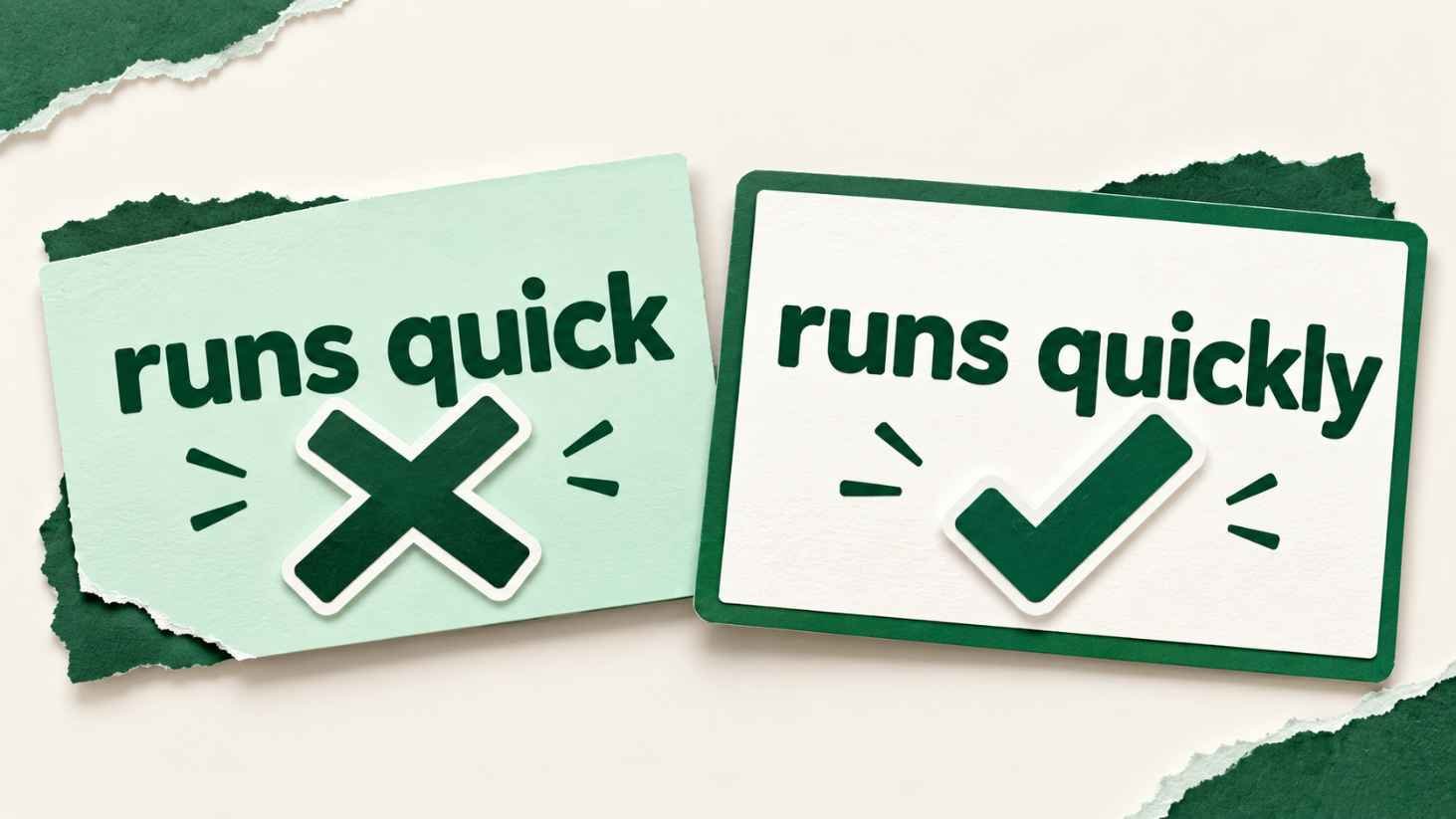
Everyone slips sometimes. Most errors come from a few repeated habits, and fixing them shows the real difference between adverb and adjective in adjectives and adverbs you use every day.
Which adjective and adverb mistakes should you fix first?
- Using an adjective after an action verb: “He runs quick.”
- Using an adverb after a linking verb: “She looks sadly.”
- Adding -ly to words that are already adverbs: “fastly.”
- Writing “real” when you mean “really”: “real tired.”
- Mixing up good and well in everyday speech.
| Incorrect | Correct | Reason |
| He runs quick. | He runs quickly. | The word describes a verb |
| She looks sadly. | She looks sad. | “Looks” is a linking verb |
| The music sounded beautifully. | The music sounded beautiful. | “Sounded” links to the noun |
| He drives careful. | He drives carefully. | The word describes a verb |
Confusing look-alike words causes the same kind of trouble. If one letter swap has ever changed your meaning, the angel vs angle spelling guide is a useful read.
Example in chat:
Friend 1: “I feel badly about the news.”
Friend 2: “Most editors prefer ‘I feel bad.’ ‘Feel’ links you to the emotion.”
Adjectives and adverbs exercises with answers
Practice makes the rules stick. Try these adjectives and adverbs exercises to test the difference between adverb and adjective on your own, then check each answer against the key underneath.
Can you choose the correct adjective or adverb?
- She sings beautiful / beautifully. Answer: beautifully.
- The soup tastes good / well. Answer: good.
- He drove careful / carefully. Answer: carefully.
- That was a real / really hard test. Answer: really.
- They arrived late / lately. Answer: late.
A score of 4 or 5 means you have the basics. Missed the soup question? Linking verbs are the usual reason. Missed the last one? Watch words that change meaning when you add -ly.
Example in chat:
Friend 1: “Quiz says ‘drive careful.’ Right?”
Friend 2: “Nope, ‘carefully.’ It describes the verb ‘drive.'”
Tips for natural usage
Correct grammar is only half the goal. These tips keep your adverbs and adjectives sounding natural, so your adjective and adverb choices read smoothly in emails, essays, captions, and conversation.
How can you use adjectives and adverbs more naturally?
- Swap “very tired” for stronger adjectives like “exhausted.”
- Cut adverbs that repeat the verb’s meaning: “whispered quietly.”
- Place adverbs where the sentence reads smoothly aloud.
- Read your draft aloud and listen for awkward modifiers.
- Proofread spelling too: “suger” should be “sugar.”
Small spelling slips weaken good sentences. The suger vs sugar spelling explanation shows how one wrong letter can pull readers away from your point.
Example in chat:
Friend 1: “She whispered quietly.”
Friend 2: “Drop ‘quietly.’ ‘Whispered’ already says it.”
Frequently asked questions
What are adjectives and adverbs?
Adjectives describe nouns. Adverbs describe verbs, adjectives, and adverbs. That is the difference between adverb and adjective.
Why are adjectives and adverbs easily confused?
Similar spelling and shared words like “fast” hide the difference between adverb and adjective. Both types also describe other words.
How are adjectives and adverbs different?
The difference between adverb and adjective is what they describe. Adjectives modify nouns, and adverbs modify actions and qualities.
Can an adjective also be an adverb?
Yes. Words like “fast” and “late” show the difference between adverb and adjective only through their job in the sentence.
What are some common mistakes with adjectives and adverbs?
The top errors use adjectives after action verbs and adverbs after linking verbs. Recheck the difference between adverb and adjective before publishing.
What is the difference between adjective and adverb with examples?
“A slow walk” uses an adjective, and “walks slowly” uses an adverb. That is the difference between adverb and adjective in one pair.
How do you find an adverb in a sentence?
Look for words answering how, when, or where. Any word that fits describes an action, which shows the difference between adverb and adjective.
Final takeaway
The difference between adverb and adjective comes down to one habit: ask what the word describes. Nouns get adjectives. Verbs, adjectives, and other adverbs get adverbs. Once you make that check automatic, adjective vs adverb choices stop feeling like guesswork.
Keep the small traps in mind too. Linking verbs take adjectives, words like “fast” and “late” do both jobs, and -ly is only a hint. Practice with the exercises, then reread your last email and fix one modifier.
Your next step is simple. Write 3 sentences today, one with an adjective, one with an adverb, and one with both, and say the difference between adverb and adjective out loud. That tiny habit is how the rule becomes second nature. If you want more, keep working through adjectives and adverbs examples until the pattern sticks.

Daniel Parker is an English language writer sharing clear grammar lessons, practical tips, and helpful examples for learners.










2 thoughts on “Difference Between Adverb and Adjective: Meaning Made Easy”