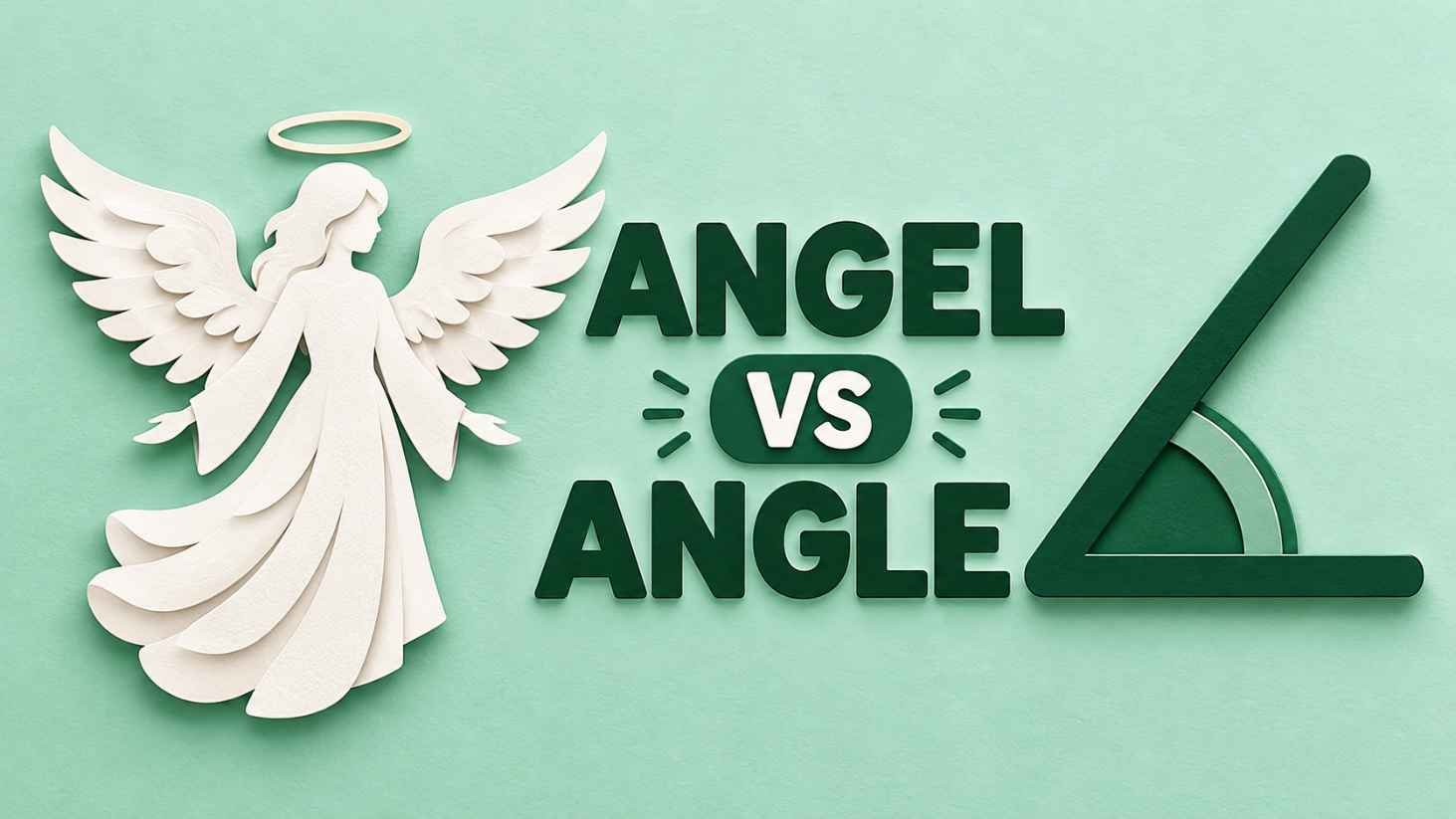

You type a quick message, hit send, and then spot it: you wrote “angle” when you meant the winged kind. That small slip stings, especially when it is a word you have known since childhood. Plenty of people search angel vs angle for exactly this reason.
This guide gives you clear meanings, real examples, and simple memory tricks. You will also learn how do you spell angle without second-guessing, plus angel in a sentence examples you can copy. Keep reading, and the angel vs angle question will be settled for good.
What is the Difference Between Angel and Angle?
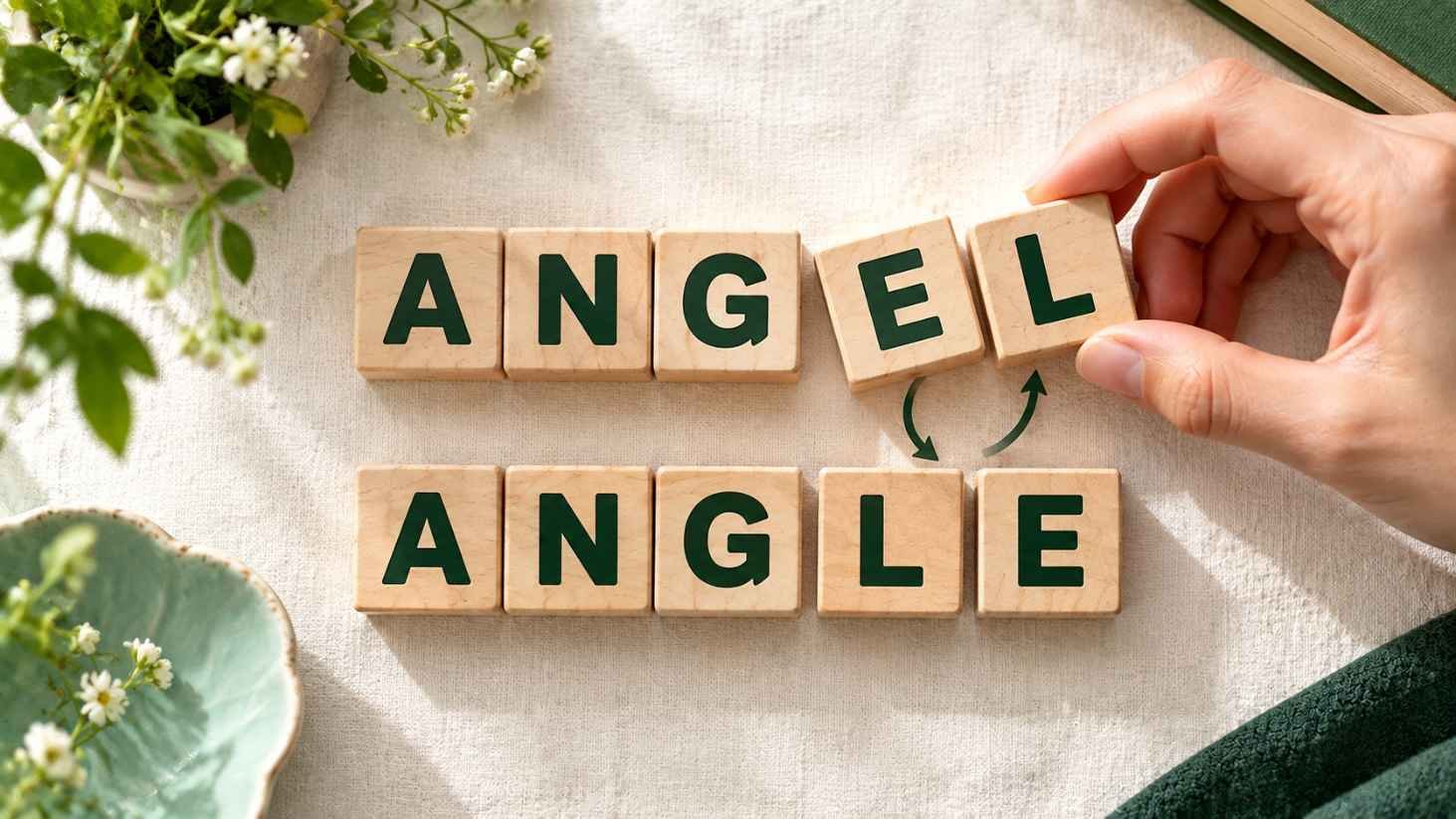
Two words, same letters, completely different jobs. This quick angel vs angle breakdown shows how each word works, and answers angel versus angle questions before they trip you up again.
What is the main difference between angel and angle?
Angel is a noun for a celestial being or an especially kind person. Angle names the space between two lines that meet at a point, and it also means a point of view. One belongs to heaven and goodness. The other belongs to geometry and perspective.
Both words use the same five letters, which makes them anagrams. That shared spelling explains most typos. Your fingers swap the last two letters, and spell check stays quiet because both results are real words.
- Angel is a noun in everyday writing, never an action word.
- Angle works as both a noun and a verb.
- Angel ends in L and refers to a spiritual being.
- Angle ends in E and connects to geometry and lines.
- Spell checkers miss the swap because both spellings are real words.
| Feature | Angel | Angle |
| Part of speech | Noun (everyday use) | Noun and verb |
| Pronunciation | AYN-jul | ANG-gul |
| Core meaning | Spiritual being or very kind person | Measure between lines or a viewpoint |
| Last letter | L | E |
| Origin | Greek angelos, “messenger” | Latin angulus, “corner” |
Example in texting:
Friend 1: Did you say your sister is an angle? 😂
Friend 2: Autocorrect strikes again. She’s an angel.
When to Use Angel

Use this word for a heavenly messenger or someone who acts with rare kindness. These angel in a sentence examples make the angel vs angle choice very easy to spot.
How is angel used in a sentence?
The word angel shows up in three main settings. Religious texts use it for messengers from God. Everyday speech uses it for a gentle, generous person. Business talk uses it for an angel investor, someone who funds a young company early.
Because angel is a noun in everyday writing, it names a being or a person. It follows words like the, an, or my, and it has a plural: angels. It never describes a quick action.
- Celestial being: angels appear in religious stories and art.
- Guardian angel: a protective spirit watching over someone.
- Kind person: call a helpful friend an angel.
- Angel investor: a person who funds a startup early.
- Plural form: add s to write angels.
- Angelic: the adjective form, meaning sweet or pure.
| Sentence | Meaning of angel |
| A choir of angels sang on the hillside. | Celestial beings |
| Mother Teresa was an angel to the poor. | Very kind person |
| Her guardian angel kept her safe on the road. | Protective spirit |
| An angel investor funded the small studio. | Early financial backer |
Example in texting:
Friend 1: You brought me soup at midnight. You’re an angel.
Friend 2: Anytime. That’s what friends do.
When to Use Angle

Reach for this word when you talk about geometry, viewpoints, or turning something slightly. This angle vs angel guide answers how do you spell angle in just a few seconds.
What does angle mean as a noun and a verb?
As a noun, angle has two main meanings. In math, it is the amount of turn between two lines that meet at a point, measured in degrees. In everyday speech, it is a viewpoint or approach, like the angle a reporter takes on a story.
As a verb, angle means to tilt, turn, or steer something in a direction. Writers also use it for fishing with a rod, and for hinting at something, as in angling for a compliment.
- Geometry: the space between two lines or surfaces that meet.
- Viewpoint: a way of looking at a problem or story.
- Tilt: to position something on a slant.
- Steer: to guide a boat, ball, or conversation in a direction.
- Angle for: to seek something in an indirect way.
- Angler: a person who fishes with a rod and line.
| Type of angle | Size | Everyday example |
| Acute angle | Less than 90 degrees | Tip of a pizza slice |
| Right angle | Exactly 90 degrees | Corner of a sheet of paper |
| Obtuse angle | Between 90 and 180 degrees | Back of a reclined chair |
| Straight angle | Exactly 180 degrees | A flat line |
Example in chat:
Friend 1: Try looking at the budget from a different angle.
Friend 2: Good idea. I only checked the costs, not the savings.
Angel and angle pronunciation: how to say each word

Say them out loud and the difference jumps out. This angel vs angle pronunciation guide also covers angel versus angle clues that help your ears catch what your eyes miss.
Do angel and angle sound the same?
No. Angel starts with a long A, like the word ace, and is said AYN-jul. Angle starts with a short A, like the word add, and is said ANG-gul. The middle sounds differ too: a soft J in angel and a hard G in angle.
Because the two words sound different, you rarely mix them up when speaking. The confusion happens in writing, where the same letters sit in nearly the same order. Reading a sentence aloud before you publish it catches many of these errors.
- Angel has a long A and a soft J sound.
- Angle has a short A and a hard G sound.
- Both words put the stress on the first syllable.
- They are not homophones, so speech gives you a clear clue.
- Say AYN-jul for the winged being and ANG-gul for the shape.
| Word | IPA | Respelling | Sounds like |
| Angel | /ˈeɪndʒəl/ | AYN-jul | “ain” + “jull” |
| Angle | /ˈæŋɡəl/ | ANG-gul | “ang” + “gull” |
Example in chat:
Friend 1: Wait, is it “ain-jull” or “ang-gull” for the shape?
Friend 2: Ang-gull for the shape. Ain-jull is the one with wings.
Angle vs. Angel: When to Use Which
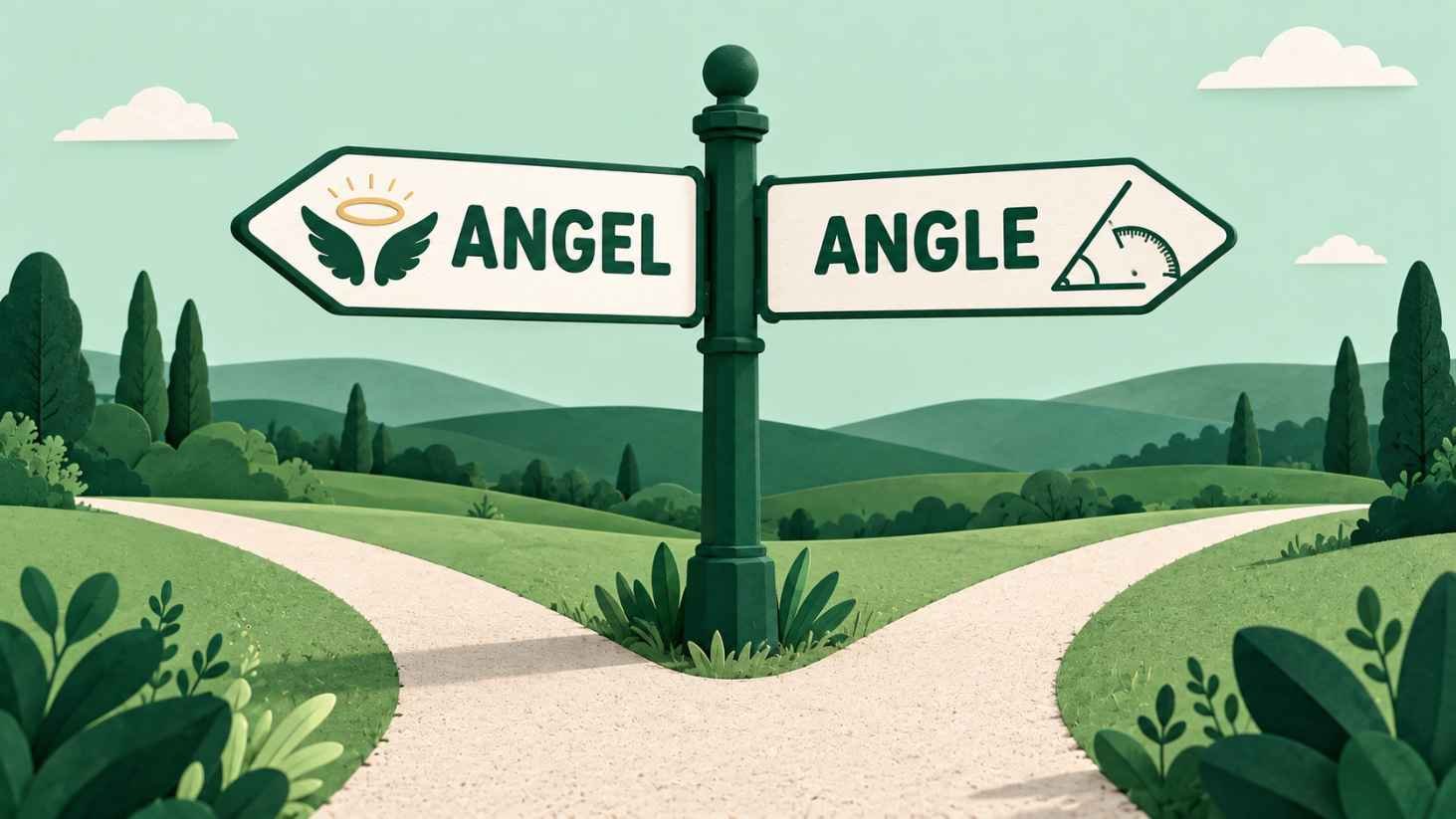
Stuck mid-sentence? Use this angle vs angel decision guide to pick the right word fast. It also shows angel in a sentence patterns you can check your own writing against.
How do you choose between angle and angel?
Start with the part of speech. If the word is a verb, use angle, because angel works as a noun in everyday writing. If it is a noun, ask what it means: a spiritual being or kind person, or a line relationship or viewpoint.
A second check works well too. Replace the word with perspective. If the sentence still makes sense, you want angle. Replace it with heavenly being. If that fits, you want angel.
- Verb slot: always choose angle.
- Wings, halos, heaven: choose angel.
- Math, shapes, degrees: choose angle.
- Viewpoint or approach: choose angle.
- Very kind person: choose angel.
- Investor who backs startups: choose angel.
| Clue in the sentence | Correct word |
| She ___ the camera downward. | angled |
| He is my guardian ___. | angel |
| Measure the ___ of the ramp. | angle |
| Our ___ investor called today. | angel |
| Try a fresh ___ on the story. | angle |
Example in texting:
Friend 1: New story idea: try the budget angle.
Friend 2: Love it. You’re an angel for pitching it.
Angel vs angle memory tricks that stick

A good trick saves you from checking every time. These angel vs angle memory tricks make angle vs angel choices feel automatic, even when you are typing in a hurry.
What is the easiest way to remember angel vs angle?
Pair each word with a neighbor that ends the same way. Angel and devil both name spiritual beings, and both end in L. Angle and line both belong to geometry, and both end in E.
The word triangle contains angle, and so does rectangle. If your sentence is about shapes, the spelling with E at the end is the right one. For angel, think of angelic, which keeps the E before the L.
A tiny proofreading habit helps too. Point at the last letter of the word, the same gesture behind the finger pointing emoji meaning, and say the word out loud.
- Angel and devil: both spiritual beings, both end in L.
- Angle and line: both geometry terms, both end in E.
- Triangle: contains angle, so spell the shape word with E.
- Angelic: keeps E before L, matching angel.
- Point and check: touch the last letter and say the word aloud.
| Trick | Points to | Best for |
| Devil and angel both end in L | Angel | Good and evil contrasts |
| Line and angle both end in E | Angle | Geometry and math |
| Triangle contains angle | Angle | Shapes and design |
| Angelic keeps the E before L | Angel | Halos and kindness |
Example in texting:
Friend 1: Is it angel or angle for my geometry homework?
Friend 2: Triangle has angle inside it. Use the E ending.
Common angel vs angle mistakes in writing and texting
Even careful writers slip here. Knowing the usual angel vs angle mistakes helps you spot them fast, and reading angel in a sentence examples out loud helps you the most.
What are the most common angel and angle mistakes?
The top error is writing angle when someone means a kind person, as in “you are an angle.” The reverse also happens: “the camera angel was too low.” Both slip past spell check because each spelling is a real word.
Texting habits play a part too. Fast chats, shorthand you might see explained in what IGH means in text, and autocorrect all reward speed over spelling. A five-second reread before sending fixes most of these slips.
- Wrong noun: writing “guardian angle” instead of guardian angel.
- Wrong viewpoint word: writing “a new angel on the story.”
- Verb error: writing “she angeled the shot” instead of angled.
- Typo swap: the last two letters trade places when typing fast.
- Autocorrect trap: phones accept both spellings as valid words.
- Plural slip: writing “three angels” for a triangle.
| Wrong | Right | Reason |
| guardian angle | guardian angel | Protective spirit |
| a fresh angel on the story | a fresh angle | Viewpoint |
| She angeled the camera. | She angled the camera. | Verb form of angle |
| The triangle has three angels. | The triangle has three angles. | Geometry |
Example in texting:
Friend 1: You’re my guardian angle 😅
Friend 2: Angel! Angle is the shape one.
Angel and angle synonyms, related words and opposites
Related words make each meaning easier to remember. This angel vs angle vocabulary list covers synonyms and opposites, and settles angel versus angle doubts by showing each word’s close neighbors.
What words are similar to angel and angle?
Words that sit near angel carry a spiritual or gentle feeling: cherub, seraph, archangel, saint, and guardian. Its opposites include devil, demon, and villain.
Words near angle carry a shape or viewpoint feeling: slant, tilt, perspective, standpoint, and approach. For the geometry meaning, related terms include corner, degree, vertex, and intersection. A loose contrast for the geometry meaning is a straight line.
- Cherub: a winged child figure in art, close to angel.
- Saint: a person seen as holy, sometimes called an angel.
- Demon: a spiritual opposite of an angel.
- Perspective: a synonym for angle in the viewpoint sense.
- Slant: a tilt or bias, close to angle.
- Vertex: the point where the two lines of an angle meet.
| Word | Linked to | Relationship |
| Cherub | Angel | Similar |
| Devil | Angel | Opposite |
| Slant | Angle | Similar |
| Standpoint | Angle | Similar |
| Vertex | Angle | Related geometry term |
| Straight line | Angle | Contrast |
Example in chat:
Friend 1: What’s another word for angle when I mean a viewpoint?
Friend 2: Try perspective or standpoint. Both fit that meaning.
How do you spell angle correctly every time?
Spelling worries are normal with this word. The answer to how do you spell angle is A-N-G-L-E, and the angle vs angel trick from earlier keeps it right every time.
What is the correct spelling of angle?
The correct spelling is angle, with the G before the L and an E at the end. The word comes from the Latin angulus, meaning corner, which is why it connects so tightly to shapes and geometry.
Common misspellings include angel (a real but different word), angul, and anlge. Typing angle slowly, letter by letter, builds the right muscle memory. Saying “ang-gull” in your head while you type also helps.
- Spell it: A, N, G, L, E.
- Letter order: G comes before L, and E finishes the word.
- Root word: Latin angulus means corner.
- Related spellings: angular, triangle, rectangle, and angled all keep angle.
- Typo alert: angel is a real word, so spell check misses it.
| Spelling | Correct? | Note |
| angle | Yes | Geometry and viewpoint |
| angled | Yes | Past tense of the verb |
| angel | Yes, different word | Spiritual being |
| anlge | No | Letters swapped |
| angul | No | Missing letters |
Example in texting:
Friend 1: How do you spell angle? I keep typing angel.
Friend 2: A-N-G-L-E. Think of triangle.
Can angle be a verb, and is angel ever one?
Verbs are the fastest shortcut in this angel vs angle puzzle. One word can act, and the other cannot. Use it to answer angel versus angle grammar questions with confidence.
Is angel ever used as a verb?
Not in everyday writing. Angel is a noun. You do not angel a ball, angel a camera, or angel your way into a job. A rare theater slang sense exists, meaning to back a show with money, but ordinary writing skips it. When the sentence needs an action, the word is angle.
Angle works as a verb in three common ways: to tilt (angled the mirror), to steer (angled the boat toward shore), and to fish or hint (angling for an invitation). The past tense is angled, and the present participle is angling.
- Angle as a verb: angle, angles, angled, angling.
- Tilt: angle a lamp toward the desk.
- Steer: angle a boat toward the dock.
- Hint: angle for a compliment or a raise.
- Angel as a verb: rare theater slang for financing a show.
Example in chat:
Friend 1: Should I write “she angeled the mirror”?
Friend 2: Write “angled.” Angle is the verb.
Why do people mix up angel and angle so often?
The confusion has real causes. Understanding why angel vs angle trips people up makes angle vs angel slips easier to catch, and you can stop blaming your own spelling skills.
What makes angel and angle so easy to confuse?
Both words are anagrams: same five letters, different order. Your eyes read the general shape of a word rather than each letter, so the brain accepts the wrong version without complaint.
Chat habits add to it. In fast conversations, like the shorthand covered in IMK meaning in chat, people type what sounds right and move on. Few people reread a quick reply, and that is where most swaps survive.
- Anagram pairs: same letters in a different order confuse readers.
- Word shape: the eye reads outlines, not every letter.
- Both are real words: spell check has nothing to flag.
- Fast typing: the last two letters swap easily.
- Same start: both begin with “ang,” so the opening feels identical.
| Cause | What happens | Quick fix |
| Anagram spelling | Eyes accept the wrong order | Reread the last two letters |
| Fast typing | Letters swap | Slow down on E and L |
| Spell check | Both words pass | Proofread by hand |
| Word shape | Brain fills in the gap | Read the sentence aloud |
Example in texting:
Friend 1: Just sent “my angle” instead of “my angel” 🤦
Friend 2: Spell check let it through. Both are real words.
Summary: Angel vs. Angle
Here is the short version. This angel vs angle recap gives you the meanings, the tricks, and one angel in a sentence example to keep handy for any future draft.
What should you remember about angel vs angle?
Angel is a noun for a celestial being, a guardian spirit, or a very kind person. Angle is a noun for the space between two lines or a viewpoint, and it is also a verb meaning to tilt or steer.
Check the part of speech first, then the meaning, then the ending letter. L goes with angel and devil. E goes with angle and line.
- Angel: spiritual being, kind person, or startup backer.
- Angle: geometry measure, viewpoint, or tilted position.
- Verb rule: use angle whenever the sentence needs an action.
- Ending trick: L for angel and devil, E for angle and line.
- Proofread: reread the last two letters before sending.
| Word | Part of speech | Meaning | Ending trick |
| Angel | Noun | Celestial being or kind person | L, like devil |
| Angle | Noun, verb | Line measure, viewpoint, tilt | E, like line |
Example in texting:
Friend 1: Final check: my sister is an angel, and I like your angle.
Friend 2: Perfect. Both spelled right.
Frequently asked questions
What is the difference between angel and angle?
The angel vs angle difference comes down to meaning and part of speech. Angel names a spiritual being, while angle names a line measure or viewpoint.
How do you spell angle?
In any angel vs angle check, spell angle as A-N-G-L-E. The E sits at the end, just like in the word line.
Is angel a noun or a verb?
In the angel vs angle debate, angel is a noun in everyday writing. Angle works as both a noun and a verb, such as angled or angling.
Do angel and angle sound the same?
No, the angel vs angle pair is easy to tell apart when said aloud. Angel sounds like AYN-jul with a soft J, and angle sounds like ANG-gul.
What is an example of angel in a sentence?
In angel vs angle practice, try this: “Our neighbor is an angel.” Here angel describes a very kind person rather than a winged being.
What are examples of angle in a sentence?
Angle vs angel gets easy with context: “Try the story from a new angle.” That angle means viewpoint, and “angle the mirror” uses it as a verb.
Why do people confuse angel and angle?
The angel vs angle mix-up happens because both words use the same five letters. Fast typing swaps the last two, and spell check accepts both.
Conclusion
The angel vs angle question feels small until a typo lands in an email or a caption. Now you know the split: angel is a noun for a celestial being or a very kind person, and angle covers geometry, viewpoints, and the verb sense of tilting or steering.
Keep three checks close. Verb slot means angle. Wings and kindness mean angel. Shapes and viewpoints mean angle. Add the ending trick, L for devil and angel, E for line and angle, and the angle vs angel decision takes two seconds.
If you ever catch yourself asking how do you spell angle, picture the word triangle: A-N-G-L-E. Reread the last two letters before you hit send, and the angel vs angle slip will stop showing up in your writing.

Daniel Parker is an English language writer sharing clear grammar lessons, practical tips, and helpful examples for learners.










2 thoughts on “Angel vs. Angle: What’s the Difference?”