
Handsome vs. Hansom: The Quick Answer
Handsome and hansom sound almost identical, but they mean two completely different things. If you are describing someone’s appearance, an impressive building, or a generous amount of money, handsome is the correct word. If you are talking about a historical horse-drawn carriage, use hansom.
For example, you might write, “He looked handsome in his new suit.” You could also write, “The detective climbed into a hansom and hurried through the streets of London.” Both sentences are correct, but swapping the two words would change the meaning.
The confusion is understandable. In everyday speech, the “d” in handsome is usually silent, so the two words sound alike. A spellchecker might not catch the mistake either, because hansom is a genuine English word rather than a simple misspelling.
English has plenty of word pairs that create similar problems. In our guide to disassociation or dissociation, for example, the challenge is choosing the appropriate form for the context. With handsome and hansom, the distinction is even more straightforward: one describes appearance or something substantial, while the other names a type of carriage.
Here is the easiest rule to remember:
- Handsome: an adjective meaning attractive, impressive, or generous in amount.
- Hansom: a noun referring to a particular kind of horse-drawn cab.
You will probably use handsome far more often in everyday writing. However, understanding both words will help you avoid an awkward spelling mistake and recognize hansom when it appears in historical fiction, museum descriptions, or older literature.
What Does Handsome Mean?
Handsome is an adjective. Its most familiar meaning is physically attractive, especially when describing a person. However, the word has a broader range of uses than many people realize.

A handsome person may have attractive features, a pleasing appearance, or a confident, dignified look. The word has traditionally been associated with men, but it is not grammatically restricted to men.
You can also describe an object, building, or financial amount as handsome. In those cases, the word usually suggests something impressive, substantial, generous, or well-proportioned.
The Oxford Learner’s Dictionaries definition of handsome provides a useful reference for its common meanings and pronunciation.
Handsome for Physical Attractiveness
This is the meaning most people recognize immediately.
Consider these examples:
- “The actor looked handsome at the award ceremony.”
- “He is a handsome young man with a warm smile.”
- “She described her grandfather as a handsome gentleman.”
- “The dog is a handsome German Shepherd with a thick coat.”
In each sentence, handsome describes appearance. It can suggest more than conventional beauty, sometimes conveying strength, elegance, or a striking overall impression.
Although people often associate the word with masculine appearance, its meaning is not limited to one gender. A writer can describe a woman as handsome, particularly when emphasizing strong features or a striking, dignified appearance.
Can You Describe a Woman as Handsome?
Yes. It is grammatically correct to call a woman handsome.
However, modern usage matters. Many speakers would describe a woman as attractive, beautiful, elegant, or striking instead. Calling a woman handsome can sound formal, traditional, or slightly old-fashioned, depending on the context.
For example:
“Everyone admired her handsome features and confident expression.”
There is nothing incorrect about that sentence. The choice simply creates a particular tone.
The important point is that handsome is an adjective, not a word reserved exclusively for men. Choose it when it expresses the appearance or impression you want to convey.
Handsome for Buildings and Objects
A building, piece of furniture, or other object can also be handsome. Here, the word often suggests attractive proportions, quality, or an impressive appearance.
For example:
- “The university has a handsome stone library.”
- “They renovated a handsome Victorian townhouse.”
- “The wooden desk is simple but handsome.”
- “The museum displays a handsome collection of antique furniture.”
In these sentences, the word is not describing a person. It conveys the idea that something looks impressive, well-designed, or pleasing.
This broader meaning is useful in descriptive writing. Instead of repeatedly using beautiful or attractive, you can use handsome when describing architecture, furnishings, and other substantial objects.
Handsome for Money, Rewards, and Offers
One meaning that surprises some readers is the use of handsome for a large or generous amount.
For example:
- “The company offered her a handsome salary.”
- “The author received a handsome advance for the book.”
- “The charity raised a handsome sum.”
- “The business made a handsome profit last year.”
Nobody is suggesting that the money has an attractive face. In these expressions, handsome means substantial or generous.
This usage is common in professional, financial, and journalistic writing. It can also sound slightly formal, which makes it useful when you want to describe a sizeable amount without using a blunt word such as large.
For more historical and lexical detail, you can consult the Oxford English Dictionary entry for handsome or the Wikipedia article on handsome.
What Does Hansom Mean?
A hansom is a light, two-wheeled horse-drawn carriage, usually called a hansom cab. It was designed for passenger transport and became particularly associated with nineteenth-century urban life.
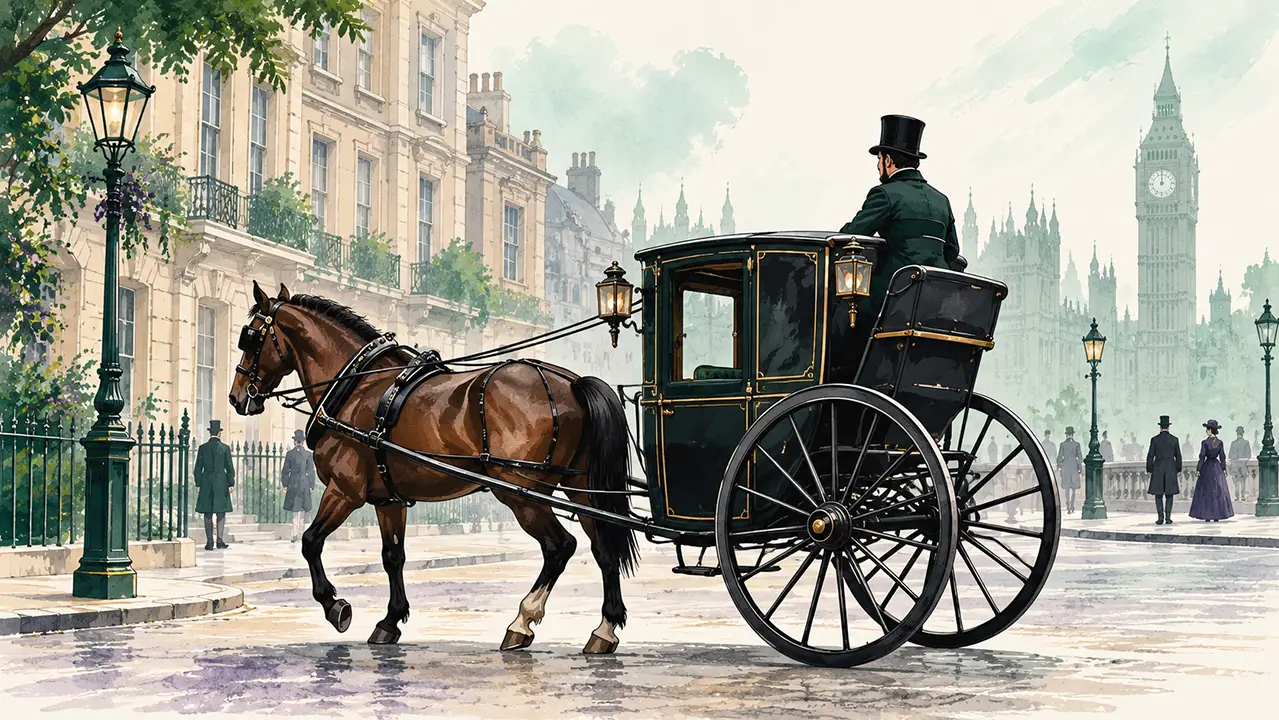
The carriage had a distinctive arrangement. Passengers sat inside the cabin, while the driver occupied an elevated seat behind them. Its compact design made it useful for moving through busy streets.
Today, the word is relatively uncommon outside historical writing, literature, museum displays, and descriptions of traditional carriages.
For example:
- “A hansom waited outside the hotel.”
- “The detective hailed a hansom cab in the rain.”
- “The museum displayed a restored hansom from the Victorian period.”
- “The passengers climbed into the hansom and set off across town.”
Notice that hansom names a vehicle. It does not describe someone’s appearance.
What Is a Hansom Cab?
A hansom cab is a particular type of horse-drawn carriage. It should not be confused with every historical carriage or coach.
The vehicle became famous in Britain during the nineteenth century and is frequently associated with Victorian London. Readers may recognize it from Sherlock Holmes stories, where characters travel through the city in horse-drawn cabs while investigating mysteries.
The name comes from Joseph Hansom, the English architect associated with the carriage’s design and patent in the 1830s. The word became the name of the vehicle itself.
That is why the spelling is hansom cab, not handsome cab. The latter might sound plausible if you were simply describing a particularly attractive carriage, but it is not the standard name for this historical vehicle.
If you are writing historical fiction, a history assignment, or a museum description, using hansom correctly adds precision. In ordinary conversation about someone’s appearance, however, the word almost certainly does not belong.
The Origin of Handsome vs. Hansom
Although the words sound alike today, they have different histories. Understanding those origins helps explain why their spellings should not be treated as alternatives.
Origin of Handsome
The word handsome developed from hand and the suffix -some. Its earlier meanings were connected with qualities such as being easy to handle, convenient, or suitable. Over time, the sense developed toward something well-formed, pleasing, or impressive.
Eventually, the word became established as a description of physical attractiveness. Its meaning also expanded to cover things that are substantial or generous, as in a handsome reward or a handsome profit.
This development is a useful reminder that English vocabulary changes gradually. A word can acquire new meanings as speakers use it in different situations, while older meanings become less familiar.
You can explore the historical forms and meanings through Wiktionary’s handsome entry and the Oxford English Dictionary.
The word also has related forms. Handsomely is an adverb, while handsomeness is a noun referring to the quality of being handsome.
For example:
“His handsomeness was often mentioned in newspaper profiles.”
Although the noun is correct, the simpler phrase his attractive appearance may sound more natural in everyday writing.
Origin of Hansom
Unlike handsome, hansom comes from a surname. It is associated with Joseph Hansom, an English architect who patented the design of the hansom cab in 1834.
The vehicle became a recognizable form of transport, particularly in British cities. As the design gained popularity, the surname became the common noun used for the carriage.
The distinction is straightforward: handsome developed as an English adjective, while hansom became the name of a vehicle associated with a particular inventor.
The two words are not spelling variants of one another. Their similar pronunciation is coincidental, and their meanings remain separate.
This is comparable to other confusing English word pairs, although the reasons for confusion differ. For example, stared or starred involves two forms with different meanings that can sound similar in conversation. With handsome and hansom, context tells you which word belongs in the sentence.
How to Pronounce Handsome and Hansom
In most common English pronunciations, handsome and hansom sound alike or extremely similar. Both are generally pronounced HAN-səm, with the stress on the first syllable.
The “d” in handsome is usually silent in ordinary speech. That is why someone hearing the word for the first time might assume it is spelled hansom.
Pronunciation alone may not help you choose the correct spelling. You need to consider what the sentence means.
Compare these examples:
- “He looks handsome.” The word describes appearance.
- “He rode in a hansom.” The word identifies a carriage.
The same principle applies to other words whose sounds can cause confusion. In afterward vs. afterwards, the difference is mainly a matter of accepted usage and regional preference. Handsome and hansom are different words with different meanings, so substituting one for the other creates an error.
British English vs. American English Usage
There is no British-versus-American spelling difference between these two words.
Both British and American English use handsome to describe a person, object, or substantial amount. Both use hansom to refer to the historical carriage.
You may encounter hansom more often in British historical writing because the vehicle is closely associated with nineteenth-century Britain. American readers can also come across it in historical novels, museum material, and stories set in Victorian London.
That difference in frequency does not make hansom a British alternative to handsome. The words are not interchangeable in either dialect.
For comparison, some English words genuinely have regional preferences. Others have distinct forms that must be selected according to meaning. The distinction between immigrate and emigrate is a good example: the appropriate word depends on the direction of movement, not simply on the writer’s location.
The rule here is simpler. Use handsome for the adjective and hansom for the carriage, regardless of whether you are writing in British or American English.
Which Spelling Should You Use?
The quickest way to choose is to identify what you are describing.
If the sentence refers to someone’s appearance, an impressive object, or a generous amount, use handsome. If it refers to the historical horse-drawn cab, use hansom.
Consider the following pairs:
Correct: “The handsome actor greeted the audience.”
Incorrect for the intended meaning: “The hansom actor greeted the audience.”
The second sentence suggests that the actor is a carriage, rather than describing his appearance.
Now consider the opposite situation:
Correct: “The detective climbed into a hansom cab.”
Incorrect for the intended historical vehicle: “The detective climbed into a handsome cab.”
The second sentence describes a cab as attractive rather than using the established name of the vehicle.
When you are unsure, replace the word temporarily with a simpler explanation. If you mean attractive or impressive, choose handsome. If you mean horse-drawn carriage, choose hansom.
This substitution test is often more reliable than relying on a spellchecker. Software can recognize that both spellings exist without understanding which one fits your intended meaning.
Common Mistakes with Handsome and Hansom
Several mistakes occur repeatedly because the words sound alike and differ by only a small amount in spelling.
Using hansom to describe a person. If you write, “He is a hansom man,” you have used the carriage word where you need the adjective handsome.
Writing handsome cab when you mean the historical vehicle. The established term is hansom cab. Use handsome cab only if you genuinely mean a cab that looks attractive, and even then, the phrase is context-dependent.
Assuming hansom is always a misspelling. It is a real word. It simply has a much narrower meaning than handsome.
Assuming the words are regional variants. Neither word is the British or American version of the other. They mean different things in both dialects.
Relying entirely on autocorrect. A spelling tool may accept hansom because it is a valid noun. That does not mean it belongs in a sentence about someone’s appearance.
Confusing spelling errors with legitimate alternative forms. English sometimes accepts different spellings or forms. For instance, Hallowe’en or Halloween concerns two established forms of the same word. Handsome and hansom, by contrast, have different meanings and separate histories.
The best habit is to read the entire sentence after checking the spelling. Ask yourself whether the word describes something or names a vehicle. That small check can prevent a technically valid word from becoming the wrong word.
Handsome Grammar: Word Forms and Usage
Because handsome is an adjective, it can appear before a noun or after a linking verb.
Examples include “a handsome man,” “a handsome building,” and “the building looks handsome.” In each case, the adjective describes a person or thing.
The word also has related grammatical forms:
- Handsome: adjective, as in “a handsome portrait.”
- Handsomer: comparative adjective, as in “the handsomer of the two actors.”
- Handsomest: superlative adjective, as in “the handsomest person in the room.”
- More handsome: an alternative comparative form.
- Most handsome: an alternative superlative form.
- Handsomely: adverb, as in “the company was handsomely rewarded.”
- Handsomeness: noun, referring to the quality of being handsome.
Is It Handsomer or More Handsome?
Both handsomer and more handsome are accepted comparative forms. Similarly, both handsomest and most handsome are correct superlatives.
For example:
“Daniel looks handsomer with his new haircut.”
“Daniel looks more handsome with his new haircut.”
Both sentences are grammatical. Some readers may find more handsome more natural in contemporary conversation, but handsomer is not incorrect.
For the superlative, you could write:
“He was the handsomest man at the event.”
Or:
“He was the most handsome man at the event.”
Choose the form that sounds natural in your sentence. If you are writing a longer passage, keep the style consistent where possible.
Is “Handsome or Handsome” a Real Phrase?
No. The phrase handsome or handsome is not a standard expression with a special grammatical meaning. It may appear as a typing error or an inaccurate search query.
If you want to compare the two words discussed here, write handsome vs. hansom or handsome or hansom.
The distinction matters because a comparison should identify two different options. Repeating the same word does not explain the difference in meaning.
Handsome or Hansom in Everyday Examples
Examples are useful because they show how the meaning changes according to context. The following sentences demonstrate how to use each word naturally in different types of writing.
Emails
In an email, handsome can describe an attractive person or a generous payment.
“Thank you for the offer. The project includes a handsome fee, and I would be pleased to discuss the details.”
If you were writing about a historical transport display, you might say:
“The museum has arranged a demonstration featuring a restored hansom cab.”
The first example uses an adjective to describe the size of a fee. The second uses a noun to identify a vehicle.
News
News writing often uses handsome to describe financial results, rewards, or impressive buildings.
“The company reported a handsome profit after a successful year.”
“The city plans to restore the handsome stone building near the central square.”
A report about historical transport might use hansom instead:
“Visitors gathered to see a restored hansom cab at the transport museum.”
In each example, the subject determines the appropriate word.
Social Media
In casual messages, handsome often appears as a compliment.
“You look handsome in that picture!”
“Your grandfather was a handsome man in his younger days.”
By contrast, hansom might appear in a post about travel, history, or a period drama:
“I finally saw a real hansom cab at the museum. The design was fascinating.”
Unless the post is about historical transport, the word you probably want is handsome.
Formal Writing
Formal writing benefits from accurate word choice, especially when a valid word could be mistaken for an error.
“The committee approved a handsome reward for the discovery.”
“The archive contains an illustration of a hansom cab used in nineteenth-century London.”
The first sentence uses handsome to mean generous or substantial. The second names a historical vehicle.
Historical Writing
Historical writing is where hansom is most likely to appear.
“The detective hailed a hansom and instructed the driver to continue toward Baker Street.”
“By the late nineteenth century, hansom cabs were a familiar feature of busy city streets.”
You might also use handsome in the same historical setting:
“The handsome townhouses along the square reflected the wealth of their original owners.”
A single passage can contain both words correctly. Their meanings remain distinct even when the historical context is the same.
Handsome vs. Hansom: Search and Usage Data
The keyword report supplied for this article shows that readers search for both the familiar adjective and less common spelling-related terms. These figures are estimates from the provided keyword dataset and should not be treated as live Google Trends results.
The report lists approximately:
| Keyword | Reported monthly search volume |
|---|---|
| handsome | 40,500 |
| meaning of handsomeness | 12,100 |
| h a n s o m | 9,900 |
| define handsome | 4,400 |
| hansome | 1,600 |
| hamsomer | 1,300 |
| hansom meaning | 1,000 |
| how do you spell handsome | 1,000 |
| define hansom | 880 |
These figures suggest that the broader word handsome attracts substantially more search interest than the historical term hansom. Searchers also look for definitions, spelling help, word forms, and common misspellings.
However, keyword volume does not tell us exactly how many people make a particular spelling error. A search for hansom meaning, for example, could come from a reader who encountered the word in a novel rather than someone who confused it with handsome.
Google Trends data would need to be checked separately before making claims about changes over time. The keyword report alone does not establish whether searches are rising or falling.
For a grammar website, the practical takeaway is to answer the spelling question immediately, then provide the definitions, examples, and word-history information that help readers understand the distinction.
Comparison Table: Handsome vs. Hansom
| Feature | Handsome | Hansom |
|---|---|---|
| Part of speech | Adjective | Noun |
| Main meaning | Attractive, impressive, or generous | A type of horse-drawn cab |
| Pronunciation | Usually HAN-səm | Usually HAN-səm |
| Typical context | Appearance, buildings, rewards, money | Historical transport and literature |
| Common today? | Yes | Uncommon |
| Example | “He received a handsome reward.” | “The detective entered a hansom.” |
| Origin | Developed from hand and -some | Named after Joseph Hansom |
The most important difference is grammatical as well as semantic. Handsome describes a person or thing. Hansom names a vehicle.
If you remember that distinction, you will rarely have trouble choosing the correct spelling.
Frequently Asked Questions
1. Is hansom just a misspelling of handsome?
Not always. Hansom is a real English noun referring to a particular type of horse-drawn carriage. It is incorrect only when used in place of handsome to describe appearance or something substantial.
2. Can I use hansom to describe a person?
No, not if you mean that the person is attractive. Write handsome instead. A sentence such as “He is a handsome man” is correct, while “He is a hansom man” uses the wrong word for that meaning.
3. Is handsome only used for men?
No. The word has traditionally been associated with men, but it can describe people of any gender. It can also describe buildings, objects, and generous amounts of money. Whether it sounds natural depends on the context and the writer’s intended tone.
4. Is hansom used in modern English?
It is uncommon in everyday conversation. You are more likely to encounter it in historical fiction, museum descriptions, transport history, or writing about Victorian London. It remains a valid word even though the vehicle is no longer a normal form of urban transport.
5. Does British English prefer hansom?
No. British and American English use handsome for appearance and hansom for the carriage. The word hansom appears frequently in British historical contexts because the vehicle is associated with nineteenth-century Britain, not because it is a regional spelling of handsome.
6. Can handsome describe things?
Yes. You can describe a handsome building, a handsome piece of furniture, or a handsome reward. The word suggests attractiveness, impressive proportions, or a substantial amount, depending on the noun it modifies.
7. Which word should I use in professional writing?
Use handsome when describing appearance, an impressive object, or a generous amount. Use hansom only when referring to the historical carriage. If a sentence feels uncertain, replace the word with its intended meaning and check whether the sentence still makes sense.
8. What is a hansom cab?
A hansom cab is a light, two-wheeled horse-drawn carriage associated with nineteenth-century urban transport. The driver sat behind the passenger cabin on an elevated seat. The vehicle was named after Joseph Hansom, who patented its design in 1834.
9. Is handsomer a correct word?
Yes. Handsomer is a correct comparative form of handsome. You can also use more handsome. For the superlative, both handsomest and most handsome are accepted.
10. How do you pronounce handsome?
Handsome is usually pronounced HAN-səm, with the stress on the first syllable. The “d” is generally silent in everyday speech, which is why the word sounds similar to hansom.
Conclusion
The difference between handsome vs. hansom comes down to meaning, not regional spelling.
Use handsome when describing an attractive person, an impressive building, or a generous amount of money. Use hansom when referring to the historical horse-drawn cab, particularly in writing about Victorian transport or literature.
The two words sound almost identical, so pronunciation alone may not help you choose the correct spelling. Instead, think about what the sentence is trying to say. If you mean attractive or substantial, write handsome. If you mean a carriage, write hansom.
It is a small distinction, but it makes a real difference to clarity. And if you remember that the adjective contains the word hand, you have a simple way to keep the spellings straight the next time you write a compliment.

Daniel Parker is an English language writer sharing clear grammar lessons, practical tips, and helpful examples for learners.