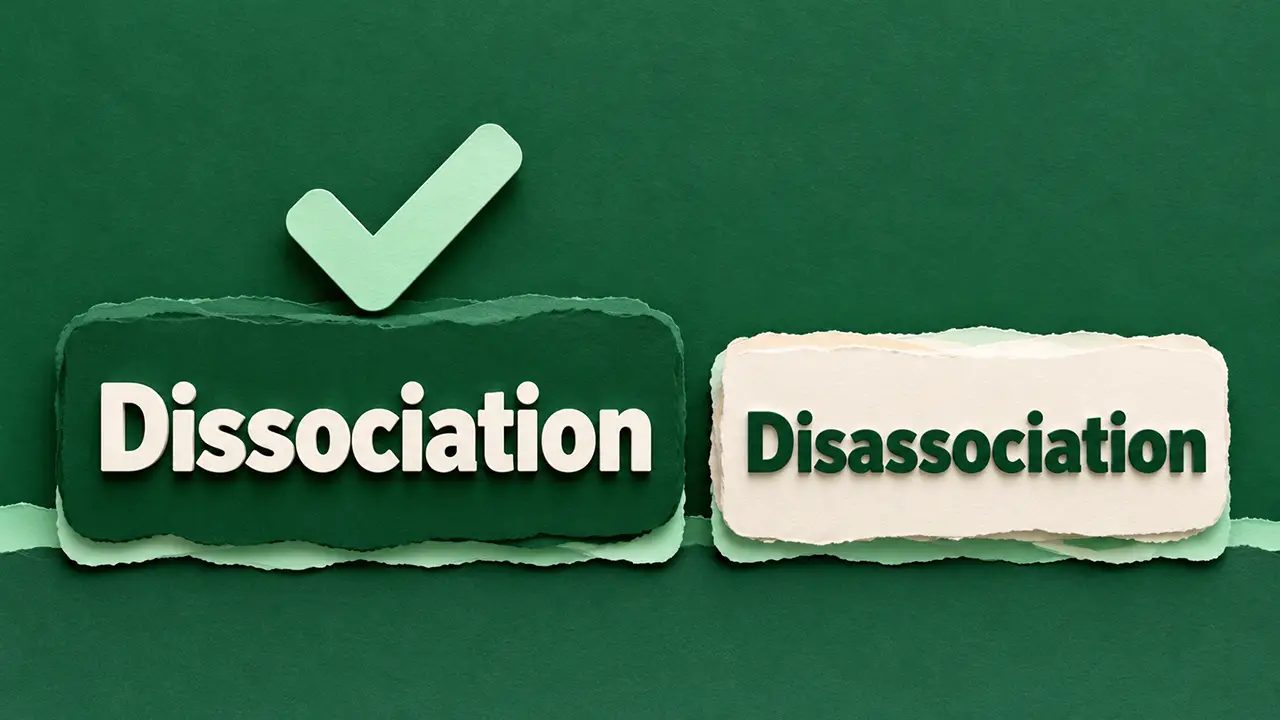
You’re mid-sentence, you reach for the word, and your fingers stall. Disassociation or dissociation? Both look fine for about two seconds, then both look wrong. Spellcheck doesn’t help much, because it accepts both.
This guide settles it from a grammar point of view: which spelling to use, how the verbs and nouns work in real sentences, and where each one fits. You’ll also see how dissociation vs disassociation plays out in everyday writing, so you can pick a word and move on.
Which is correct: disassociation or dissociation?

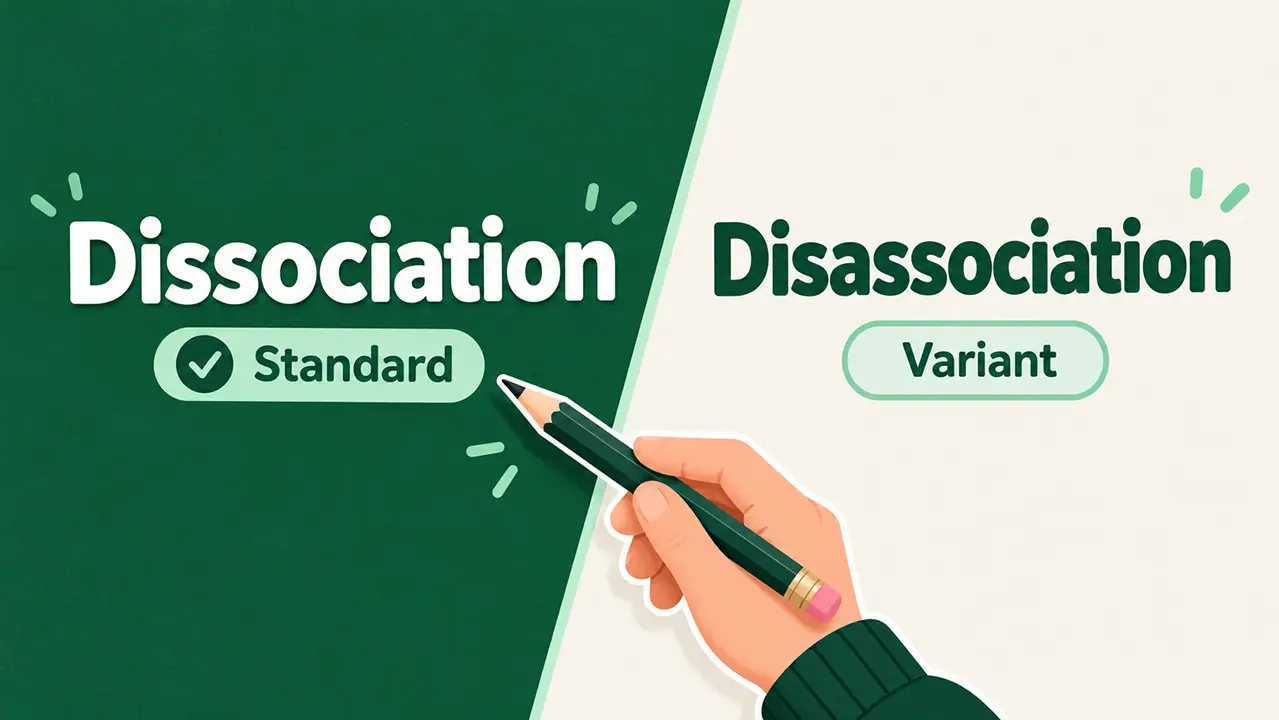
Both are real words, but dissociation is the standard spelling in most published writing. Disassociation is a variant that dictionaries list, and it gets used a lot in casual speech. If you want the safe choice for an essay, an email, a report, or a blog post, go with dissociation and its verb, dissociate.
Plenty of English pairs behave this way, where two forms exist and one wins in formal writing. Afterward vs afterwards is a close cousin, since both are accepted and the choice often comes down to region and habit. The difference here is that one form (dissociate) is clearly preferred by editors and style guides, so there’s less room for personal taste.
Here’s the quick version in a table.
| Word | Part of speech | Standard? | Typical use |
| Dissociation | Noun | Yes | Psychology, chemistry, formal writing |
| Dissociate | Verb | Yes | Psychology, chemistry, formal writing |
| Disassociation | Noun | Variant | Casual writing, speech |
| Disassociate | Verb | Variant | Casual writing, speech |
Example in chat:
Friend 1: Which one do I put in my essay, disassociation or dissociation?
Friend 2: Dissociation. Nobody will flag it.
What does dissociation mean?
In general usage, dissociation means separating one thing from another, or the state of being separated. The American Psychological Association’s dictionary gives the psychological sense: a split in mental processes that normally work together, such as memory, identity, and perception.
That’s the meaning most people have in mind when they search the word. You’ll hear it in therapy, in articles about trauma, and in everyday talk about zoning out or feeling detached. The Oxford English Dictionary entry traces the broader history of the noun, which stretches well beyond mental health, and the Wikipedia article on dissociation in psychology gives a readable overview of how the term is used in that field.
So the word has a general sense (separation) and a few specialized senses (psychological and chemical). When you read it, context tells you which one the writer means. A sentence about acids and water points to chemistry. A sentence about feeling disconnected from your body points to psychology.
What does disassociation mean?
Disassociation usually means pulling yourself away from a person, group, idea, or habit. Think of someone leaving a club, ending a friendship, or publicly distancing themselves from a statement. It describes a choice, and it’s about relationships and affiliations more than inner mental states.
Some dictionaries do treat disassociation as a plain variant of dissociation, so the two overlap. In practice, though, many writers reserve disassociation for the social meaning and dissociation for the clinical and scientific ones. Whether or not a dictionary backs that split, it’s a handy habit that keeps your meaning clear.
Cutting ties often comes with a bigger question, which is what to do with the memories afterward. The pair forgive vs forget comes up a lot in that situation, because people who walk away from a relationship often wonder whether they have to do either one. Different words, different jobs, and the same careful reading helps you pick them.
Example in texting:
Friend 1: I’m disassociating myself from that whole group chat.
Friend 2: Fair. Peace is worth more than being in the loop.
How do you use dissociate and disassociate in a sentence?

Both verbs usually take the preposition from. You dissociate one thing from another, and you disassociate yourself from a person or group. The second thing in the sentence is what you’re pulling away from.
Here are a few examples that show the pattern:
- The company moved quickly to dissociate itself from the scandal.
- She wanted to dissociate the research findings from the sponsor’s agenda.
- He disassociated himself from his old friends after the move.
- Chemists watch how the salt dissociates in water.
The reflexive form (“dissociate yourself,” “disassociate herself”) is very common, and it works well when a person is the one pulling away. Without a reflexive pronoun, the verb needs a clear object or a “from” phrase, or the sentence feels unfinished.
Prepositions like this depend on point of view. Immigrate vs emigrate works the same way, since the right verb changes depending on whether you describe the leaving or the arriving. With dissociate and disassociate, “from” marks what’s being left behind.
One more detail: dissociate can also be used without “from” in science writing. “The compound dissociates completely” is a perfectly normal sentence, and “dissociates” there means the compound breaks apart into smaller pieces.
How do you write dissociated or disassociated?
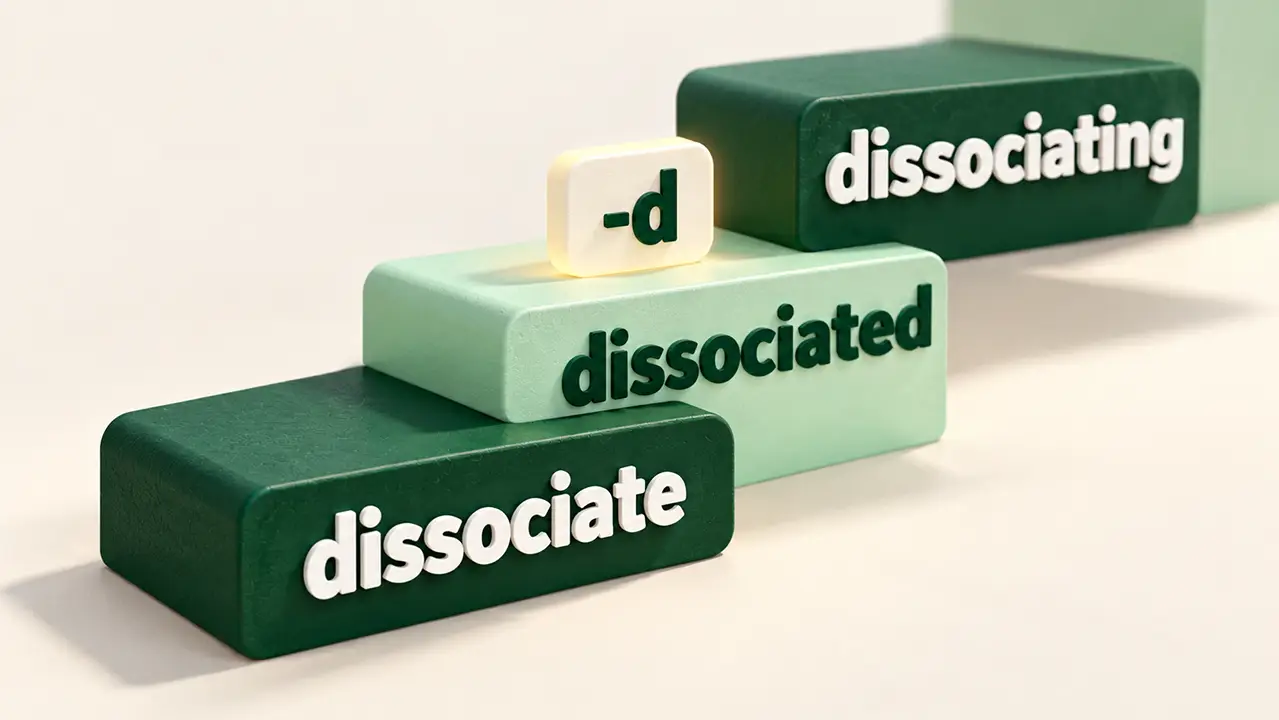
Both verbs are regular, so the past tense just adds “-d.” You get dissociated or disassociated, depending on which verb you started with, and you’d write “dissociating” or “disassociating” for the present participle. There’s no irregular form to memorize, which is a relief.
| Form | Dissociate | Disassociate |
| Base verb | dissociate | disassociate |
| Third person | dissociates | disassociates |
| Past tense | dissociated | disassociated |
| Past participle | dissociated | disassociated |
| Present participle | dissociating | disassociating |
| Noun | dissociation | disassociation |
| Adjective | dissociative | none in standard use |
Irregular verbs cause far more trouble, which is why pairs like ate or eaten need a second look: the simple past and the past participle are different forms there. Dissociate skips that headache because both forms are identical.
The adjective is worth a mention. Dissociative is the standard adjective, as in “dissociative disorder” or “dissociative episode.” Nobody writes “disassociative” in formal contexts, and that’s one more reason the dissociate family is the safer pick.
Example in chat:
Friend 1: Should I write “I dissociated” or “I was dissociating”?
Friend 2: Either works. “Dissociated” is the quick past tense, “was dissociating” describes the stretch of time.
Dissociating vs disassociating vs zoning out
People use these terms loosely in daily talk, and a little precision helps. Dissociating vs zoning out is the comparison that comes up most. Zoning out is a normal lapse of attention: you read a page, realize you absorbed nothing, and go back. Dissociating is stronger and can involve numbness, a sense that the world is unreal, or missing time.
In grammar terms, “dissociating” is the present participle of dissociate, and you can use it in the progressive tenses (“I was dissociating”) or as a modifier (“a dissociating patient”). “Disassociating” works the same way grammatically, but in formal writing about mental states, dissociating is the standard.
Describing these moments in writing often leads to a side question about a nearby word. Someone who stares blankly during an episode wonders whether to write stared or starred, and the answer is easy: you stared at something, and an actor starred in something.
For readers who want everyday examples of how dissociation shows up, Psychology Today’s overview is clear and approachable. If the topic feels personal, a doctor or licensed therapist is the right person to talk to, since a grammar article can’t diagnose anything.
Where do these words come from, and why does the extra “a” show up?
Both words rest on the idea of association, meaning a joining or connection. Dissociate comes from Latin roots meaning to separate companions or allies. Disassociate is built more directly in English by sticking the prefix “dis-” onto “associate.”
That construction explains the extra “a.” If you start with “associate” and add “dis-,” you get “disassociate.” The older Latin-based form drops that double sound, giving “dissociate.” Both routes make sense, which is exactly why both survive in the wild.
Spelling doubts like this one show up everywhere in English. A word can look right for one reason and wrong for another, like the “y” or “ie” ending debate in cutey or cutie. When you’re stuck, the best tiebreaker is the standard dictionary spelling, since it’s the one editors and readers expect.
Pronunciation adds one more wrinkle. People say dissociate with a “sh” sound in the middle (dis-SOH-shee-ate) or an “s” sound (dis-SOH-see-ate), and both are accepted. Disassociate gets an extra syllable (dis-uh-SOH-see-ate), which is why it sounds clunkier out loud.
What are the most common mistakes with disassociation and dissociation?

The most frequent slip is using disassociation in a clinical or scientific setting, where dissociation is the standard term. It’s usually understood, but it can make professional writing look less careful. If you’re writing about therapy, trauma, or chemistry, use dissociate and dissociation.
A second mistake is leaving out “from” when the sentence needs it. “She disassociated the company” leaves readers guessing. “She disassociated herself from the company” tells them exactly what happened.
A third is mixing up the noun and verb, writing something like “I need to dissociation myself.” The noun is dissociation, the verb is dissociate, and the adjective is dissociative.
Small spacing and form errors pop up in a lot of places, too. Writers who merge words by accident make the same kind of mistake as aswell or as well, where one missing space changes whether a sentence is correct.
Here’s a quick correction list:
| Incorrect | Correct |
| She was disassociative during the meeting. | She was dissociative during the meeting. |
| He dissociation from the group. | He dissociated from the group. |
| The salt disassociates in water. | The salt dissociates in water. |
| They disassociated the two ideas. | They dissociated the two ideas. |
How is dissociation used in psychology, chemistry, and everyday writing?
The word’s meaning shifts a bit by field, and grammar stays the same. In psychology, the American Psychiatric Association’s page on dissociative disorders lists three major types: dissociative identity disorder, depersonalization/derealization disorder, and dissociative amnesia. The Medical News Today article is a friendly read on how dissociation relates to trauma and stress.
When writers describe recovery from these experiences, they often talk about long personal paths and setbacks. If you’re wondering how to pluralize that image, the plural of journey is journeys, and it applies to any story about healing, travel, or growth.
In chemistry, dissociation describes a compound splitting into smaller particles, often ions, usually in water. The classic example is table salt separating into sodium and chloride ions. The Wikipedia article on dissociation in chemistry covers the details, including how dissociation constants work. Chemistry students sometimes confuse dissociation with dissolving. Dissolving means a substance mixes into a liquid, like sugar in water, while dissociation means a compound breaks into ions.
In everyday writing, you can use dissociate to mean separating ideas, as in “She tried to dissociate her personal opinions from her reporting.” That’s a neutral, formal use, and it’s a solid reason to keep dissociate in your vocabulary.
Quick rules to remember
If you only keep a few things from this guide, keep these. Use dissociation and dissociate in formal writing, science, and anything about mental health. Use disassociate only when you mean stepping away from a person or group, and consider swapping in “distance yourself” or “cut ties” when you can. Pair the verbs with “from.” Add “-d” for the past tense, and use “dissociative” as the adjective.
A reasonable rule of thumb: if a professional editor might read it, go with dissociation. If it’s a text to a friend, either will do.
FAQs about disassociation or dissociation
Is it disassociation or dissociation?
Dissociation is the standard spelling. Disassociation appears as a variant, and in formal writing, disassociation or dissociation is a choice that favors dissociation.
Is disassociation a real word?
Yes. Dictionaries list it as a variant, though style guides prefer dissociation for formal writing, so disassociation works better in casual contexts.
What is the difference between dissociate and disassociate?
They overlap heavily. Dissociate is the standard verb in psychology and science, while disassociate usually shows up in casual talk about pulling away from people.
Is it dissociated or disassociated?
Both are correct past tense forms of their respective verbs. Use dissociated for formal writing, and save disassociated for relaxed contexts where you mean distancing yourself.
What preposition goes with dissociate?
Use “from.” You dissociate or disassociate something or yourself from a person, group, or idea, and the “from” phrase names what you’re leaving behind.
Is dissociation a noun or a verb?
It’s a noun. The verb is dissociate, and the adjective is dissociative. Disassociation follows the same pattern, as a noun with the verb disassociate.
Can I use disassociating in a formal essay?
Better to avoid it. Dissociating is the standard participle, so formal essays about psychology, science, or social topics read more cleanly with the dissociate family.
Conclusion
When you’re deciding between disassociation or dissociation, go with dissociation in anything formal, scientific, or related to mental health. Keep disassociation for casual talk about leaving people or groups behind, and remember that dissociation vs disassociation is mostly a question of register, not a question of one being “wrong.”
Check the verb forms (dissociated, dissociating), use “from” after the verb, and reach for the adjective dissociative when you need one. Next time your fingers stall on the keyboard, you’ll know which spelling to type. Bookmark this page for the next time the debate comes up, and send it to anyone who’s still squinting at the screen.

Daniel Parker is an English language writer sharing clear grammar lessons, practical tips, and helpful examples for learners.









1 thought on “Disassociation or Dissociation: Meaning and Correct Usage”