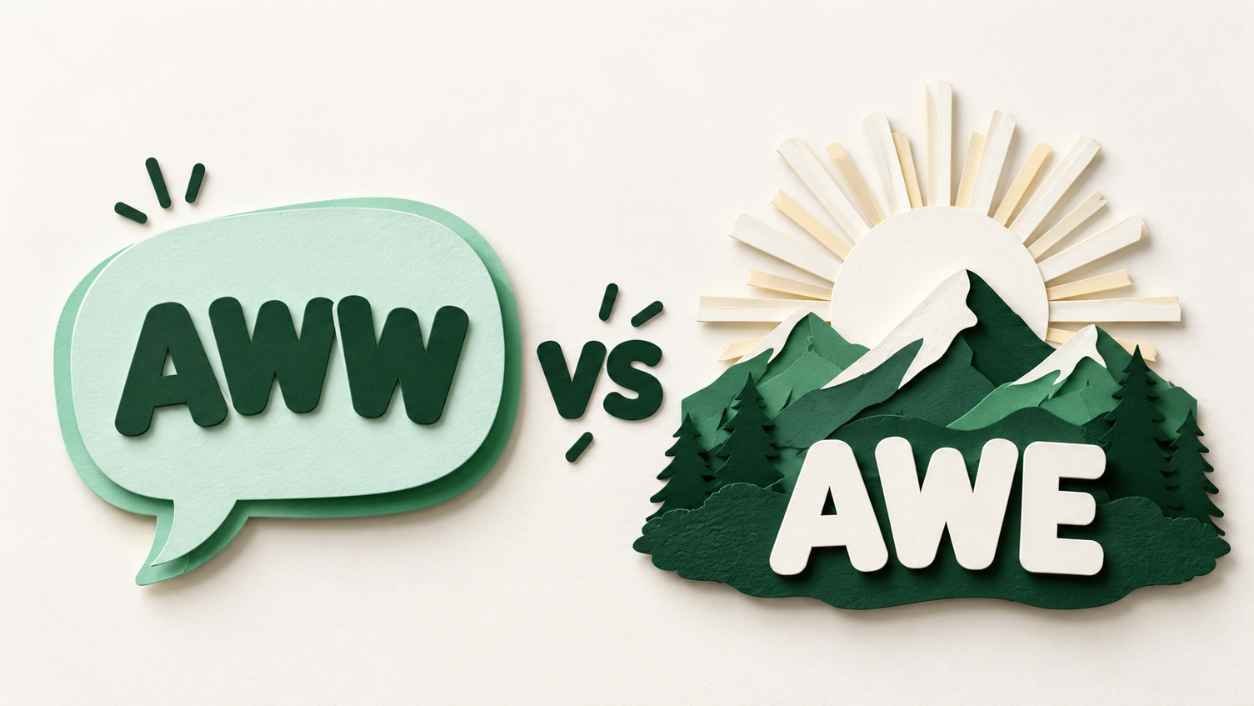

One wrong letter can make a warm text sound odd or a formal email look careless. You spot a puppy video and type “aww,” then freeze. Is it aww, aw, or awe? If you have searched aww we or aw vs awe, you are in good company, because these words sound identical.
This guide gives you clear definitions, real examples, and a simple memory trick. You will also see how awe vs aww and aw vs awe show up in texts, news, and essays. Keep reading and the confusion ends here.
Aww or Awe – Quick Answer

Short on time? Here is the fast version of aw vs awe for anyone who just typed awe or aww and wants a clean answer without reading a whole lesson.
Aww (or aw) is an interjection, a sound people make when something is cute, sad, or sweet. Awe is a noun and verb for wonder and respect. They sound the same, so spelling is the only way readers tell them apart. Use aww for quick reactions and awe for big, overwhelming feelings.
What Is the Quickest Way to Choose Between Aww and Awe?
- Say it as a reaction: if you would sigh it, write aww.
- Check for wonder: if the sentence describes amazement, write awe.
- Look at the grammar: awe follows words like “in” and “with.”
- Test the swap: replace the word with “wonder”; if it fits, use awe.
- Spot the comma: “Aww,” usually opens a sentence and sits before a comma.
Example in texting:
Friend 1: Look at my new puppy!
Friend 2: Aww, he’s tiny. I’m in awe of those ears.
The Origin of Aww or Awe

Curious where these words started? Aww and awe share a sound but not a history, which is why aw vs awe feels tricky and awe or aww gets searched often.
Awe traces back to Old English ege and Old Norse agi, words for fear and dread. Over centuries, the meaning shifted toward reverence and wonder. Aww is much younger. It is an onomatopoeia, spelled to match a sound people make when they feel tenderness or sympathy.
How Did Awe Shift From Fear to Wonder?
- Old English ege meant fear or terror.
- Old Norse agi carried the same sense of dread.
- Middle English blended these into awe, tied to respect for power.
- Awful once meant “full of awe,” not “terrible.”
- Aw and aww entered print as spoken sounds, mostly in dialogue.
Example in chat:
Friend 1: Why does “awful” have “awe” inside it?
Friend 2: It used to mean full of awe. The meaning flipped over time.
British English vs American English Spelling
Does your spelling change across the Atlantic? Good news for aw vs awe learners: it does not, and awe or aww works exactly the same in London and Los Angeles.
Unlike colour and color or centre and center, awe has one spelling in every English-speaking country. British, American, Canadian, and Australian writers all use awe for wonder. The informal aw and aww follow the same pattern, appearing in chats and comments worldwide.
| English type | Word for wonder | Reaction word | Example |
| British English | awe | aw or aww | She stared in awe. |
| American English | awe | aw or aww | He felt awe at the view. |
| Canadian English | awe | aw or aww | Aww, that is sweet. |
| Australian English | awe | aw or aww | They watched in awe. |
Is Awe Spelled Differently in the UK and the US?
- Awe is spelled the same in British and American English.
- Awed and awesome also stay identical across regions.
- Aww is informal in every region.
- Aw is the standard dictionary spelling of the interjection.
- Accents change the vowel slightly, never the spelling.
Example in chat:
Friend 1: Do Brits spell awe differently?
Friend 2: Nope. Same word, same spelling, same wonder.
Which Spelling Should You Use?
Still stuck? Here is a simple rule for awe vs aww: let the job of the word decide, then check it against the aw vs awe examples listed right below.
Choose by function, not by region. If the word reacts to something, it is aww or aw. If it names a feeling of wonder or works as a verb meaning to amaze, it is awe. Your audience decides how formal you need to sound.
Use aww when:
You want to show tenderness, sympathy, or mild disappointment in informal writing, such as a text to a friend or a comment under a cute video.
Use awe when:
You describe wonder or deep respect, or you need the verb meaning to amaze. This works in essays, reports, and speeches.
Audience-based advice:
Match your tone to your readers. Friends and followers accept aww. Teachers, editors, and clients expect awe in formal writing, and they usually expect no interjection at all.
How Do You Match the Word to Your Audience?
- Friends: aww feels warm and natural in texts.
- Teachers: skip interjections in essays and use awe for wonder.
- Clients: keep emails polished with awe, not aww.
- Social posts: aww and awww both read as friendly.
- Editors: expect aw if an interjection truly belongs in dialogue.
Example in chat:
Friend 1: Can I write “aww” in my essay?
Friend 2: Save it for texts. Write “in awe” if you mean wonder.
Common Mistakes with Aww or Awe
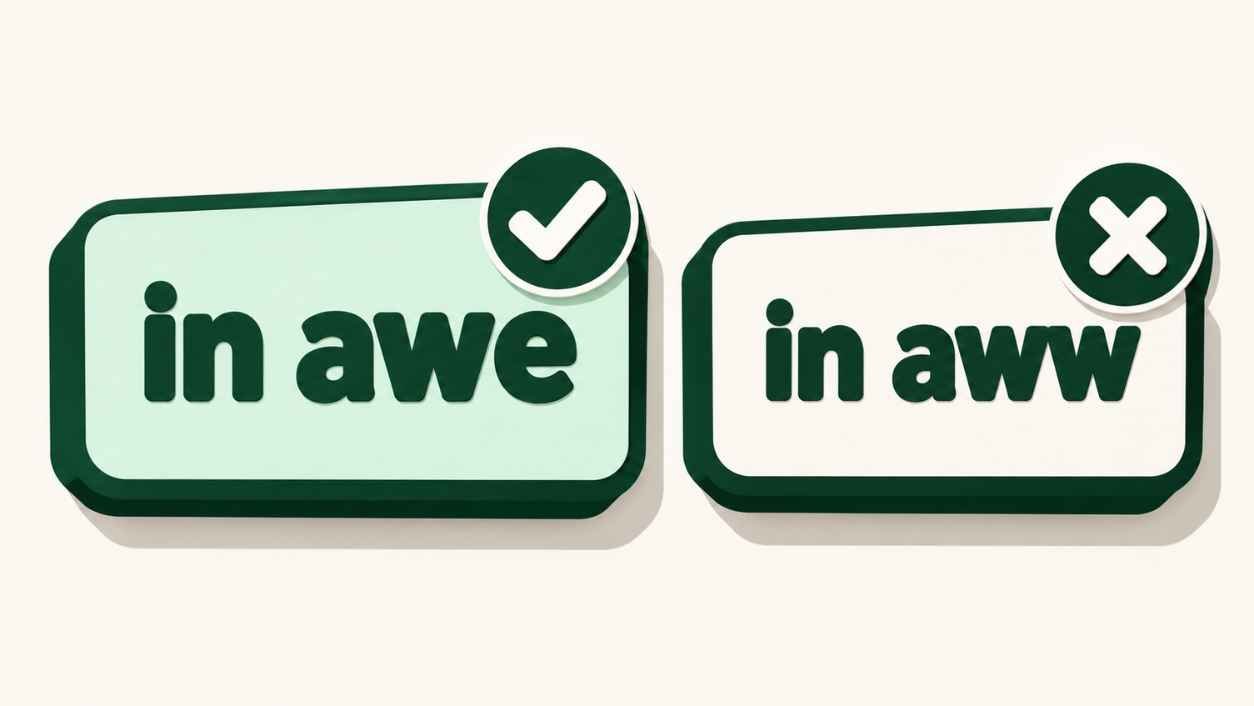
Everyone slips sometimes. These mistakes show up again and again in aw vs awe searches, and spotting them helps you stop mixing up awe or aww for good starting today.
These errors usually come from spelling by sound. Writers hear a word and guess its letters. The same thing happens with silent letters, which the knaw or gnaw spelling guide covers. Awe and aww are even closer, since they sound identical.
What Are the Most Common Aww and Awe Spelling Errors?
| Mistake | Correction | Why |
| I was in aww of the view | I was in awe of the view | Awe is the noun for wonder |
| Awe, that puppy is adorable | Aww, that puppy is adorable | Reactions use the sound spelling |
| The view was aw inspiring | The view was awe-inspiring | Awe-inspiring is a compound adjective |
| She awwed the crowd | She awed the crowd | The verb form is awed |
| Awsome idea | Awesome idea | Awesome is built from awe |
- Swapping nouns for sounds creates lines like “in aww of her.”
- Writing awe for cute reactions makes a warm text sound odd.
- Adding extra w’s to awe in formal writing looks like a typo.
- Forgetting the hyphen in awe-inspiring is common, so check your style guide.
- Misspelling awesome as “awsome” happens often in quick messages.
Example in texting:
Friend 1: I was in aww at the concert.
Friend 2: In awe. One w, plus the e. Wonder gets the e.
Aww or Awe in Everyday Examples

Seeing words in real sentences makes the choice click. These everyday examples show aw vs awe at work, and they answer awe or aww questions in emails, news, and chats.
Each setting has a default. Formal places such as email, news, and reports lean on awe. Casual places such as comments and chats lean on aww. Read the examples below, then try writing one of your own for each setting.
Emails
“I watched your presentation in awe, and the whole team learned something.”
News
“Thousands of visitors looked on in awe as the northern lights filled the sky.”
Social Media
“Aww, congrats on the new job! So happy for you.”
Formal Writing
“The cathedral’s scale fills first-time visitors with awe.”
Chat Messages
“Aww, thank you! You just made my day.” Chat has plenty of short reactions beyond aww, and the breakdown of igh meaning covers another one.
Which Word Fits Each Everyday Situation?
- Emails need awe for admiration and no interjection for polish.
- News copy uses awe in phrases like “in awe” and “awe-inspiring.”
- Comments welcome aww for cute or touching posts.
- Essays avoid aww entirely unless you are quoting dialogue.
- DMs accept aww, awww, and aw without raising eyebrows.
Example in chat:
Friend 1: Your sister’s wedding speech made me cry.
Friend 2: Aww, thank you. Everyone looked at her in awe.
Aw vs Aww: Which Spelling Do Dictionaries Prefer?
A twist most guides skip: dictionaries list aw for the sound, so aw vs awe is the sharper comparison, while awe or aww is how many readers actually type it.
Writing guides point to book data where aw far outnumbers aww in print. That makes aw the safer choice for edited writing such as fiction dialogue. Aww dominates comments, captions, and texts, where stretched spellings feel warm. Both have a place, as long as awe stays separate.
Should You Write Aw or Aww in Edited Writing?
| Spelling | Where it fits | Notes |
| aw | Fiction dialogue, edited prose | Dictionary standard |
| aww | Texts, captions, comments | Informal, stretched |
| awww | DMs, reactions | Extra emphasis, never formal |
| awe | Any writing about wonder | Noun and verb |
- Aw is the dictionary form for pity, sympathy, or mild annoyance.
- Aww adds emphasis and warmth in casual writing.
- Extra letters such as awww signal stronger feeling in chats.
- Fiction editors may prefer aw in dialogue.
- Awe keeps its own spelling in every setting.
Example in chat:
Friend 1: Is “aw” even a word? Looks weird.
Friend 2: Yep, it’s the dictionary spelling. Aww is the casual stretch.
Aww Meaning in Texting and Social Media

Open any comment section and you will find it. In texting, aww carries real feeling, and knowing aw vs awe and awe or aw keeps your replies warm and clear.
In chats, aww works as a tiny emotional reply. It can mean “this is cute,” “I feel for you,” or “that is sweet.” Tone depends on context and punctuation. A longer awwww usually adds affection, while a short aw can sound mildly sympathetic or even a little annoyed.
What Does Aww Mean When Someone Texts It?
| Message | Likely meaning | Tone |
| Aww, thanks! | Gratitude | Friendly |
| Awww, that’s so sweet | Strong tenderness | Affectionate |
| Aw, man… | Mild disappointment | Sympathetic |
| Aww, poor thing | Sympathy | Soft |
- Cute reaction: aww answers pets, babies, and sweet photos.
- Sympathy: aww follows bad news from a friend.
- Gratitude: aww often replies to a kind message.
- Teasing: a drawn-out awwww can sound playful or sarcastic.
- Emphasis: more w’s usually mean stronger feeling.
Example in texting:
Friend 1: I baked you a cake for your birthday!
Friend 2: Awww, you did not have to. Thank you!
What Does Awe Mean as a Noun and a Verb?
Awe does two jobs. As a noun it names wonder, and as a verb it means to amaze someone, which matters for aw vs awe and awe or aww choices.
As a noun, awe is a feeling of wonder, often mixed with respect. As a verb, awe means to fill someone with wonder. Aww never takes either role. It stays an interjection and does not take verb endings in standard writing, so a form like “awwed” is a mistake.
How Is Awe Used in Sentences?
| Part of speech | Example | Meaning |
| Noun | The crowd stood in awe. | Wonder |
| Verb | The show awed the audience. | Amazed |
| Adjective | an awe-inspiring view | Causing wonder |
| Adjective | an awestruck child | Overwhelmed by wonder |
- In awe of is the most common noun phrase.
- Awe-inspiring describes things that cause wonder and is usually hyphenated.
- Awestruck is one word and describes a person.
- Awed is the past form of the verb.
- Aww has no verb or noun forms in standard writing.
Example in chat:
Friend 1: How was the Grand Canyon?
Friend 2: Honestly, I stood there in awe for ten minutes.
Awe Words You Already Know: Awesome, Awful, and Awestruck
Awe hides inside more words than you think. Spotting it settles aw vs awe doubts quickly, and it helps whenever awe or aww crosses your mind while you type fast.
Awesome, awful, awestruck, and awe-inspiring all contain awe. Awesome began as a word for something that causes awe and now often means great. Awful once meant full of awe and now means very bad. The root keeps its spelling, which gives you a handy check for your own sentences.
Which Words Contain Awe and What Do They Mean?
- Awesome now often means great, though it began as awe-causing.
- Awful once meant inspiring awe and now means very bad.
- Awestruck describes someone overwhelmed by wonder.
- Awe-inspiring describes a sight or event that creates wonder.
- Spelling check: none of these words use a double w.
Example in chat:
Friend 1: That view was awesome!
Friend 2: Agreed. Awe-inspiring, even. Both words start with awe.
How Do You Pronounce Aw, Aww, and Awe?

Say them out loud and they match. That sameness is the exact reason aw vs awe trips people up, and why awe vs aww gets searched so often online today.
In most accents, aw, aww, and awe share the same vowel sound, close to the vowel in “saw.” The final e in awe adds no extra sound. In accents that merge certain vowels, as many American speakers do, the sound sits closer to “ah.” These words are homophones, so spelling is the only difference.
Do Aw, Aww, and Awe Sound the Same?
- Awe is pronounced like “aw,” with a silent e.
- Aww has the same sound, stretched longer for emphasis.
- Homophones share pronunciation but differ in spelling and meaning.
- Accents change the vowel slightly, never the spelling.
- Reading aloud will not help, so use meaning to choose.
Example in chat:
Friend 1: How do you say “awe”?
Friend 2: Like “aw.” Same sound, different job.
Why Do People Stretch Aww Into Awwww?
Typing extra letters feels natural. It copies a drawn-out sigh, so aww grows long while awe never does, and aw vs awe stays clear even in awe or aw debates.
Stretching letters adds feeling that plain text cannot carry. Awww sounds sweeter than aw, and awwwww sounds even more affectionate or playful. Awe never stretches, because it names a feeling. If you see “awwwe,” treat it as a typo.
When Does a Longer Aww Make Sense?
- Awww fits a sweet photo or a kind message.
- Awwww can sound playful when you tease a friend.
- Aw alone often signals sympathy or a mild letdown.
- Capital letters like AWWW add loud affection online.
- Formal writing keeps awe or leaves the sound out.
Example in texting:
Friend 1: Got the job!
Friend 2: AWWWW congrats! I’m so proud of you.
Aww or Awe – Usage Data
Numbers help here. Keyword tools show roughly 1.4K monthly searches for aww we plus smaller counts for awe vs aww, so the aw vs awe confusion is a real problem.
Search volume tells us what people struggle with. Most queries come from writers checking a spelling before they hit send. Variations such as awe or aww and awe or aw show readers searching in their own word order. Treat these figures as rough estimates, since tools differ.
Why people search this keyword:
The words are homophones. They sound identical, differ by one letter, and appear in very different places. Writers want to avoid a typo in an email, caption, or essay.
Popular regions:
Searches probably come from English-speaking countries such as the United States and the United Kingdom, plus places where many people learn English as a second language, such as India and Pakistan. I do not have verified country-level figures.
Usage contexts:
Social media, messaging apps, academic writing, and blogging. Aww thrives in the first two. Awe belongs to the last two.
What Do the Search Numbers Tell Us?
| Keyword | Approx. monthly searches | Likely reader need |
| aww we | 1.4K | Quick answer to aww or awe |
| awe vs aww | 150 | Direct comparison |
| awe or aww | 80 | Choosing the right word |
| awe or aw | 40 | Dictionary spelling check |
- Aww we is the biggest variation, likely a typed shortcut for aww or awe.
- Awe vs aww shows steady demand for side-by-side comparisons.
- Awe or aww draws readers who need a fast choice.
- Awe or aw attracts careful spellers checking the dictionary form.
- Tool estimates vary, so treat every figure as approximate.
Example in chat:
Friend 1: Why does everyone Google this?
Friend 2: Same sound, one letter apart. Easy to mix up.
Quick Memory Tricks for Aww and Awe
Memory tricks beat rules when you are typing in a hurry. These simple hooks make aw vs awe stick, and they settle awe or aww in about two seconds flat.
Memory hooks work best for look-alike pairs, and the guide on accessible or assessable uses the same idea for another confusing pair. For awe and aww, tie the choice to one letter and one job. The letter is E, and the job is wonder.
What Is the Easiest Way to Remember Awe vs Aww?
- Awe and amazement both contain an E, so wonder gets the E.
- Aww is a sound: if you would sigh it, use the double w.
- Verb test: if it can become “awed,” the word is awe.
- Wonder test: swap in “wonder,” and a fit means awe.
- Reaction test: if it can stand alone before a comma, use aww.
Example in texting:
Friend 1: Which one is it, awe or aww?
Friend 2: Wonder gets the E. Sighs get the double w.
Comparison Table (Keyword Variations)
Tables make differences easy to see. This one lines up aw vs awe, awe vs aww, and related forms so you can scan the answer in just a few seconds.
Each row covers one form, its type, and the best place to use it. Bookmark this section if you write often, because the table answers most questions about awe or aww at a glance. Hyphens and verb endings are included too.
| Form | Type | Meaning | Best use |
| Awe | Noun, verb | Wonder, respect; to amaze | Any writing |
| Awed | Verb form | Filled with awe | Formal and casual |
| Awestruck | Adjective | Overwhelmed by wonder | Descriptive writing |
| Awe-inspiring | Adjective | Causing wonder | Descriptive writing |
| Aw | Interjection | Pity, sympathy, mild annoyance | Dialogue, informal |
| Aww | Interjection | Warm reaction | Texts, comments |
| Awww | Interjection | Stronger tenderness | DMs, social posts |
Which Form Fits Your Sentence Best?
- Awe fits any sentence about wonder or respect.
- Awed fits past events where someone felt amazed.
- Aw suits dialogue in stories and edited prose.
- Aww suits friendly texts, comments, and captions.
- Awww adds extra warmth in casual chats only.
Example in chat:
Friend 1: Our guide was awed by the old temple.
Friend 2: Same here. Then a kitten wandered in. Aww!
FAQs
1. What is the difference between aww and awe?
In aw vs awe, aww is a reaction sound for cute or sad moments. Awe is a noun and verb for wonder or respect.
2. Is “aww” a real word?
Yes, aww is a real but informal word. In aw vs awe debates, dictionaries prefer the shorter aw spelling.
3. Is “awe” formal?
Awe suits formal and academic writing very well. In aw vs awe, awe is the safe pick for essays and reports.
4. Can I use “aww” in essays?
Avoid aww in essays because it is an informal reaction. For aw vs awe in formal pieces, use awe for wonder.
5. Why do people confuse these words?
They sound identical and differ by only one letter. That is the core of the aw vs awe problem when people type by ear.
6. Is there a spelling difference in US and UK?
No, both regions spell awe the same way. The aw vs awe rules stay identical in American and British English.
7. How can I remember the difference?
Link wonder to the letter E. For aw vs awe, remember that awe and amazement both contain E, while aww is a sound.
Conclusion
Once you see the pattern, aw vs awe is simple. Aww and aw are sounds people make when something feels cute, sad, or sweet. Awe is a noun and a verb for wonder and respect.
Next time you write, pause and ask what the word is doing. If it reacts, use aww or aw. If it describes wonder, use awe. That one habit settles awe vs aww in almost every sentence, from a quick DM to a formal report.
Anyone typing aww we into a search bar is asking this exact question, and the aw vs awe answer never changes between the US and UK. Before you hit send, read your sentence once and pick the word that matches the feeling.

Daniel Parker is an English language writer sharing clear grammar lessons, practical tips, and helpful examples for learners.










1 thought on “Aww or Awe: What’s the Difference ? (guide 2026)”