You typed a word that looked right, then your spell checker frowned. I’ve been there with silent letters, and it stings a little. Many readers search knaw meaning hoping for a quick, honest answer.
This guide settles it with history, pronunciation, and real examples for gnaw or knaw. Spelling slips cost credibility in emails, essays, and posts, so the answer matters. By the end, the knaw meaning question will be closed. Keep reading, because one surprise is waiting.
Knaw or Gnaw – Quick Answer
Short on time? Here is the fast version of the knaw meaning mystery. The gnaw or knaw debate has one winner for modern writing, and you can copy it now.
Which Spelling Is Correct in Modern English?
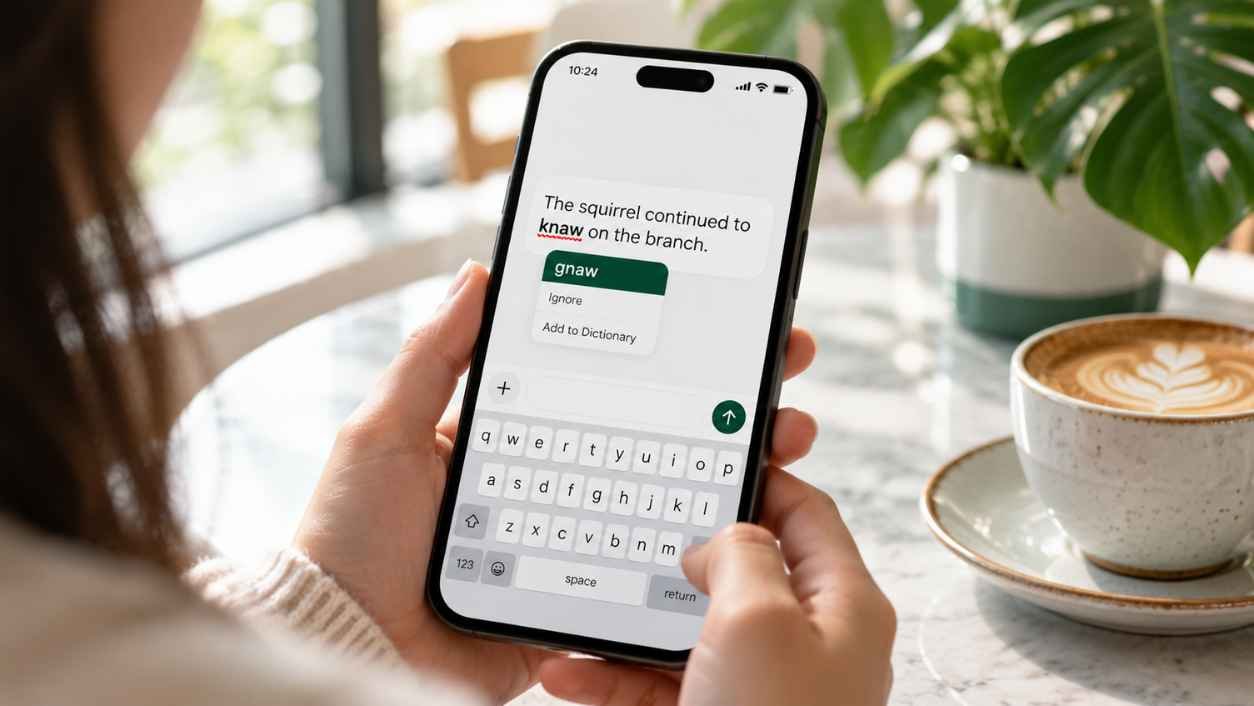
- Gnaw is the correct spelling in modern English dictionaries and everyday writing.
- Knaw is an archaic spelling that modern readers treat as a mistake.
- Silent g makes gnaw sound like “naw,” which tricks the eye.
- Gnawed and gnawing keep the same gn opening in every form.
- Pronunciation stays identical, so only your spelling can show the difference.
- Safe rule: write gnaw in every email, essay, and social post.
- Memory trick: link gnaw with gnat and gnash, which share the silent g.
Example in texting:
Friend 1: Do I write “knaw” or “gnaw” in my caption?
Friend 2: Gnaw. Remember the dog that gnawed your slipper?
Knaw Meaning (Is It a Real Word?)

Everyone wants the plain truth about knaw meaning, so here it is. Dictionaries and archives show whether gnaw or knaw ever had real standing, and the answer surprises many readers.
Does Knaw Have Any Meaning in English?
- Modern writing: knaw reads as a typo for gnaw in current English.
- Archaic spelling: Wordnik treats knaw as an outdated variant of gnaw.
- Eye dialect: some authors print know as knaw to imitate regional speech.
- Same verb: older texts treat knaw and gnaw as one verb with two spellings.
- Spell checkers: most tools underline knaw, which signals a change to gnaw.
- Search intent: people typing knaw meaning want the gnaw definition: bite or chew repeatedly.
- Practical verdict: use gnaw for exams, work emails, and published content.
Example in chat:
Friend 1: Is “knaw” a real word?
Friend 2: Only in old or dialect writing. Write gnaw.
Gnaw Meaning in Simple Words
Now that knaw meaning points back to gnaw, let’s define the real word clearly. Learners who search gnaw or knaw usually need this plain definition before they study anything else.
What Does Gnaw Mean in Simple Terms?
- Literal meaning: to bite or chew something hard again and again.
- Figurative meaning: to trouble someone slowly, like worry or guilt.
- Physical wear: gnaw also means wearing something away through steady biting or scraping.
- Verb type: gnaw works as both a transitive and an intransitive verb.
- Common pairing: gnaw on a bone, gnaw at your focus.
- Typical subjects: dogs, rats, beavers, termites, and worries.
- Intensity: gnawing means slow, repeated pressure over time.
- Everyday level: the word works in casual chat and formal reports alike.
Example in texting:
Friend 1: Why is Biscuit chewing the chair leg again?
Friend 2: Puppies gnaw when their teeth hurt. Buy a chew toy.
The Origin of Knaw or Gnaw
Every odd spelling has a backstory. The knaw meaning puzzle makes more sense once you see where the word began and how gnaw or knaw spellings drifted apart over time.
Where Does the Word Gnaw Come From?
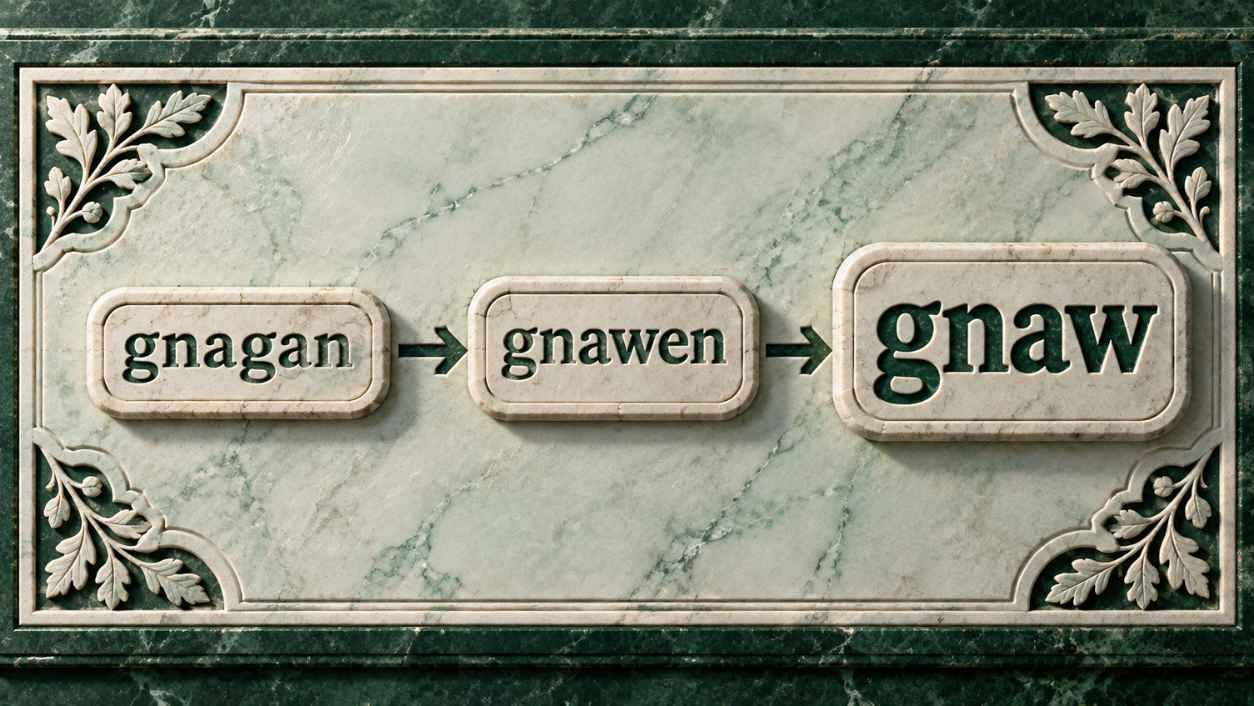
- Old English: gnaw descends from gnagan, meaning to bite or chew.
- Middle English: the form gnawen sits between Old English and today’s spelling.
- Proto-Germanic: linguists trace the verb to an older Germanic root.
- Dutch cousin: Dutch spells the related verb knagen with a k.
- Scots variant: a Scottish historical dictionary records knaw in the 15th century.
- Silent g: speakers stopped pronouncing the g, but the spelling stayed.
- Sound imitation: the word may echo the noise of gnawing.
- Figurative use: worry gnawing at a person dates to the early 1200s.
Example in chat:
Friend 1: Why does gnaw start with a g if nobody says it?
Friend 2: Old English said it. We kept the spelling after the sound faded.
British English vs American English Spelling
Many spelling debates split along the Atlantic, so people wonder about knaw meaning in each variety. Good news about gnaw or knaw: British and American writers all spell it identically.
Is Gnaw Spelled Differently in the UK and US?
- UK spelling: British English uses gnaw, with no variant form.
- US spelling: American English uses gnaw in exactly the same way.
- Other varieties: Canadian, Australian, and Indian English also use gnaw.
- Pronunciation: in non-rhotic accents, gnaw sounds the same as nor.
- Meaning: the definition stays identical across all English varieties.
- Spelling reforms: changes that gave American English color and center never touched gnaw.
Comparison Table
| English variety | Correct spelling | Example |
| British English | gnaw | Mice gnaw through the cable. |
| American English | gnaw | Guilt can gnaw at you. |
| Canadian English | gnaw | Beavers gnaw young trees. |
| Australian English | gnaw | Termites gnaw the fence posts. |
Example in texting:
Friend 1: Our UK editor wants “gnaw.” Does the US team spell it differently?
Friend 2: Nope. Same word, same spelling, no changes.
Which Spelling Should You Use?
Choosing takes a few seconds. Whenever knaw meaning doubts appear, one answer fits every audience, and the gnaw or knaw choice never depends on region, formality, tone, genre, or topic.
When Is It Okay to Write Knaw?
- Academic work: use gnaw in essays, reports, and exam answers.
- Business writing: use gnaw in emails, proposals, and presentations.
- SEO and web copy: use gnaw so readers and search engines recognize the word.
- Fiction and dialogue: knaw can mimic dialect speech, but use it with clear intent.
- Quoting old texts: keep knaw exactly as printed in a historical source.
- Global audience: gnaw works for US, UK, Commonwealth, and international readers.
- Teaching: show learners gnaw first, then explain why the g stays silent.
Example in chat:
Friend 1: I’m quoting a 1500s poem that prints “knaw.” Should I fix it?
Friend 2: Keep it exactly as printed and add a short note.
Common Mistakes with Knaw or Gnaw
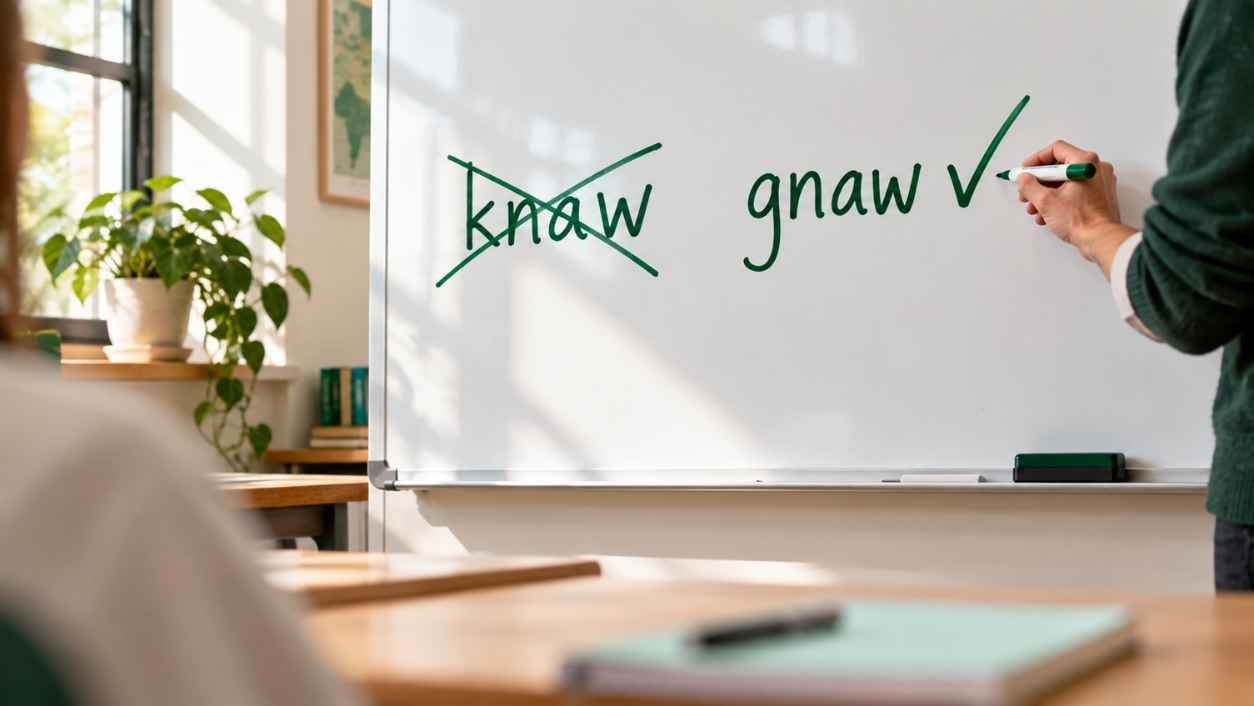
Slips happen to confident writers too. These errors around knaw meaning repeat across essays and posts, and each gnaw or knaw mistake has a quick fix you can learn today.
What Are the Most Common Gnaw Spelling Errors?
- Spelling by sound: writers hear “naw” and guess a k or n at the start.
- Copying kn words: know, knee, and knife push writers toward a k start.
- Wrong forms: knawed and knawing repeat the same root error.
- Fast typing: weak proofreading lets knaw slip into finished drafts.
- Assumed variants: UK and US English both use gnaw, so no regional excuse exists.
- Nag confusion: nag means to pester, while gnaw means to bite or trouble.
- Sound guessing also creates errors like the assessible spelling mix-up.
| Mistake | Correct form | Why it happens |
| knaw | gnaw | Silent g sound |
| knawed | gnawed | Past tense copies the error |
| knawing | gnawing | The -ing form copies the error |
| knaw on a bone | gnaw on a bone | Whole phrase inherits the slip |
Example in texting:
Friend 1: Worry started to knaw at me all night.
Friend 2: Small fix: gnaw at me. Silent g, big difference.
Knaw or Gnaw in Everyday Examples
Seeing the word in sentences locks the spelling in faster than rules do. These knaw meaning examples show gnaw or knaw choices across emails, news, social media, and formal writing.
How Do You Use Gnaw in Daily Writing?
- Short sentences: keep the subject and the gnaw action close together.
- Prepositions: pair gnaw with at for worries and on for objects.
- Tense check: use gnawed for past events and gnawing for ongoing ones.
- Read aloud: if a sentence sounds right with “naw,” recheck the first letters.
- Context test: if something bites, wears, or troubles, gnaw fits.
Emails
- Doubt about the deadline began to gnaw at the team all week.
- Please keep supplies sealed so mice cannot gnaw through the packaging.
News
- Beavers gnaw through trees along the riverbank each winter.
- Questions about the budget continue to gnaw at local voters.
Social Media
- That unfinished project keeps gnawing at me.
- My dog gnawed the remote, and now the TV is stuck on mute.
Formal Writing
- Anxiety may gnaw at long-term confidence if left unaddressed.
- Termites gnaw wood structures slowly and weaken them over months.
Example in chat:
Friend 1: Spell check wants “gnaw” in my report. Is that right?
Friend 2: Yes. Termites gnaw wood, and the word never starts with k.
Gnaw Past Tense and Other Word Forms
Verb forms bring fresh spelling worries for many learners. Anyone checking knaw meaning soon asks about endings, so this section covers gnaw or knaw forms like gnawed, gnawing, and gnawn.
What Is the Past Tense of Gnaw?
- Simple past: gnawed is the standard past tense.
- Past participle: gnawed works with have, has, and had.
- Archaic participle: gnawn survives in older texts but sounds dated.
- Present participle: gnawing is the -ing form for ongoing actions.
- Third person: gnaws goes with he, she, and it.
- Adjective use: gnawing can describe a noun; see the difference between adjectives and adverbs.
- Misspelled forms: knawed, knawing, and knawn are all errors.
| Form | Correct spelling | Example |
| Base form | gnaw | Mice gnaw cables. |
| Third person | gnaws | She gnaws a pencil when nervous. |
| Past tense | gnawed | The puppy gnawed a slipper. |
| Past participle | gnawed | Doubt has gnawed at him. |
| Present participle | gnawing | A gnawing worry kept her awake. |
Example in texting:
Friend 1: Is it “has gnawn” or “has gnawed”?
Friend 2: Gnawed. Gnawn is old. Gnawed sounds natural today.
Knaw or Gnaw – Google Trends & Usage Data
Search habits reveal what readers truly struggle with. Data around knaw meaning and gnaw or knaw shows people want fast spelling confirmation and clear examples they can use right away.
Why Do People Search Knaw or Gnaw?
- Keyword data: tools list roughly 1,200 monthly searches for knaw meaning and 300 for knaw or gnaw.
- Spoken first: most people hear gnaw aloud before they ever read it.
- Silent letters: the silent g leaves the first sound unclear.
- Learner demand: students and ESL learners search for quick spelling checks.
- Source agreement: reference books and publishers print gnaw as the standard form.
- Informal use: knaw mostly appears in casual posts, comments, and spelling questions.
| Search phrase | Likely reader need | Best answer |
| knaw meaning | Is knaw a word? | Archaic spelling; use gnaw |
| knaw or gnaw | Which spelling is right? | Gnaw |
| gnaw or knaw | Same check, reversed order | Gnaw |
| gnawed or knawed | Past tense spelling | Gnawed |
Example in chat:
Friend 1: Why does everyone search “knaw or gnaw” online?
Friend 2: They hear the word first. The silent g hides in speech.
Gnaw Synonyms and Related Words
Strong writers keep alternatives ready. Readers checking knaw meaning often want synonyms too, so these words come close to gnaw while the gnaw or knaw spelling stays fixed at gnaw.
What Are Good Synonyms for Gnaw?
- Chew: the closest everyday word for repeated biting.
- Nibble: small, light bites, usually gentler than gnawing.
- Bite: a single action, while gnaw repeats the action over time.
- Munch: noisy chewing, usually of food.
- Erode: wear something away slowly over time.
- Corrode: eat away at material, matching gnaw’s wearing sense.
- Nag: pester constantly, close to gnaw’s worry sense.
- Plague: trouble someone persistently, as guilt can.
| Synonym | Best for | Example |
| chew | food, gum, toys | The dog chews a toy. |
| nibble | light bites | Mice nibble crumbs. |
| erode | slow damage | Waves erode the cliff. |
| plague | ongoing trouble | Doubts plague him. |
Example in texting:
Friend 1: Is “nibble” the same as “gnaw”?
Friend 2: Close, but gnaw is harder and slower. Use nibble for crumbs.
Silent Letter Words That Confuse Spellers
Silent letters cause many spelling slips. The knaw meaning confusion belongs to a family of tricky spelling words, and the gnaw or knaw pair is only one example among many.
Which Words Start With a Silent G or K?
- Gnat: a biting insect whose name may be related to gnaw.
- Gnash: to grind teeth together, with a silent g.
- Gnome: a mythical garden creature, with a silent g.
- Gnarled: twisted and rough, often describing trees or hands.
- Know: to understand, with a silent k at the start.
- Knee: the joint in your leg, with a silent k.
- Knife: a cutting tool, with a silent k.
- Knit: to make fabric from yarn, with a silent k.
| Silent letter | Example words | Spelling tip |
| gn- | gnaw, gnat, gnash, gnome | The g stays in print |
| kn- | know, knee, knife, knit | The k stays in print |
| wr- | write, wrong, wrist | The w stays in print |
| -mb | thumb, climb, lamb | The final b stays quiet |
Example in chat:
Friend 1: Why do gnat and knee both look weird?
Friend 2: Silent letters. The g and k stayed in spelling after the sounds faded.
What Does Gnawing at Someone Mean?

Few phrases sound more human than worry gnawing at the mind. This is the emotional side of knaw meaning, and gnaw or knaw spelling still matters when you write it.
How Do You Use Gnawing at Me in a Sentence?
- Core meaning: a feeling that keeps causing anxiety or worry.
- Common pattern: gnaw at plus a person: gnaw at me, gnaw at him.
- Typical subjects: guilt, doubt, hunger, fear, regret, and unanswered questions.
- Hunger use: hunger can gnaw at the stomach before dinner.
- Time sense: the feeling lasts, so writers choose gnawing for long worries.
- Past form: the guilt gnawed at her for weeks.
- Spelling check: write gnawing at me, never knawing at me.
- Tone: it sounds serious, so it suits essays, stories, and honest emails.
Example in texting:
Friend 1: That unanswered text is gnawing at me.
Friend 2: Just ask her. Waiting only makes the worry gnaw harder.
How Do You Pronounce Gnaw?
Hearing the word out loud helps the spelling stick. The knaw meaning search often starts with sound, so here is how gnaw or knaw reads aloud in common English accents.
Why Does Gnaw Sound Like Naw or Nor?
- US sound: American speakers say it like “naw.”
- UK sound: British speakers use a longer vowel, close to “nor.”
- Non-rhotic accents: gnaw and nor can sound identical there.
- Silent g: the g adds no sound at the start.
- Syllables: gnaw has one syllable, so say it in one smooth beat.
- Rhymes: saw, law, draw, and claw all rhyme with gnaw.
- Common slip: avoid saying “guh-naw,” since the g stays silent.
- Past tense sound: gnawed sounds like “nawd” and rhymes with clawed.
Example in chat:
Friend 1: I always say “guh-naw.” Is that wrong?
Friend 2: Yes. Skip the g. Say “naw,” like saw with an n.
Why Do People Spell Gnaw as Knaw?
Mistakes have reasons. The knaw meaning query exists because sound, habit, and history all push many writers toward k, and gnaw or knaw guessing feels natural even when it fails.
What Causes the Knaw Spelling Mistake?
- Sound guessing: people write what they hear, and the first sound is n.
- The kn pattern: know, knee, and knife teach writers that silent starts use k.
- Old variants: historical Scots texts used knaw, so the form has a real past.
- Dialect writing: phonetic dialect spelling can produce knaw on purpose.
- Rare letters: gn starts few common words, so it feels unfamiliar.
- Typing speed: fast typing and light proofreading let the error pass.
- Spoken exposure: the word appears more in speech than in print.
Example in texting:
Friend 1: Why did I type “knaw”? I know it’s gnaw.
Friend 2: Kn words trick everyone. Know, knee, knife, and now knaw.
Comparison Table: Knaw vs Gnaw
Side by side, the answer is easy to see. This knaw meaning comparison puts the gnaw or knaw facts in one place so you can scan, save, and share them.
Which Is Correct: Knaw or Gnaw?
- Correct today: gnaw, in every major English variety.
- Knaw status: archaic or dialect spelling, treated as an error in modern writing.
- Meaning: both point to biting or chewing repeatedly.
- Pronunciation: both sound like “naw” when spoken.
- Writing advice: choose gnaw for school, work, and publishing.
- Forms: gnaws, gnawed, and gnawing.
| Feature | Gnaw | Knaw |
| Modern standard spelling | Yes | No |
| Dictionary status | Standard entry | Archaic or dialect spelling |
| Meaning | Bite or chew repeatedly; trouble | Historical form of gnaw |
| Past tense | gnawed | knawed (misspelling) |
| Pronunciation | naw or nor | Same sound |
| Safe for exams and work | Yes | No |
Example in chat:
Friend 1: Final check: gnaw or knaw for my report?
Friend 2: Gnaw. Save knaw for quoting old Scottish texts.
FAQs About Knaw or Gnaw
Is knaw a real word?
The knaw meaning is gnaw, but only as an archaic spelling. Use gnaw today.
What does knaw mean?
The knaw meaning is to bite or chew repeatedly. Modern writers spell it gnaw.
Why is the g silent in gnaw?
Speakers dropped the g sound over time. Spelling behind knaw meaning searches kept it.
Is it knaw or gnaw in British English?
British English uses gnaw. The knaw meaning question has the same answer there.
What is the past tense of gnaw?
The past tense is gnawed. Knawed repeats the error behind knaw meaning searches.
Can gnaw be used for feelings?
Yes, guilt can gnaw at you. That figurative sense belongs to knaw meaning too.
How do you remember the spelling of gnaw?
Link gnaw with gnat and gnash. Knaw meaning doubts fade once you spot the pattern.
Conclusion
The knaw meaning question has a clear answer. Gnaw is the spelling to use today, while knaw survives only as an archaic or dialect form, so modern readers treat it as a typo. If you came here for knaw meaning, remember the definition: to bite or chew again and again, or to trouble someone slowly.
The silent g causes most of the confusion. Link gnaw with gnat and gnash, keep gnawed and gnawing in mind, and the gnaw or knaw habit will fade after a few uses. Misspellings feel small, yet readers notice them. One correct word protects your credibility in every email, essay, and post.
Before you close this tab, write one sentence with gnaw. Say it aloud, spell it once, and the knaw meaning search will not need repeating.

Daniel Parker is an English language writer sharing clear grammar lessons, practical tips, and helpful examples for learners.










2 thoughts on “Knaw Meaning and Gnaw Meaning: The Surprising Truth”