
You typed the word, stared at it for a second too long, then wondered if you’d just made a mistake in front of your boss, your teacher, or a client reading your email. That tiny pause over optimise or optimize happens to almost everyone who writes online.
Here’s the good news: by the end of this guide, you’ll know exactly which spelling fits your reader, why both forms exist, and how to stay consistent without a single awkward guess again. You’ll also get real examples, a secondary keyword breakdown for optimise or optimize uk writers, and a comparison table you can bookmark. Keep reading, because the confusion ends here.

Optimize or Optimise – Quick Answer
Short on time? Here’s the fast version. Optimize is the American spelling and optimise is the British spelling, and understanding optimise vs optimize takes about thirty seconds once you see it laid out.
- Optimize is used in the United States and most American style guides.
- Optimise is the standard form in the UK, Australia, and much of the Commonwealth.
- Both words carry the identical meaning: to make something as effective as possible.
- The choice depends entirely on your audience, not on correctness.
- Style guides rarely penalize either spelling when used consistently.
Examples:
- We need to optimize our checkout page for mobile users. (US)
- We need to optimise our checkout page for mobile users. (UK)
- The team plans to optimize ad spend before the holidays. (US)
- The team plans to optimise ad spend before the holidays. (UK)
Example in texting: Friend 1: is it optimize or optimise for a UK client Friend 2: optimise, they’re British, go with the -ise version
What Does “Optimize or Optimise” Really Mean?
Both spellings point to one simple idea: making something work better, faster, or more efficiently than before, no matter which side of the Atlantic you’re writing for.
- The core meaning is to improve something until it performs at its best.
- Neither spelling changes the definition, the pronunciation, or the grammar.
- Marketers use it to describe improving campaigns, pages, or budgets.
- Developers use it to describe improving code speed or performance.
- Everyday speakers use it loosely to mean improving routines or habits.
How Is Optimize or Optimise Used in Everyday Conversations?
People drop this word into work chats, fitness talk, and marketing meetings constantly, almost never pausing to think about which regional spelling they’re actually typing.
- Marketers talk about optimizing landing pages for conversions.
- Developers discuss optimizing scripts to load faster.
- Fitness fans mention optimizing their sleep or diet routines.
- Students optimize their study schedules before exams.
- Business owners optimize spending to protect their margins.
Example in chat: Friend 1: trying to optimise my morning routine this week Friend 2: same, cutting out the phone scrolling first thing
The Origin of Optimize or Optimise

The story behind optimize or optimise starts far from any keyboard, in a Latin word that quietly shaped modern business language centuries later.
- Both words trace back to the Latin term optimus, meaning “best.”
- The word passed through French before settling into English usage.
- American English later adopted the -ize ending pattern broadly.
- British English kept closer ties to the -ise ending pattern.
- Regional spelling systems diverged as dictionaries formalized separately.
In American English, plenty of everyday words follow the same -ize pattern:
- organize
- realize
- optimize
In British English, the matching words typically use the -ise ending instead:
- organise
- realise
- optimise
Confusion like this isn’t unique to this word pair either. Similar mix-ups pop up across English spelling more broadly, the same way people second-guess an entirely different kind of word confusion in the specs vs specks spelling breakdown, where sound alone tricks writers into picking the wrong form.
Example in texting: Friend 1: why does British English even use -ise Friend 2: it followed French spelling patterns more closely, apparently
British English vs American English Spelling

This single word pair reflects a much bigger pattern that touches hundreds of other English words, not just optimize or optimise on its own.
- American spelling generally favors the shorter, phonetic -ize form.
- British spelling generally favors the older, French-influenced -ise form.
- Canada often mixes both systems depending on the publisher.
- Australia and New Zealand mostly follow British conventions.
- Oxford dictionaries technically accept -ize as a valid British option too.
| Feature | American English | British English |
| Ending | -ize | -ise |
| Example 1 | optimize | optimise |
| Example 2 | organize | organise |
| Example 3 | realize | realise |
| Meaning | Same | Same |
Worth noting: some British style guides, including Oxford’s own house style, actually allow -ize as a legitimate British spelling. That’s part of why the optimise or optimize uk question keeps popping up in search results.
Example in chat: Friend 1: does the UK really allow optimize too Friend 2: yeah, Oxford spelling technically permits it, weirdly enough
Optimise or Optimize UK: What British Writers Should Know
British writers face an extra layer of confusion here, since two competing British standards exist side by side, and picking wrong can still look inconsistent to readers.
- Most UK newspapers and brands default to optimise, not optimize.
- Oxford University Press style permits -ize spellings in formal writing.
- Cambridge dictionaries lean toward -ise as the primary British form.
- Government and legal UK documents usually prefer optimise for consistency.
- Choosing one form and sticking with it matters more than which one.
| UK Style Source | Preferred Form |
| Oxford style guide | Either, -ize favored |
| Cambridge dictionary | Optimise |
| BBC and most UK media | Optimise |
| UK government writing | Optimise |
Example in texting: Friend 1: our UK client wants everything in British spelling Friend 2: use optimise then, safest choice for a general UK audience
Which Spelling Should You Use?
Choosing between optimize or optimise really comes down to one question: who is actually going to read what you’re writing right now?
- Match the spelling to your reader’s country whenever possible.
- Check your CMS or spellcheck language settings before publishing.
- Business clients often specify their preferred regional spelling upfront.
- Academic papers usually follow the university’s required style guide.
- When unsure, default to the larger audience segment you’re targeting.
Use Optimize if:
- Your audience is based in the United States.
- You write content for American businesses or platforms.
- Your website analytics show mostly US traffic.
- Your spellcheck and CMS are set to US English.
- Your brand style guide already specifies the -ize ending.
Use Optimise if:
- Your audience is based in the United Kingdom.
- You write for readers in Australia, Canada, or New Zealand.
- You’re following a British or Commonwealth style guide.
- Your client explicitly requests British English spelling.
- Your publication’s editorial policy defaults to -ise endings.
For Global Websites
If your traffic comes from everywhere, simplicity wins over trying to please every region individually.
- Pick one spelling and apply it site-wide.
- Stay consistent across every page and blog post.
- Avoid switching spellings mid-article or mid-sentence.
- Document your choice in a written style guide for writers.
- Trust that consistency builds more credibility than “correctness.”
Example in chat: Friend 1: should our global blog use optimize or optimise Friend 2: pick optimize since most of our traffic is US-based
Optimised or Optimized: Past Tense Spelling Rules

The same regional pattern carries straight into past tense and other word forms, which trips people up just as often as the base word does.
- Optimized is the American past tense and past participle form.
- Optimised is the British past tense and past participle form.
- The same rule applies to optimizing versus optimising as well.
- Related nouns follow suit too: optimization versus optimisation.
- Mixing tenses within one article looks inconsistent to careful readers.
| Word Form | American | British |
| Base verb | optimize | optimise |
| Past tense | optimized | optimised |
| Present participle | optimizing | optimising |
| Noun form | optimization | optimisation |
Example in texting: Friend 1: is it optimized or optimised for the UK report Friend 2: optimised, keep it consistent with the rest of the doc
Common Mistakes with Optimize or Optimise
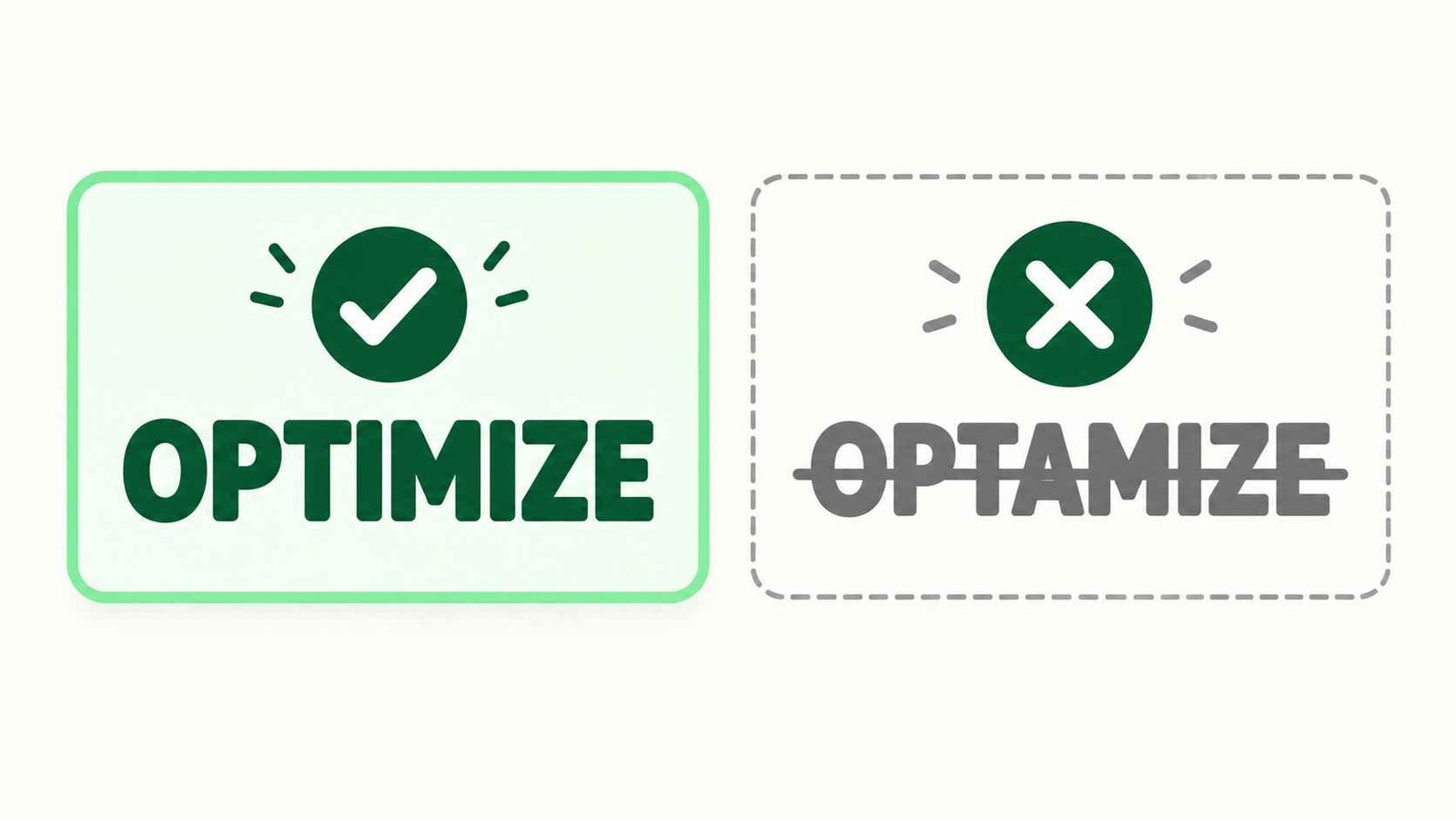
Even confident writers slip up here, usually because spellcheck, autocorrect, and habit all pull in different directions at once.
- Mixing both spellings within a single article or email.
- Believing one version is wrong when both are fully correct.
- Changing spelling inside a direct quote that used the other form.
- Misspelling the word entirely, like writing “optamize” or “optimyze.”
- Ignoring a brand’s existing style guide and switching spellings randomly.
| Mistake | Fix |
| Using both forms in one post | Choose one and stay consistent |
| Assuming one spelling is incorrect | Both are correct, region-based |
| Editing quoted text spelling | Keep the original spelling in quotes |
| Typos like “optamize” | Correct spelling is optimize |
Example in chat: Friend 1: I just noticed I used both spellings in the same post Friend 2: happens a lot, just find and replace one version
Why Do Companies Use Optimize or Optimise Differently?
Brand voice, target market, and even legal documentation all quietly influence which spelling a company settles on for its content.
- Global brands often standardize on optimize for wider search reach.
- UK-based companies typically optimise their materials for local trust.
- Legal and compliance teams follow strict regional spelling rules.
- Marketing teams sometimes A/B test which spelling performs better.
- Franchise businesses may use different spellings per regional site.
Example in texting: Friend 1: why does our US site say optimize and UK site say optimise Friend 2: it’s intentional, matches each region’s audience expectations
Optimize or Optimise in Everyday Examples
Seeing the word inside real, everyday writing makes the regional pattern click faster than any rule chart ever could on its own.
- Everyday writing includes emails, news, social posts, and reports.
- Each context still follows the same simple US vs UK rule.
- Formal writing tends to be stricter about spelling consistency.
- Casual writing is more forgiving of occasional inconsistency.
- Reading real examples helps the difference feel natural, not forced.
- Please optimize the report before sending it. (US)
- Please optimise the report before sending it. (UK)
News
- The company plans to optimize production costs. (US)
- The company plans to optimise production costs. (UK)
Social Media
- Trying to optimize my morning routine! (US)
- Time to optimise my workflow. (UK)
Formal Writing
- This system helps businesses optimize efficiency. (US)
- This system helps businesses optimise efficiency. (UK)
Example in chat: Friend 1: which one should go in the client email Friend 2: check their country first, then match optimize or optimise
When Should You Switch Between Optimize and Optimise?
Switching spellings mid-career or mid-project is more common than people admit, especially for freelancers writing for clients across different countries.
- Switch when you change clients based in a different region.
- Switch when your employer updates its official style guide.
- Switch when a publication you write for has strict house rules.
- Never switch mid-document, even if your audience feels mixed.
- When freelancing, ask the client which spelling they prefer upfront.
Example in texting: Friend 1: I write for a US client and a UK client, how do I keep track Friend 2: keep a simple style note for each client, saves so much confusion
Optimise vs Optimize in SEO and Digital Marketing
SEO writers face a genuinely practical version of this debate, since search volume, competition, and audience location all factor into the final decision.
- Check search volume for both spellings in your target region.
- Use Google Search Console data to see what your audience actually types.
- Some SEO tools show optimize with dramatically higher global volume.
- UK-focused campaigns still benefit from targeting optimise directly.
- Titles and headers should match the dominant regional spelling used.
| Factor | Optimize | Optimise |
| Global search volume | Higher | Lower |
| UK search relevance | Lower | Higher |
| US search relevance | Higher | Lower |
| Best for global SEO | Often preferred | Situational |
Example in chat: Friend 1: which spelling should the blog title use for SEO Friend 2: optimize probably, way more global search volume overall
Optimize or Optimise – Google Trends & Usage Data
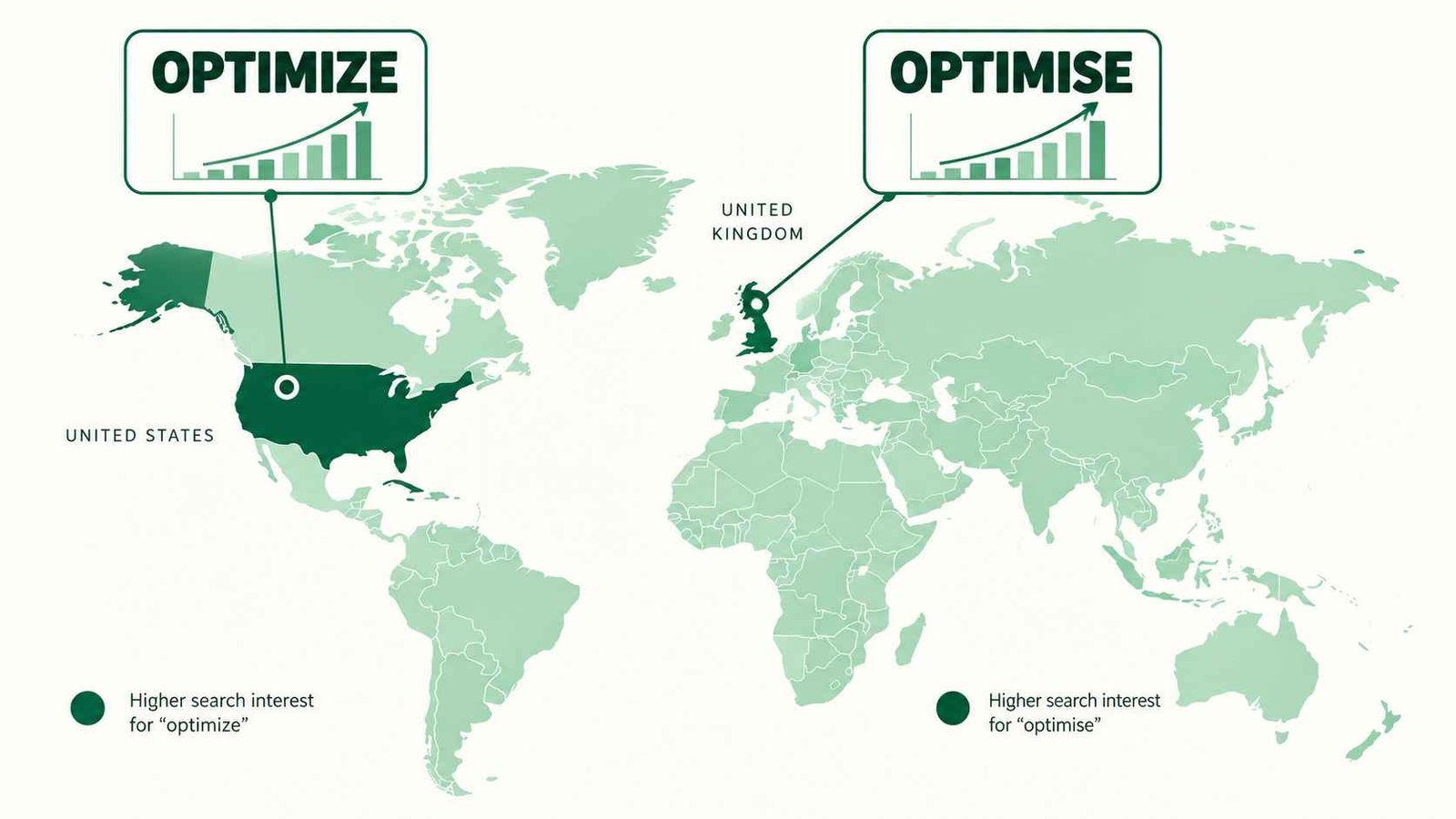
Search behavior tells a clear geographic story once you actually look at where each spelling gets typed most often.
- Optimize dominates search volume across the United States.
- Optimise remains far more common throughout the United Kingdom.
- Both spellings appear constantly across global digital marketing content.
- Search engines don’t penalize either spelling for ranking purposes.
- The clearest pattern is geography, never correctness or quality.
| Region | Preferred Spelling | Typical Usage |
| United States | Optimize | Marketing, tech, business |
| United Kingdom | Optimise | Media, government, business |
| Australia | Optimise | General and business writing |
| Canada | Mixed | Depends on publisher |
Example in texting: Friend 1: does Google actually prefer one spelling Friend 2: no, it just depends on the searcher’s location and language settings
Optimize or Optimise: Which One Do Style Guides Recommend?
Editorial style guides rarely leave this to guesswork, and most major publishers already have a documented answer for their writers to follow.
- AP Style (US-based) recommends optimize for American publications.
- Oxford Style Manual permits both, favoring -ize historically.
- Cambridge and BBC style guides recommend optimise for UK content.
- Academic journals typically follow the publisher’s home-country convention.
- Freelancers should always request the client’s preferred style guide.
Example in chat: Friend 1: does AP style say optimize or optimise Friend 2: optimize, since AP style is built for American English writing
Comparison Table: Optimize vs Optimise
| Word | Region | Correct? | Meaning | Formal? |
| Optimize | USA | Yes | Make better | Yes |
| Optimise | UK | Yes | Make better | Yes |
Both words mean exactly the same thing. The only real difference between optimize or optimise is the regional spelling convention behind each one.
FAQs
1. Is optimize correct?
Yes, optimize is fully correct in American English and widely accepted worldwide in digital content.
2. Is optimise wrong?
No, optimise is completely correct in British English and preferred throughout the UK and Commonwealth.
3. Which spelling is better for SEO?
Neither spelling ranks better on its own; choose whichever version of optimize or optimise matches your target audience’s search habits.
4. Can I use both in one article?
No, mixing spellings looks inconsistent; pick either optimize or optimise and use it throughout the entire piece.
5. Why does my spellcheck change it?
Your language settings control this behavior, so switching between optimize or optimise often happens automatically based on your region setting.
6. Do they mean the same thing?
Yes, both words describe the exact same action of making something as effective as possible, regardless of spelling.
7. Which spelling does Google prefer?
Google doesn’t favor either form; ranking depends on relevance and intent, not whether you chose optimize or optimise.
Conclusion
The debate over optimize or optimise really isn’t complicated once you strip away the confusion. Both spellings are correct, and the only real difference is geography: optimize for American audiences, optimise for British and Commonwealth readers. Neither version is more professional, more modern, or more “correct” than the other.
What actually matters is consistency. Once you settle on optimize or optimise for a project, carry that choice through every page, email, and heading without switching halfway through. Pair that with your preferred secondary keyword strategy, whether that’s targeting optimised or optimized search terms or writing specifically for an optimise or optimize uk audience, and the spelling question stops being a stumbling block entirely.
Next time you pause over the keyboard, ask one simple question: who’s actually reading this? The answer tells you everything you need to know.

Daniel Parker is an English language writer sharing clear grammar lessons, practical tips, and helpful examples for learners.










3 thoughts on “Optimize or Optimise: Which Spelling Should You Use?(2026)”