
You type the sentence, stare at it, then quietly wonder if you just embarrassed yourself in front of your boss or your teacher. That tiny freeze over ridden vs rode happens to careful writers just as often as beginners, and it usually strikes at the worst possible moment.
Here’s the good news: by the end of this guide you’ll know exactly when to use ridden vs rode, why English keeps this odd little pair around, and how to spot the mistake before anyone else does. You’ll get real examples, a full rode vs ridden breakdown, a comparison table you can bookmark for later, and a handful of quick memory tricks that actually stick. Keep reading, because the confusion ends here.

Ridden or Rode – Quick Answer
Short on time? Here’s the fast version: rode is the simple past tense, and ridden is the past participle that always needs a helping verb like have, has, or had standing next to it.
- Rode works alone in a finished-time sentence, like “yesterday” or “last week.”
- Ridden never stands alone; it always pairs with a helper verb.
- Both words come from the same irregular base verb, ride.
- Choosing wrong makes writing look careless, even when the meaning is clear.
- The fix takes seconds once the pattern clicks for good.
| Form | Used With | Example |
| Rode | Nothing extra needed | I rode a bike yesterday. |
| Ridden | have / has / had | I have ridden a bike before. |
| Rided | Never correct | ❌ Not a real word |
Example in texting: Friend 1: is it rode or ridden for “I ___ my bike this morning” Friend 2: rode, since it’s a finished action with no “have” attached
If you keep that one test in mind, ridden or rode stops being a guessing game and starts feeling like second nature. The trick works in speech, in emails, and even in fast-typed group chats where nobody has time to overthink a sentence.
The Origin of Ridden or Rode

The story behind ridden or rode starts centuries before texting existed, in an Old English word that quietly shaped how modern speakers describe motion and travel.
- The verb traces back to Old English rīdan, meaning to travel on horseback.
- English kept many irregular verbs for actions people used constantly.
- The base form stayed ride, while the vowel changed for each tense.
- Regular verbs like walk simply add -ed, but ride does not.
- Learners often guess wrong because they expect a regular pattern here.
Why Did Ride Become an Irregular Verb?
- Old Germanic languages carried many strong verbs with vowel shifts.
- Frequent, everyday actions tended to resist spelling simplification over time.
- Ride, sing, and drink all follow this same vowel-change family.
- Modern English simply inherited the pattern instead of regularizing it.
- Dictionaries preserved the forms because usage never dropped off.
Example in chat: Friend 1: why doesn’t ride just become rided like walked Friend 2: it’s an old irregular verb, English never smoothed it out
Linguists sometimes describe these old vowel-shift verbs as fossils of an older grammar system, still living quietly inside modern sentences. That’s part of why rode or ridden keeps tripping people up long after they’ve mastered the rest of English tense rules.
British English vs American English Spelling
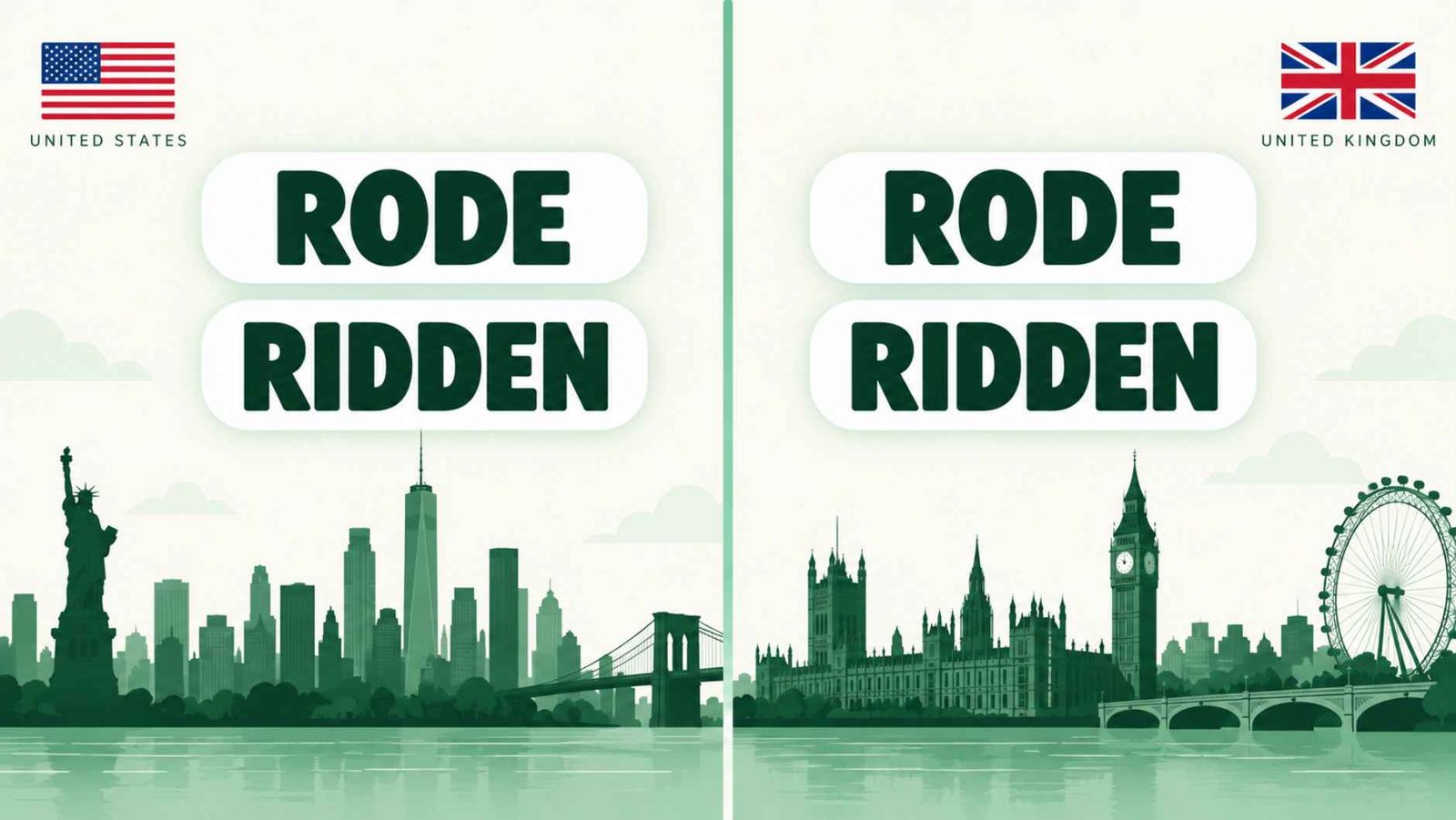
Here’s something that surprises a lot of people searching ridden or rode: there is no British versus American spelling split hiding anywhere in this word pair at all.
- Both UK and US English use the identical forms rode and ridden.
- There is no -ize or -ise style variant to worry about here.
- The real challenge is grammar usage, not regional spelling preference.
- Commonwealth English, American English, and Australian English all match exactly.
- Confusing this with spelling debates only adds unnecessary stress for writers.
| Form | British English | American English | Correct? |
| rode | rode | rode | ✅ Yes |
| ridden | ridden | ridden | ✅ Yes |
| rided | rided | rided | ❌ No |
This is actually the opposite situation from genuine regional spelling splits, the kind you’ll find in a detailed optimize or optimise breakdown, where the US and UK really do use different endings for the same word.
Example in texting: Friend 1: does UK English spell ridden differently Friend 2: nope, ridden and rode are identical everywhere
That means anyone searching for a “British spelling” of ridden vs rode is chasing a difference that simply doesn’t exist. Save that energy for the actual grammar rule instead, since that’s where the real confusion always lives.
What Does Ridden or Rode Really Mean?
People searching ridden or rode usually just want one plain answer: both words describe the act of riding something, but only one fits a given sentence’s tense.
- Rode describes a completed action set in a specific past moment.
- Ridden describes an action connected to the present through a helper verb.
- Neither word changes the core meaning of riding a horse, bike, or bus.
- The difference lives entirely in grammar, not in definition or tone.
- Getting this right signals careful, professional writing to any reader.
How Is Ridden or Rode Used in Everyday Conversations?
- People text friends about weekend bike rides using “rode.”
- Travelers describe completed trips with rode in trip recaps.
- Resumes and bios use ridden to describe lifetime riding experience.
- Coaches and trainers ask athletes what they’ve ridden before.
- Casual chats rarely pause to think about which form fits.
Example in chat: Friend 1: I rode my bike to work today, first time in months Friend 2: nice, I’ve ridden mine maybe twice all year
Notice how naturally both forms slide into a normal text exchange without either person stopping to think about grammar. That’s exactly the goal: once the pattern feels automatic, ridden or rode stops being something you have to consciously check.
Which Spelling Should You Use?
This isn’t really a spelling question at all; choosing between rode vs ridden depends entirely on your sentence’s tense, not on your country or audience.
- Use rode when describing a single, finished past action.
- Use ridden whenever a helper verb like have, has, or had appears.
- US audiences follow this exact same tense-based rule.
- UK audiences and Commonwealth writers follow the identical rule too.
- Global, region-neutral writing still applies the same grammar logic.
Is It Ridden or Rode After “Have”?
- Always choose ridden immediately after have, has, or had.
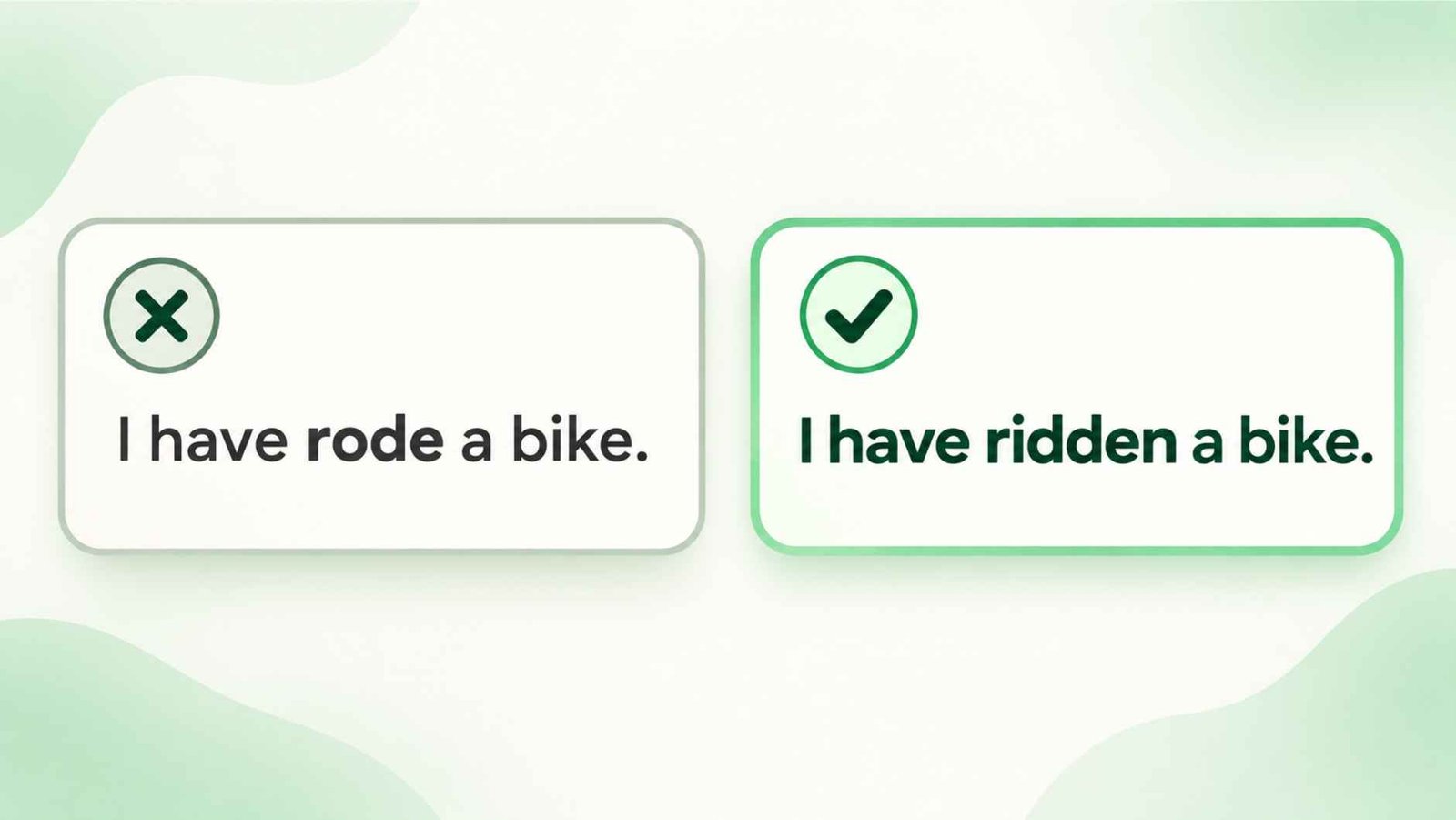
- “I have rode” is a common but incorrect construction to avoid.
- “I have ridden” is the grammatically correct version every time.
- This rule holds true in speech, writing, and formal documents alike.
- Memorizing this one pairing solves most ridden or rode confusion instantly.
Example in texting: Friend 1: is it “I have ridden” or “I have rode” Friend 2: ridden, always pair have/has/had with ridden
This single pairing rule solves the vast majority of real-world rode vs ridden mistakes, whether you’re drafting a work email or finishing a school essay under a tight deadline.
Ridden or Rode in Grammar Exams and Tests
Students preparing for English exams run into ridden or rode constantly, since irregular verb forms show up on nearly every grammar test from middle school onward.
- Exam questions often test verb tense through fill-in-the-blank sentences.
- Multiple-choice sections frequently pair “have ___” with ridden as the answer.
- Standardized tests treat rode and ridden as classic irregular verb examples.
- Teachers emphasize this pair because mistakes appear so frequently in essays.
- ESL learners specifically study ride, rode, ridden as a model irregular verb.
| Exam Section | Correct Form | Common Wrong Answer |
| Simple past sentence | rode | ridden |
| Present perfect sentence | ridden | rode |
| Past perfect sentence | had ridden | had rode |
Example in chat: Friend 1: my English test had a whole section on rode vs ridden Friend 2: classic irregular verb trap, happens every semester
Teachers keep testing this pair for a reason: it separates students who memorized isolated vocabulary from students who actually understand how English tense structure works underneath the surface.
Why Do People Confuse Ridden and Rode?
Confusion around ridden or rode isn’t a sign of poor grammar skills; it’s simply what happens when an irregular verb collides with everyday speech patterns nobody slows down to check.
- English speakers expect regular -ed endings on most verbs by habit.
- Spoken English often blurs the difference since both words sound similar.
- Autocorrect and spellcheck catch spelling errors, not tense mistakes like this.
- Non-native speakers memorize rules that don’t always match real usage.
- Repetition of the wrong form in casual speech reinforces the habit further.
Does Spellcheck Catch Rode or Ridden Mistakes?
- Standard spellcheck tools flag misspelled words, not incorrect tense choices.
- Grammar-specific tools catch some rode-or-ridden errors, but not all.
- “I have rode” often passes spellcheck completely undetected.
- Reading sentences aloud helps catch tense errors spellcheck misses.
- Human proofreading still matters for this exact kind of mistake.
Example in texting: Friend 1: spellcheck didn’t catch “I have rode” in my email Friend 2: yeah it only checks spelling, not grammar like that
That gap is exactly why manual proofreading still matters, especially for anything going to a client, a teacher, or a wider audience where rode or ridden mistakes are easy to spot.
Common Mistakes with Ridden or Rode
Even confident writers slip here, usually because habit, speech patterns, and rushed typing all pull in different directions at the exact same moment.
- Mixing rode into sentences that already contain have, has, or had.
- Dropping ridden into simple past sentences where rode actually belongs.
- Assuming one form is simply wrong instead of tense-specific.
- Editing someone else’s quoted speech to “fix” a form that was correct.
- Ignoring the pattern entirely and just guessing under time pressure.
| Mistake | Fix |
| I have rode a horse. | I have ridden a horse. |
| She ridden to school yesterday. | She rode to school yesterday. |
| He has rode this trail before. | He has ridden this trail before. |
| They ridden the bus last night. | They rode the bus last night. |
Example in chat: Friend 1: I just texted “I have rode” to my whole group chat Friend 2: happens constantly, just remember have pairs with ridden
Small slips like this rarely confuse anyone about your meaning, but they do add up. Cleaning up ridden or rode mistakes is one of the fastest, easiest wins for anyone trying to sound more polished in writing.
Ridden vs Rode: Regional and Dialect Usage
Even though spelling never changes across regions, dialect and casual speech patterns still shape how often people slip on ridden or rode in everyday conversation.
- American casual speech frequently drops ridden in favor of rode.
- British speech shows the same casual slip in informal contexts.
- Formal writing in every English-speaking region sticks to the correct rule.
- Regional accents never change which form is grammatically correct.
- Style guides across countries agree completely on this specific rule.
| Region | Spelling Difference | Grammar Rule Difference |
| United States | None | None |
| United Kingdom | None | None |
| Australia | None | None |
| Canada | None | None |
Example in texting: Friend 1: do Aussies say rode or ridden differently Friend 2: same rule everywhere, it’s not a regional thing at all
So whether you’re writing for a reader in London, Sydney, or Los Angeles, the same ridden vs rode logic applies without any adjustment needed for location or dialect.
When Should You Use Ridden Instead of Rode?
This question drives a huge chunk of searches for ridden or rode, and the answer comes down to a single, reliable grammar signal worth memorizing today.
- Use ridden the moment have, has, or had appears beforehand.
- Use ridden in present perfect sentences describing life experience.
- Use ridden in past perfect sentences describing an earlier completed action.
- Never use ridden as a standalone verb without a helper attached.
- When unsure, test the sentence by adding “have” before the verb.
What Happens If You Use the Wrong Form?
- Readers may see the sentence as careless or unpolished writing.
- Teachers and editors will mark the sentence as a grammar error.
- Professional emails using the wrong form can look unprofessional to clients.
- Exams typically deduct points for irregular verb tense mistakes.
- The meaning usually stays clear, but credibility takes a small hit.
Example in chat: Friend 1: does it really matter if I mix up rode and ridden Friend 2: not for meaning, but it does look sloppy in formal stuff
Think of it like a small wrinkle in an otherwise clean shirt. Nobody misses the message, but a careful reader still notices, and fixing rode vs ridden takes far less effort than ironing out a bigger writing habit later.
Ridden or Rode in Everyday Examples
Seeing rode or ridden inside real, everyday writing makes the pattern click faster than any rule chart on its own ever could.
- Everyday writing spans emails, texts, news pieces, and social captions.
- Each context still follows the exact same tense-based rule underneath.
- Formal writing stays strict about choosing the correct form always.
- Casual writing is more forgiving, though mistakes still stand out.
- Practicing with real sentences builds confidence faster than memorizing rules alone.
| Context | Rode Example | Ridden Example |
| I rode the bus to the office. | I have ridden this route many times. | |
| News | The athlete rode his bike across town. | She has ridden in several races. |
| Social Media | I rode a horse for the first time! | I’ve ridden this trail before. |
| Formal Writing | The team rode through the storm. | The explorer has ridden across the desert. |
Example in texting: Friend 1: I rode my bike to the lake this morning Friend 2: love that, I’ve ridden that same trail so many times
Notice the pattern repeating across every context above: a single completed trip calls for rode, while a life experience or repeated history calls for ridden. That contrast holds steady whether you’re writing a casual caption or a formal report.
Ridden and Rode in Sports and Travel Writing
Sports journalists and travel writers reach for ridden vs rode constantly, since both fields describe motion, competition, and personal experience across every past tense imaginable.
- Race recaps use rode to describe a specific completed event.
- Athlete profiles use ridden to summarize a career’s worth of experience.
- Travel blogs mix both forms depending on the sentence structure used.
- Cycling and equestrian writing rely heavily on this exact verb pair.
- Editors in these fields catch tense mistakes as a routine check.
Example in chat: Friend 1: the article said the jockey “has rode” that horse before, is that right Friend 2: no, should be “has ridden,” classic tense slip in sports writing
Even published, edited content slips on ridden or rode from time to time, which just proves how easily this irregular pair sneaks past a fast-moving editorial process.
Ridden or Rode – Google Trends & Usage Data

Search behavior tells a clear story once you actually look at what people type when they’re unsure about rode vs ridden in real time.
- People frequently search “is it ridden or rode” during writing tasks.
- Related searches include “have rode or have ridden,” showing the same confusion.
- Search volume spikes around school terms and grammar homework seasons.
- ESL learners represent a large share of these specific searches.
- Most searchers are simply double-checking a sentence before hitting send.
| Search Phrase | Typical Searcher Intent |
| ridden or rode | Choosing the correct form |
| rode or ridden | Same confusion, reversed order |
| is it ridden or rode | Quick confirmation before publishing |
| rode vs ridden | Comparing both forms directly |
Example in texting: Friend 1: I googled “is it ridden or rode” for the third time this week Friend 2: honestly same, it never fully sticks in my head
The steady search volume behind rode or ridden shows this isn’t a rare, obscure grammar point. It’s a common, recurring question that deserves a clear, permanent answer instead of a fresh search every single time.
How to Remember Ridden vs Rode Forever
A few simple memory tricks make ridden or rode stick permanently, so you stop second-guessing every sentence that mentions bikes, horses, or buses.
- Picture rode as a solo word, matching its standalone usage.
- Picture ridden as always needing a partner, like have or had.
- Say the sentence aloud and test whether “have” fits naturally beforehand.
- Practice with short, real sentences from your own daily routine.
- Repetition over a few days locks the pattern into memory.
Example in chat: Friend 1: any trick for remembering rode vs ridden Friend 2: just ask yourself if “have” fits, that settles it every time
Another simple trick: count the letters. Ridden has an extra “d,” a small visual reminder that it needs an extra word, the helper verb, standing right in front of it. Little anchors like this make the rule stick far longer than a plain grammar definition ever could, especially for visual learners who forget written rules quickly but remember small patterns like this one for years.
Comparison Table: Ridden vs Rode

| Feature | Rode | Ridden |
| Verb form | Past simple | Past participle |
| Needs helper verb | No | Yes (have/has/had) |
| Example | I rode a bike. | I have ridden a bike. |
| Used in exams | Yes | Yes |
| Used in formal writing | Yes | Yes |
| Can be used alone | Yes | No |
Both words share the same base verb, but only one fits any given sentence. The real difference between ridden or rode always comes down to whether a helping verb is standing nearby. Keep this table bookmarked for the next time a sentence makes you pause, since a quick glance usually settles the question faster than a search engine ever could.
FAQs About Ridden or Rode
1. Is “I have rode a bike” correct?
No. The correct sentence is “I have ridden a bike,” since have always pairs with the past participle form.
2. Is “I rode a bike yesterday” correct?
Yes, that’s correct. Rode fits any sentence describing a finished, specific past moment.
3. What is the base form of rode and ridden?
The shared base form for this ridden or rode pair is simply “ride.”
4. Do British and American English use different forms?
No, both regions use identical forms, so the ridden vs rode rule never changes by country.
5. Why do people confuse ridden and rode?
Because ride is an irregular verb, and casual speech blurs the tense difference constantly.
6. Can I say “I ridden to school”?
No, that’s incorrect. Say “I rode to school,” since no helper verb appears there.
7. How can I remember the rule for good?
Use rode alone, and always pair ridden with have, has, or had nearby.
Conclusion
The confusion around ridden or rode comes from one simple source: ride is an irregular verb, and English never smoothed it into a regular -ed pattern. Once you separate the two roles, the choice becomes automatic. Rode stands alone in a finished past moment, while ridden always needs a helper verb like have, has, or had standing right beside it.
This small grammar point shapes how professional your writing looks in emails, exams, and everyday posts. Getting rode vs ridden wrong doesn’t usually confuse a reader, but it does make careful writing look rushed, and small slips like this tend to stack up over time in a résumé, a report, or a client email. Next time you’re unsure, just test the sentence with “have” in front of it, and the right choice for ridden vs rode will settle itself in seconds.
The rule really is that small: one word stands alone, the other always brings a helper along for support. Once that image sticks, ridden or rode stops feeling like a grammar trap and starts feeling like second nature every time you sit down to write.

Daniel Parker is an English language writer sharing clear grammar lessons, practical tips, and helpful examples for learners.










1 thought on “Ridden or Rode? Learn the Correct Past Tense of Ride”