You type the word, stare at it, then type it again. Writing or writting? Somehow one extra letter makes a word you’ve used for years look completely wrong.
This mix-up is more common than you’d think, and it comes down to one small spelling rule most people never learned. Below, you’ll get the direct answer, the reason behind it, and the correct spelling confirmed through enough examples that you’ll never second-guess writing again.
Writing or Writting: Quick Answer

Writing is the only correct spelling. Writting is a common misspelling that adds an extra t, and it doesn’t exist in any dictionary, in British or American English.
Correct and Incorrect Examples of Writing
- Correct: She loves writing short stories every weekend.
- Incorrect: She loves writting short stories every weekend.
- Correct: His writing has improved since last year.
- Incorrect: His writting has improved since last year.
- Correct: Creative writing is her favorite class.
- Incorrect: Creative writting is her favorite class.
Example in texting:
Friend 1: can you help me with my writing homework tonight?
Friend 2: yeah, send it over, i’ll look at it after dinner
Why “Writting” Is Not a Real Word
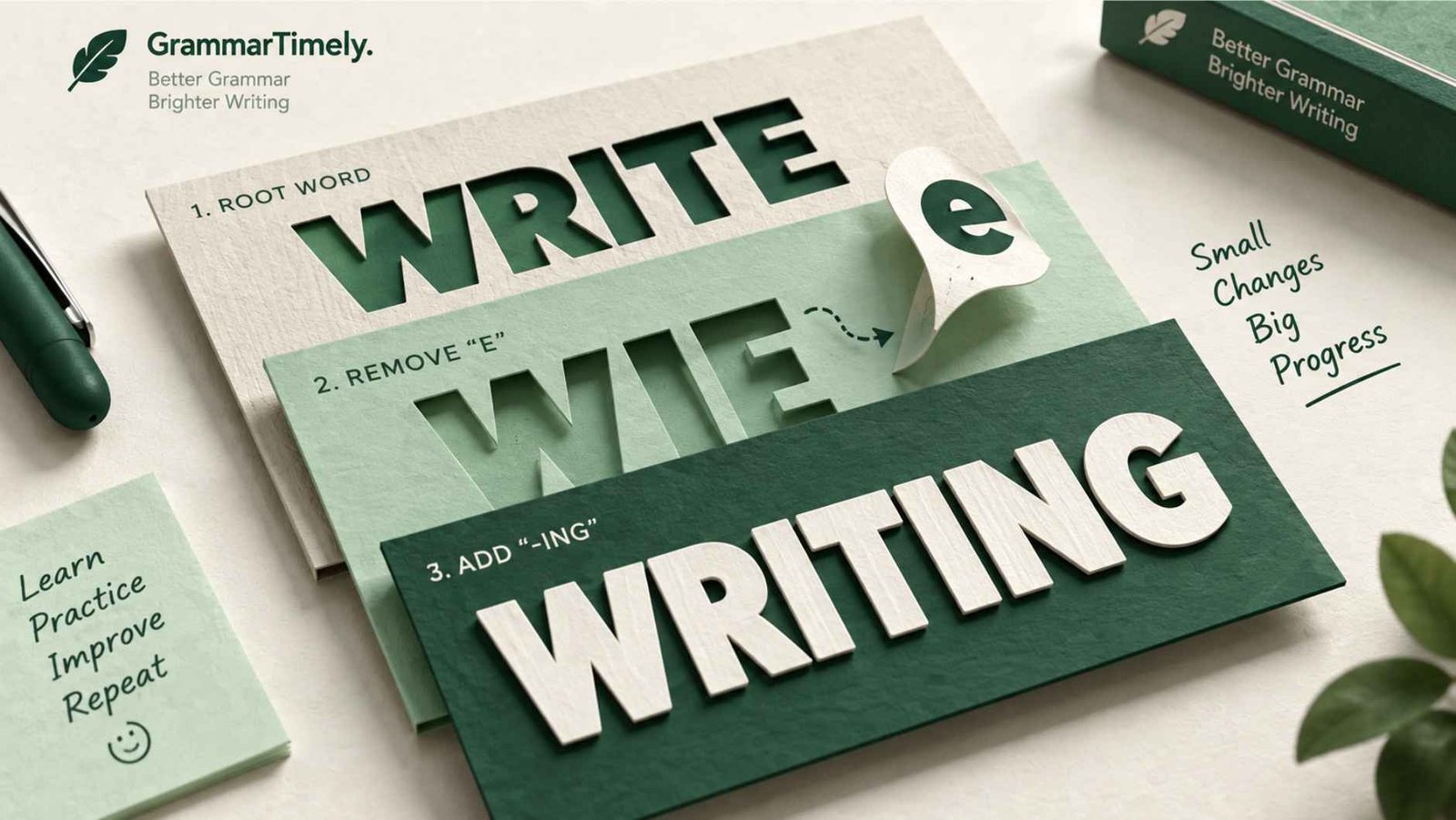
The mix-up starts with a spelling rule almost nobody explains clearly. Writing follows the silent e rule when -ing gets added, not the doubling rule people expect.
The Silent E Rule Behind Writing
- Write ends in a silent e, not a short vowel sound.
- Adding -ing means you drop the silent e first.
- Write minus e, plus -ing, becomes writing.
- Consonant doubling only applies to short, stressed vowel sounds.
- Words like sit and hit double because of a short vowel.
- Write has a long vowel sound, so no doubling happens.
Example in chat:
Friend 1: is it writing or writting, i always forget
Friend 2: writing, just one t. write drops the e first
British English vs American English Spelling of Writing
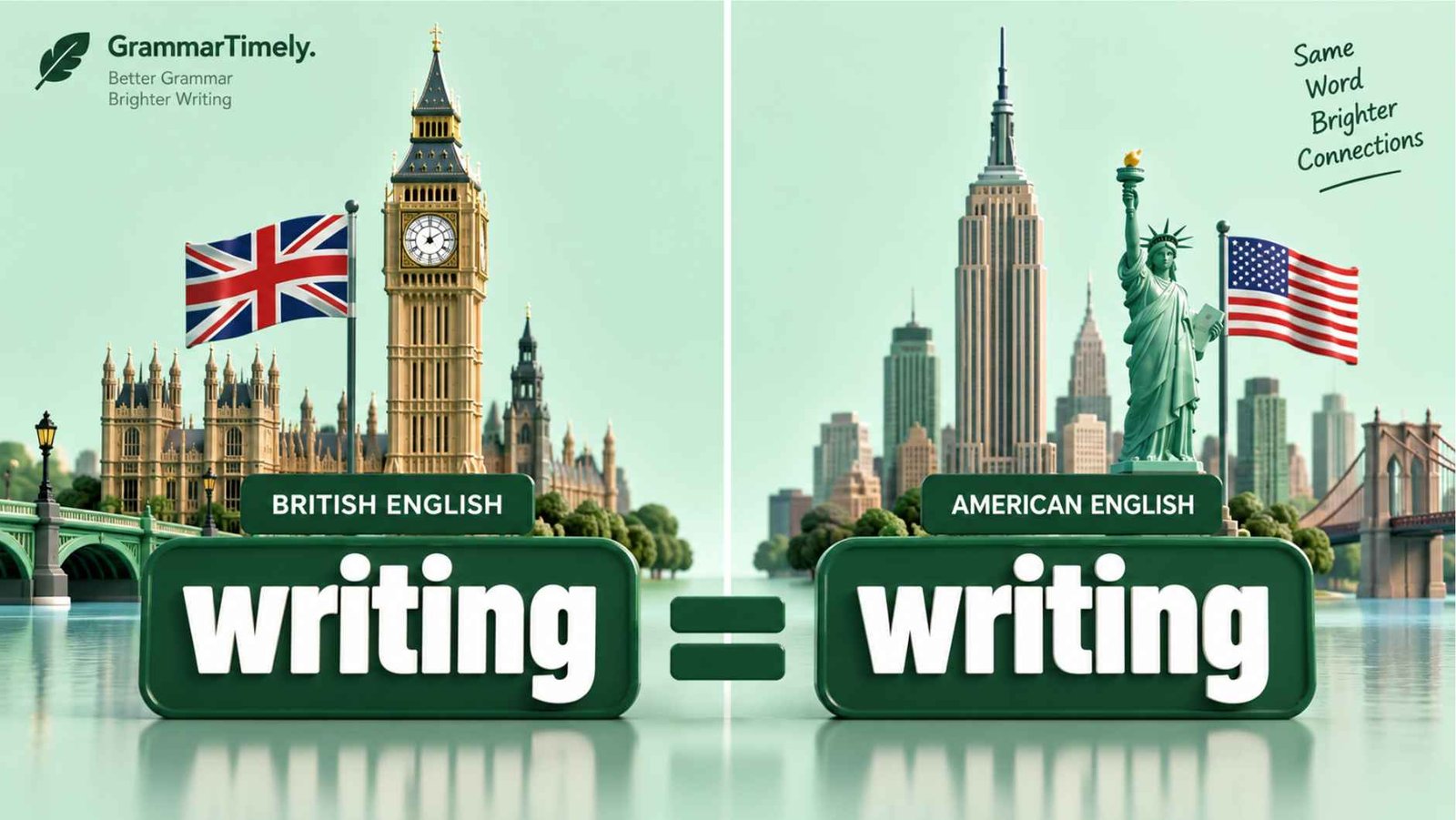
Spelling battles between British and American English usually involve words like colour or color. Writing isn’t one of them. Both versions spell it exactly the same way.
Do British and American English Spell Writing Differently?
- British English: writing, written, writes, no differences at all.
- American English: writing, written, writes, identical spelling throughout.
- Differences usually involve -our vs -or endings, not this word.
- Colour becomes color in American English; writing stays the same.
- Travelling doubles the L in British English; writing never doubles.
- No dialect anywhere accepts writting as a valid spelling.
| Word | British English | American English |
| Colour | colour | color |
| Travelling | travelling | traveling |
| Writing | writing | writing |
| Organise | organise | organize |
Example in texting:
Friend 1: is writing spelled differently in the uk
Friend 2: nope, same everywhere. writing is writing
Writing vs Written: What’s the Difference

Writing and written look related, but they do different jobs in a sentence. Mixing them up is almost as common as spelling writing with an extra t.
When to Use Writing vs Written in a Sentence
- Writing is the present participle: “I am writing a letter.”
- Written is the past participle: “The letter was written yesterday.”
- Use writing after am, is, are, was, were plus a subject.
- Use written after has, have, had, or was/were in passive voice.
- Writen with one t is never correct in any context.
- Both words come from the irregular verb write.
| Form | Tense | Example |
| Write | Base form | I write every morning. |
| Writing | Present participle | I am writing a letter. |
| Wrote | Simple past | I wrote a letter yesterday. |
| Written | Past participle | I have written three letters. |
Example in chat:
Friend 1: has the report been writing or written yet
Friend 2: written, past tense needs the extra syllable
Common Mistakes With Writing or Writting
The mistake behind writting rarely comes from ignorance. It usually comes from habit, autocorrect, or confusing writing with words that really do double letters.
Why Do People Misspell Writing as Writting?
- Autocorrect sometimes fails to catch the extra t.
- People confuse writing with doubling words like sitting or hitting.
- Fast typing causes accidental double letters in common words.
- Non-native speakers often apply doubling rules too broadly.
- Muscle memory from typing written carries over into writing.
- Spell checkers on mobile keyboards miss it more than desktop tools.
Writing isn’t the only word that trips people up this way. The address or adress mix-up follows a similar pattern: one extra or missing letter, and a word you know well suddenly looks wrong.
| Common mistake | Why it happens | Correct spelling |
| Writting | Confusing it with doubling words | Writing |
| Writen | Missing the second t in the past participle | Written |
| Writeing | Keeping the silent e by mistake | Writing |
| Writting a essay | Extra t plus wrong article usage | Writing an essay |
Example in texting:
Friend 1: sry for the late reply, been writting all day lol
Friend 2: *writing 😂 but no worries, take your time
What Does Writing Really Mean?
Before worrying about spelling, it helps to nail down what writing means. The word carries more than one sense, and context decides which one applies.
Different Meanings of Writing
- Writing means forming letters or words by hand or by typing.
- It also means the activity of composing sentences, stories, or reports.
- As a noun, writing refers to a finished piece of text.
- “In writing” means a promise or agreement is documented, not spoken.
- Handwriting is a narrower term for the physical act of writing.
- Academic writing, creative writing, and technical writing are specific styles.
Example in chat:
Friend 1: can you send that in writing so i have proof
Friend 2: yep, emailing it to you right now
How Is Writing Used in Everyday Conversation?
Writing shows up everywhere: emails, texts, social captions, and formal reports. The tone shifts with the setting, but the spelling never changes.
Writing Across Different Everyday Contexts
- Email writing stays polite and reasonably formal, even between coworkers.
- Texting shortens writing with abbreviations like “wru” or “idk.”
- Social media captions mix casual writing with hashtags and emojis.
- Formal writing avoids contractions and sticks to complete sentences.
- News writing favors short paragraphs and a direct structure.
- Academic writing requires citations and a more structured tone.
Example in texting:
Friend 1: ur writing style in that email was way too formal lol
Friend 2: i know, i panic and sound like a lawyer
When Should You Use Writing Instead of Writting?
Writting is never correct, in any scenario. The bigger question is when to use writing versus related forms like write or written.
Choosing the Right Form of Write
- Use writing for ongoing or continuous actions happening now.
- Use write for simple present tense statements or instructions.
- Use wrote for a completed action in the simple past.
- Use written for passive voice or with have, has, had.
- Writing also works as a gerund, acting like a noun.
- Never use writting in any tense, context, or dialect.
Example in chat:
Friend 1: should i say im writing or i write in the bio
Friend 2: writing sounds more natural for a job description
Comparison Table: Writing vs Writting
Sometimes the fastest way to settle a spelling question is a direct side-by-side look. Here’s exactly how writing compares to the incorrect writting.
Writing vs Writting at a Glance
| Feature | Writing | Writting |
| Correct spelling | Yes | No |
| Found in dictionaries | Yes | No |
| Used in British English | Yes | No |
| Used in American English | Yes | No |
| Accepted by spell check | Yes | Flagged as an error |
| Grammar rule behind it | Silent e dropped before -ing | No real rule supports it |
- Writing passes every spell checker; writting never does.
- Writing appears in every major dictionary, printed and online.
- Writting has zero dictionary listings, formal or informal.
- Search engines auto-correct writting searches to writing results.
- Teachers mark writting wrong in every grading system.
- Job applications with writting can hurt a first impression.
Example in texting:
Friend 1: is it 1 or 2 t’s in writing
Friend 2: 1 t. writing not writting, promise
Frequently Asked Questions
1. Is writting a correct spelling?
No. Writting is not correct in any form of English. The correct spelling is always writing, with a single t.
2. Why do people spell writing as writting?
Most mistakes come from confusing writing with double-letter words like sitting or hitting. Autocorrect and fast typing also contribute to the error.
3. What is the rule for adding -ing to write?
Write ends in a silent e, so the e gets dropped before adding -ing. That produces writing, not a doubled consonant.
4. Is writing spelled differently in British and American English?
No. Writing is spelled exactly the same in both dialects. British and American English only differ on words like colour or travelling.
5. Is it writen or written?
Written is correct, with two t’s, since it’s the irregular past participle of write. Writen with one t is always wrong.
6. Is writing a noun or a verb?
Writing works as both. As a verb, it’s the present participle of write; as a noun, it names the activity or the resulting text.
7. Why is spelling important in writing?
Correct spelling makes writing easier to read and more credible. A single misspelled word like writting can distract readers from your message.
Conclusion
Writing only ever takes one t. Writting comes from misapplying the doubling rule, and no dictionary or dialect accepts it as a valid spelling of writing. Once you remember that write drops its silent e before adding -ing, the correct spelling of writing stops being something you have to double-check.
The same logic applies to written, which does double the t because it’s an irregular past participle, not a regular -ing form. Keep those two rules separate and both words become automatic.
Next time autocorrect or a fast typing session tempts you toward writting, pause for one second and type writing instead. That single habit fixes the mistake for good.

Daniel Parker is an English language writer sharing clear grammar lessons, practical tips, and helpful examples for learners.










1 thought on “Writing or Writting: The Correct Spelling, Explained”