
You typed it, then stared at it. Divet? Divot? Something looked off, but you couldn’t say which version was wrong, and Google’s autocorrect wasn’t helping either.
This guide settles it for good. You’ll get the correct spelling, the real divot meaning, where the word came from, and how to use divot confidently in emails, texts, or on the golf course. No guessing required.
Divet or Divot – Quick Answer
Divot is correct. Divet is a common misspelling, not a real word in any English dictionary, British or American. The confusion happens because “divet” sounds like it could be right when spoken quickly, and the two words share every letter except one swap near the end.
Divot or Divet Meaning
A divot is a piece of turf, grass, or ground that gets torn up, usually by a golf club, a shoe, a hoof, or heavy foot traffic. In everyday speech, people also use it loosely for any small scooped-out chunk of a surface.
- Divot: real word, correct in all English dialects
- Divet: misspelling, not found in any standard dictionary
- Both are pronounced almost the same, which drives the mix-up
- Divot functions as a noun and, less often, a verb (“to divot”)
- The word covers golf, lawn care, and general damage to soil or turf
The Origin of Divet or Divot
Divot traces back to Scottish dialect, where it originally meant a piece of turf cut for roofing or fuel. Over time, English speakers borrowed the word into general and sporting vocabulary, and it eventually became attached to golf, where torn-up turf is a daily occurrence.
- Rooted in Scots and older Northern English speech
- Once referred to turf cut and stacked for building or burning
- Entered mainstream English through farming and land use
- Adopted by golf terminology in the 19th and 20th centuries
- No historical spelling, in any era, ever used “divet”
What Is a Divot in Golf?
Ask any golfer and they’ll know this one instantly. A divot is the chunk of grass a club rips out of the ground on impact, and replacing it is basic golf etiquette that every player learns early.
- Formed when the clubhead strikes the ground before or after the ball
- Common with irons, rarely with putters
- Golfers are expected to replace it or fill it with sand mix
- Left-behind divots damage the fairway for other players
- A “divot hole” is the empty patch left when the turf isn’t returned
Example in conversation: Friend 1: My shot was clean, but I left a huge divot on the fairway. Friend 2: Did you at least put it back?
British English vs American English Spelling
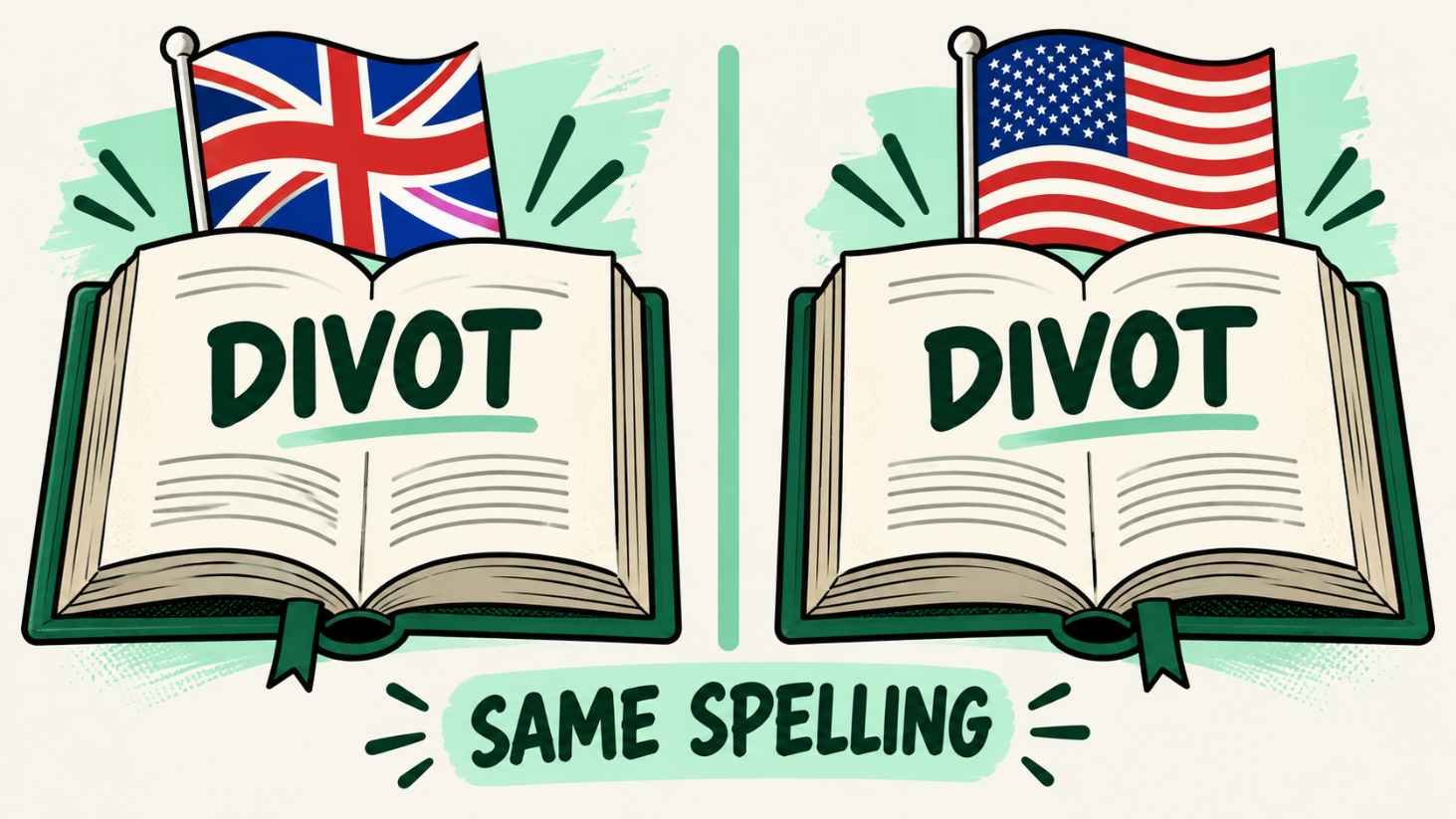
Unlike words such as “colour” and “color,” divot doesn’t split along British and American lines. Both regions spell it the same way, which makes the “divet” version even harder to justify as a regional variant.
| Region | Accepted Spelling | Notes |
| British English | Divot | Used in Cambridge and Oxford dictionaries |
| American English | Divot | Used in Merriam-Webster |
| Any dialect | Divet | Not recognized anywhere |
- Not a US vs UK spelling difference, unlike “flavour” or “flavor”
- Cambridge Dictionary lists only divot
- Merriam-Webster lists only divot
- No regional dictionary anywhere accepts divet
- The mix-up is a spelling error, not a dialect choice
Which Spelling Should You Use?
Always divot. There’s no context, formal or casual, where “divet” is the accepted choice, so this one has a single, simple answer.
For different audiences:
- Students: Use divot in essays and assignments without exception
- Golfers: Stick to divot in scorecards, apps, and conversation
- Writers and bloggers: Run spell-check before publishing, since autocorrect sometimes lets “divet” slip through
- Non-native speakers: Memorize divot as a single unit, since the “et” ending in “divet” is what causes the error
- Social media users: Divot is short enough to spell correctly even in fast typing
Why Do People Confuse Divet and Divot?
The mix-up isn’t random. Several small habits push people toward the wrong spelling, even when they’ve seen divot written correctly before.
- English has many common words ending in -et, like “cadet” and “cabinet”
- Spoken divot can sound like it ends in a soft “et”
- Autocorrect sometimes fails to flag uncommon golf terms
- Limited exposure to written golf content means fewer visual reminders
- Fast typing and voice-to-text both increase the error rate
Example in chat: Friend 1: I hit such a big divet on that last hole lol Friend 2: It’s divot, but yeah that’s a rough patch you left behind
Common Mistakes with Divet or Divot
Beyond the spelling itself, a few related errors show up often. Getting the full picture helps you avoid every version of the mistake, not just the main one.
- Writing divet instead of divot in any context
- Assuming “divet” is a British spelling variant, which it isn’t
- Confusing divot with “rivet,” a completely unrelated word
- Using divot as a verb incorrectly, like “I divoted the ball” instead of “my shot took a divot”
- Mixing up divot with “pitch mark,” a related but different golf term
If you’ve ever second-guessed a tricky spelling like this one, it’s worth checking how the same confusion plays out with other commonly misspelled words, including the ongoing mix-up between creator and creater, which follows a similar pattern of one letter changing the whole word.
Divot vs Pitch Mark: What’s the Difference
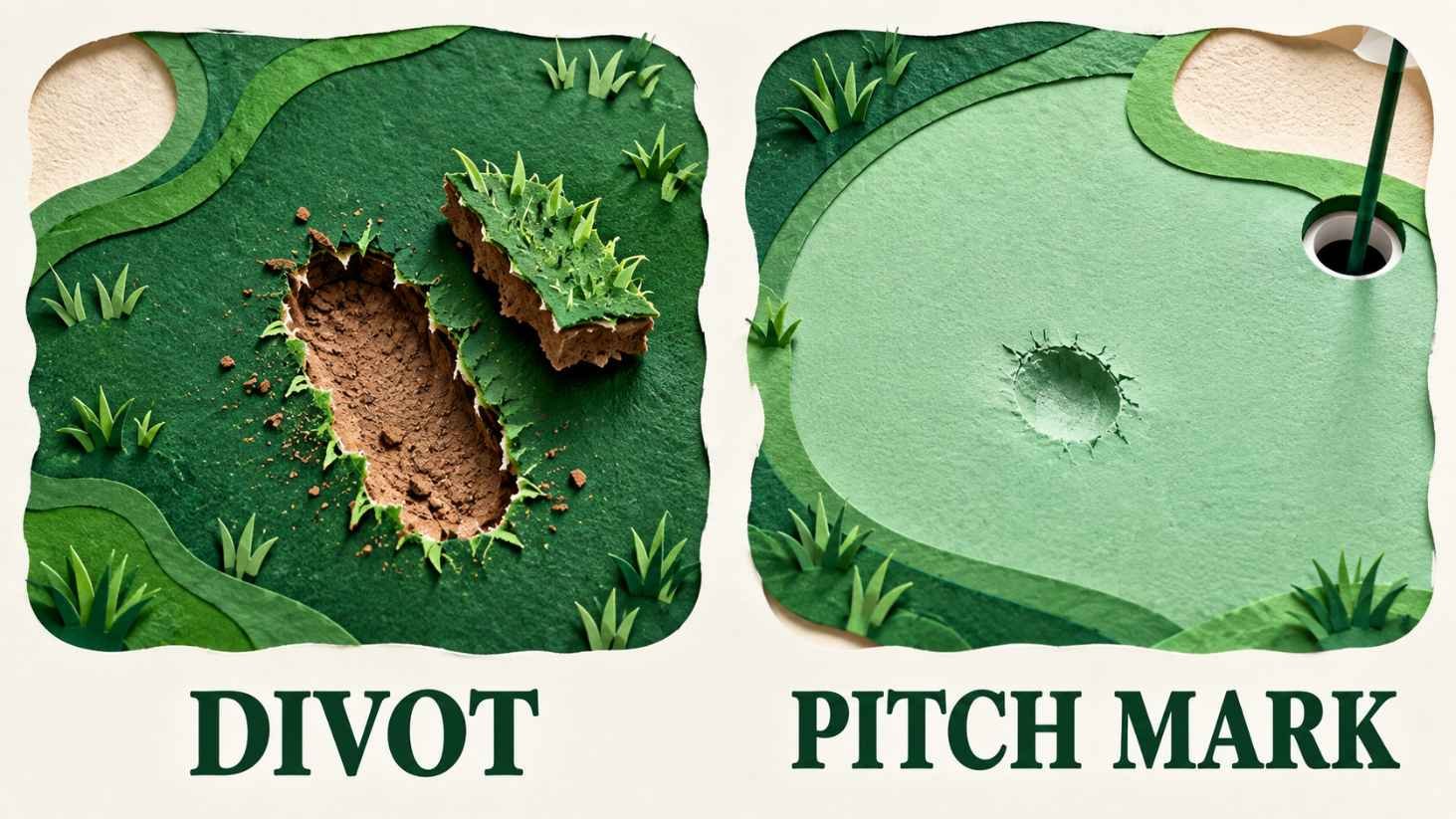
Golfers often confuse these two terms, but they describe different things. A divot happens on the fairway from a swing, while a pitch mark happens on the green from a ball landing.
| Term | Where It Happens | What Causes It |
| Divot | Fairway or rough | Club striking the ground |
| Pitch mark | Putting green | Ball landing and denting the turf |
- A divot removes a chunk of turf, sometimes fully detached
- A pitch mark only dents the surface, without removing grass
- Golf etiquette requires fixing both, but with different tools
- Divots get replaced or filled with a sand-seed mix
- Pitch marks get repaired with a small divot tool, pressed and smoothed
Divot in Everyday Examples
Divot shows up far beyond the golf course. Seeing it used across different types of writing makes the correct spelling easier to remember and apply.
Emails
“Please remember to repair your divot before moving to the next hole” is a standard line in golf club communication and membership reminders.
News
Sports journalists regularly describe a player’s shot by noting the size or direction of the divot left in the turf.
Social Media
Golf influencers post before-and-after photos captioned with something like “biggest divot of the season.”
Academic Writing
Turf science and agronomy papers use divot when discussing sports field maintenance and recovery.
Sports Writing
Commentators often mention a “clean strike, no divot” to describe a well-executed shot.
How Do You Pronounce Divot Correctly?

Pronunciation adds to the confusion, so it helps to break the word down clearly. Divot is said as “DIV-uht,” with the stress on the first syllable.
- First syllable: “div,” rhymes with “give”
- Second syllable: soft “uht” sound, not a hard “et”
- Stress falls on the first syllable, not the second
- No regional accent changes the correct spelling, only the sound
- Saying it slowly out loud helps you remember it ends in “-ot,” not “-et”
Divet or Divot – Google Trends & Usage Data
Search data shows a clear pattern: far more people search for the correct spelling than the incorrect one, though the misspelling still generates steady volume.
Why people search this keyword:
- Uncertainty over spelling before writing something down
- Curiosity after hearing the word during a golf broadcast
- Fact-checking before publishing content or homework
- Confusion triggered by autocorrect suggestions
Popular regions:
- United Kingdom, tied closely to golf culture and terminology
- United States, largely golf and sports related
- Countries with strong golf tourism and coaching industries
Usage contexts:
- Golf instruction and etiquette guides
- Lawn care and landscaping discussions
- General vocabulary and spelling questions
- Sports journalism and commentary
Synonyms and Related Words for Divot
Knowing related terms helps you use divot with more precision, especially in writing where variety matters.
- Turf: general term for grass and the soil beneath it
- Sod: a cut piece of turf, often used in landscaping
- Clod: a lump of earth or clay, less specific than divot
- Gouge: a mark or dig, used more broadly outside golf
- Pitch mark: the golf-specific dent left by a landing ball
Comparison Table (Keyword Variations)
| Keyword Variation | Correct? | Common Context |
| Divot | Yes | Golf, turf, general use |
| Divet | No | Misspelling only |
| Divot meaning | Yes | Search query |
| Divet or divot | Search phrase | Used to compare spellings |
| What is a divot | Yes | Search query |
Is Divet a Real Word at All?

No. Divet doesn’t appear in Cambridge, Oxford, or Merriam-Webster, and it has no separate meaning of its own. It exists only as a misspelling of divot, nothing more.
- Not listed in any major English dictionary
- No historical or dialect usage supports it as a valid form
- Spell-checkers typically flag it, though some miss golf-specific vocabulary
- Treating it as a “casual spelling” is inaccurate, since it’s simply wrong
- If you see it in published writing, it’s an editing error
FAQs
1. Is “divet” a real word?
No, divet is not a real word. It’s a misspelling of divot, and no dictionary recognizes it as a valid entry.
2. What is the correct spelling: divet or divot?
Divot is the correct spelling in both British and American English. Divet is always incorrect.
3. What does “divot” mean?
A divot is a piece of turf or ground torn up, most often by a golf swing, a shoe, or heavy foot traffic.
4. Is “divot” used in both US and UK English?
Yes, divot is standard in both American and British dictionaries, with no regional spelling difference.
5. Why do people write “divet” instead of “divot”?
People write “divet” because of how the word sounds when spoken, plus limited exposure to the correct written form of divot.
6. Is a divot the same as a pitch mark?
No. A divot comes from a club striking the ground, while a pitch mark comes from a ball landing on the green.
7. Where is “divot” commonly used?
Divot appears most in golf instruction, sports journalism, lawn care writing, and everyday conversation about damaged turf.
Conclusion
The answer to divet or divot comes down to one clear rule: divot is correct, and divet isn’t a word at all. Whether you’re describing a golf shot, a torn patch of lawn, or just trying to spell it right in an email, divot is the version every dictionary and every golf course agrees on.
Next time you’re unsure, remember the pattern: divot ends in “-ot,” matches “spot” and “slot,” and has zero exceptions across British or American English. Say it, write it, and spell-check it as divot, and you’ll never second-guess this one again.

Daniel Parker is an English language writer sharing clear grammar lessons, practical tips, and helpful examples for learners.









