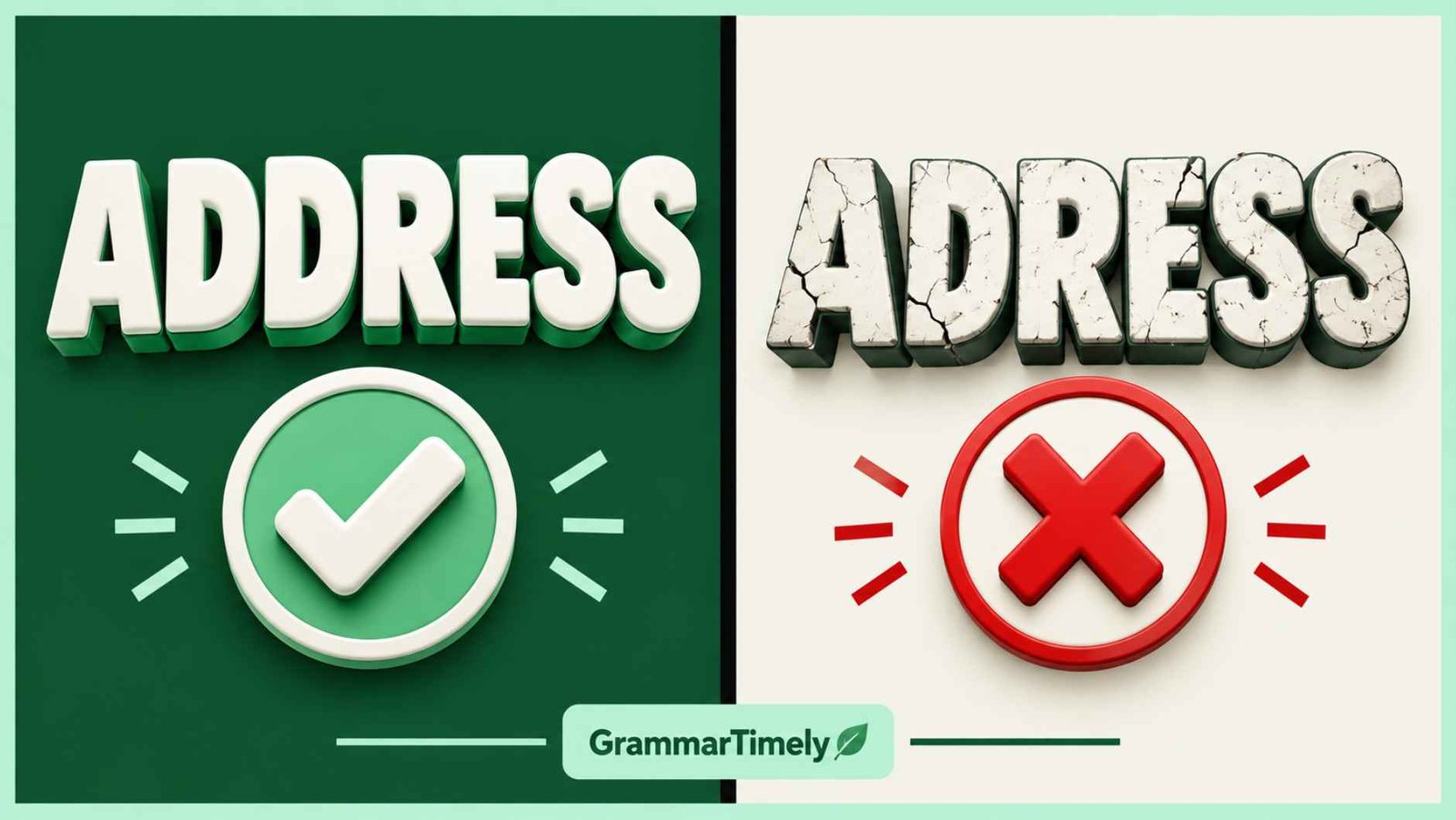
You type it fast, hit send, and then stare at it for a second too long. Is it address or adress? That tiny pause happens to almost everyone, and it usually shows up right before you send an email, fill out a form, or finish a resume.
This guide settles it in one line, then walks through why the word looks the way it does, where people go wrong, and how to remember it for good. If you’ve ever second-guessed your address spelling mid-sentence, you’re about to stop doing that.
Address or Adress – Quick Answer
Address is correct. Adress is a common misspelling and it never appears in standard English, no matter the context or the country.
Why the quick answer matters
The word carries two doubled letters: dd and ss. Drop either one and the spelling breaks, even though the word still sounds almost identical out loud.
Examples:
- Correct: Please write your address clearly on the form.
- Incorrect: Please write your adress clearly on the form.
- Correct: She gave me her home address.
- Incorrect: She gave me her home adress.
What Does Address Really Mean?
Address covers more ground than most people realize, and knowing its full range makes the spelling stick better than any memory trick alone.
Address works as a noun and a verb, and both meanings show up daily.
- Noun: the location where someone lives, works, or receives mail.
- Noun: a formal speech, like a president’s address to the nation.
- Noun: a web or email location, such as a URL or inbox.
- Verb: to speak directly to a person or a group.
- Verb: to deal with a problem or a specific issue.
- Verb: to write a name and location on an envelope.
Example in chat:
Friend 1: can u send me ur address? need to mail the gift
Friend 2: sure, one sec, sending it now
The Origin of Address or Adress
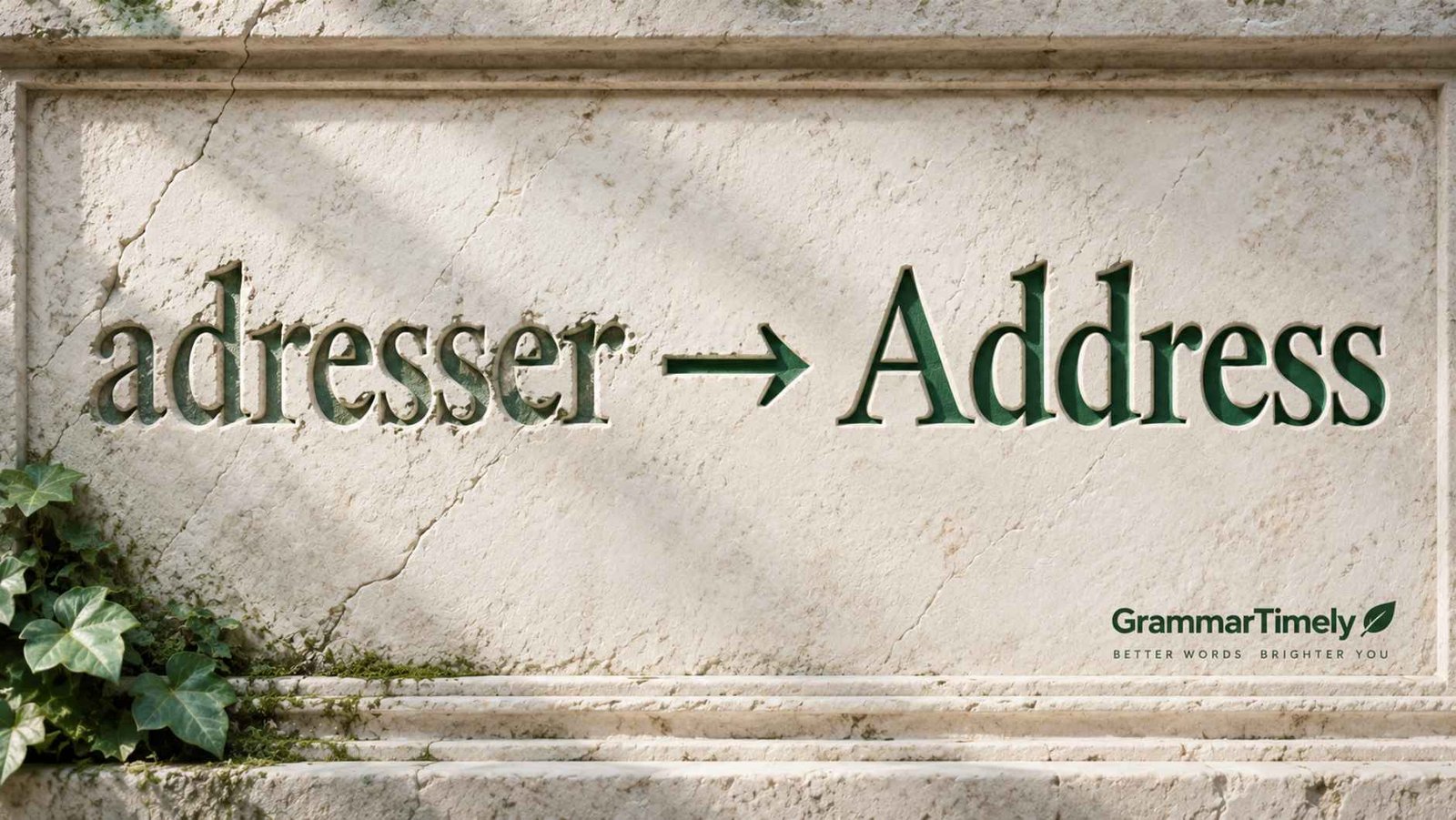
Address traces back to Old French, and that origin explains why the doubled letters exist at all instead of looking like a random spelling quirk.
How the word reached modern English
The word comes from the Old French adresser, meaning to direct or to guide something toward a target. It entered Middle English still tied to that sense of direction, whether directing a letter, a speech, or a person’s attention.
- Old French adresser meant to direct or straighten.
- Middle English kept the meaning of directing speech or mail.
- Modern spelling locked in the double d and double s.
- Adress likely comes from dropping a letter during quick writing.
- No dictionary anywhere lists adress as a valid variant.
Knowing the history helps, but it’s the doubled letters that do the real work day to day. The next section covers whether that changes by country.
British English vs American English Spelling
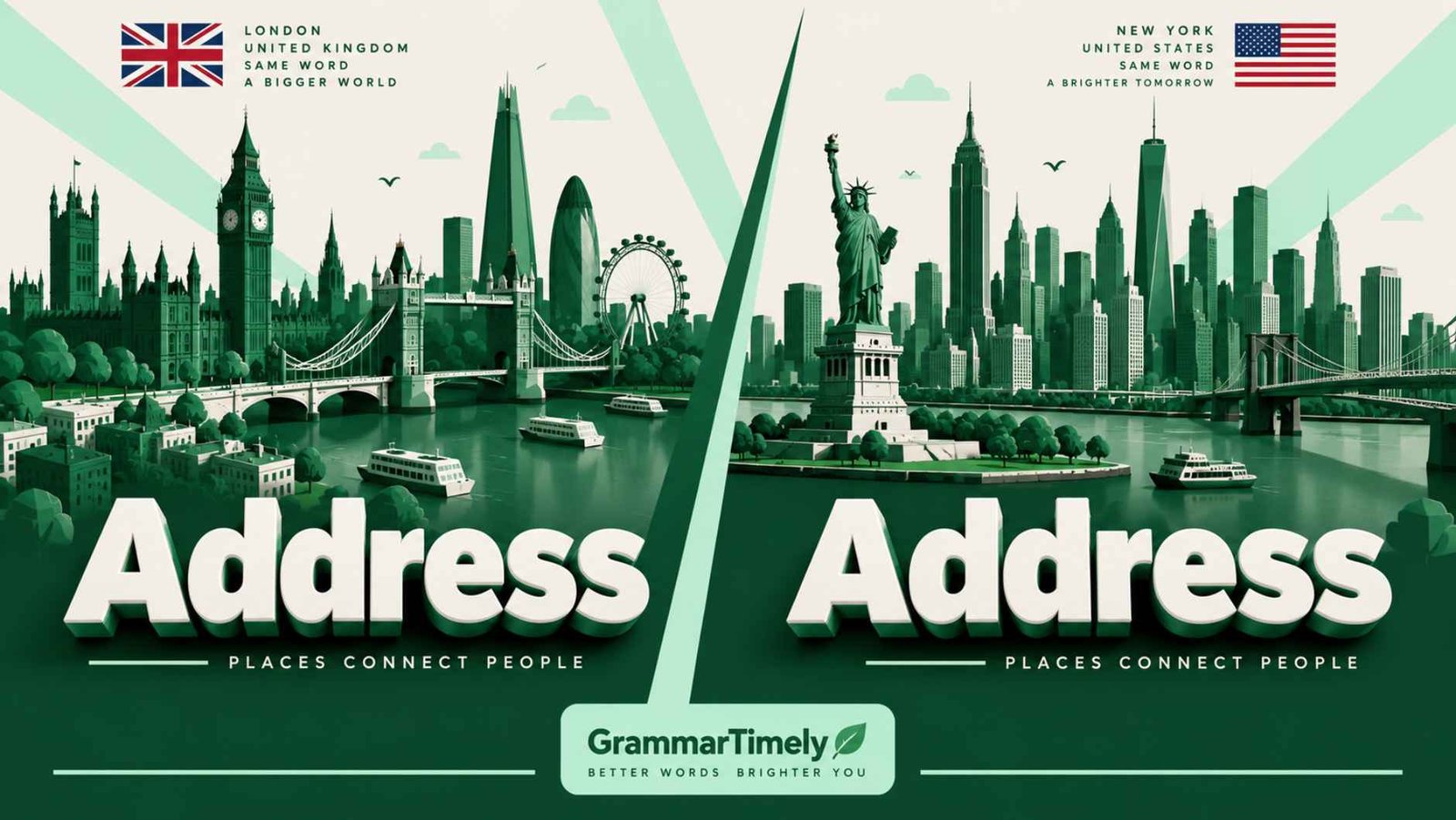
Plenty of words split between British and American spelling (colour versus color, for example), so people assume address does too, but it doesn’t work that way here.
Address stays exactly the same in both British and American English. There’s no colour or color style variation to memorize, which makes this one easier than most.
Comparison Table
| Region | Correct spelling | Incorrect spelling |
| American English | address | adress |
| British English | address | adress |
| Australian English | address | adress |
| Canadian English | address | adress |
| South African English | address | adress |
Address Spelling Rule You Can Actually Remember
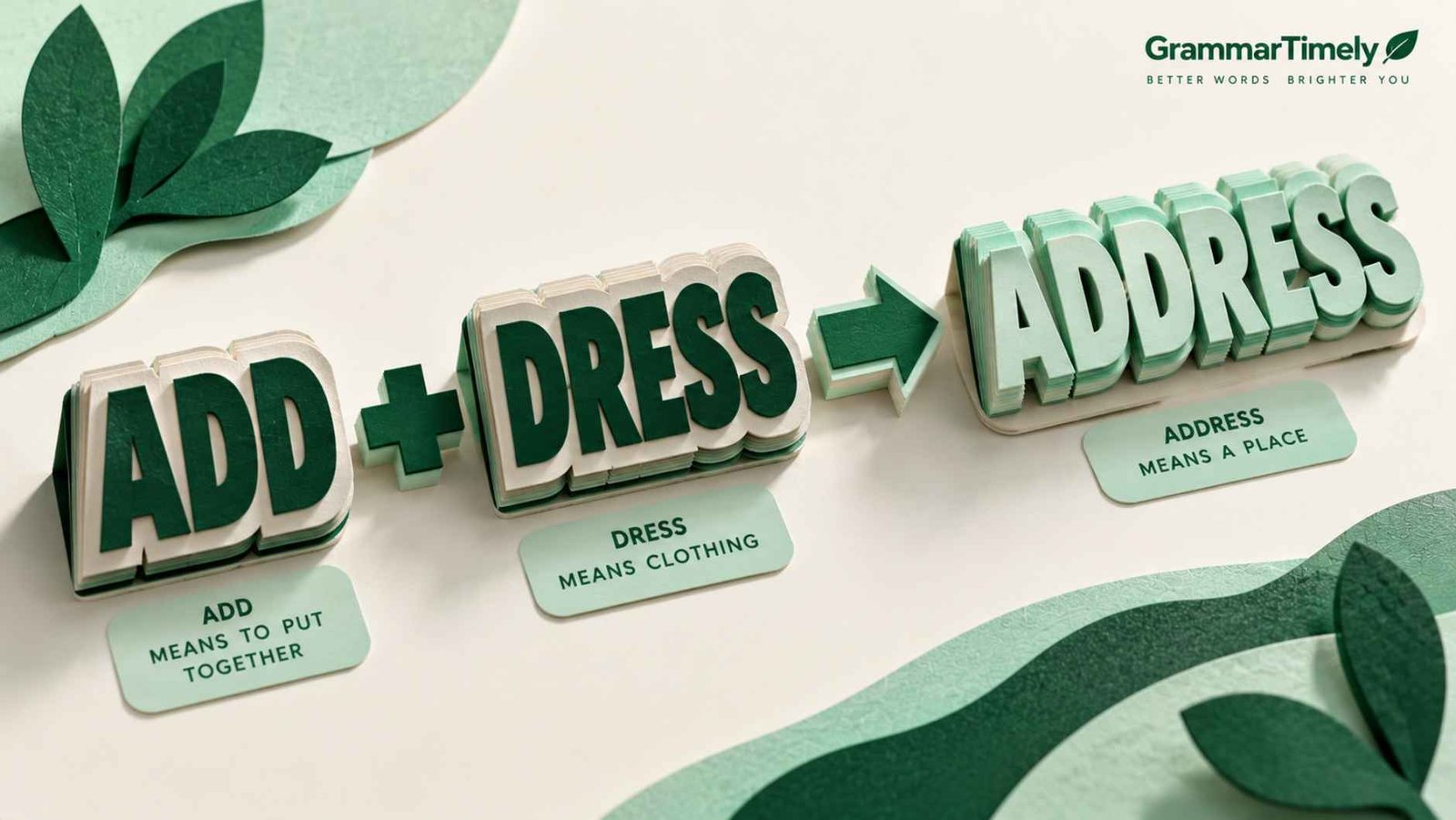
Most spelling rules feel abstract until you tie them to something concrete, and address has one of the easiest memory hooks in English once you see it.
Break the word into two familiar chunks: “add” plus “dress.” Both halves are common English words on their own, and stacking them gives you the exact letter count you need.
- Add: gives you the first “d” and sets up the double d.
- Dress: gives you the double s at the end.
- Count: two d’s, two s’s, nothing extra, nothing missing.
- Say it slow: ad, dress, and the spelling follows naturally.
- Write it once: copying the word by hand locks it in fast.
- Test yourself: cover the word and rebuild it from add plus dress.
| Memory trick | How it works |
| Add + dress | Splits the word into two known words |
| Two d’s, two s’s | Simple letter count to check before sending |
| Sound it, then spell it | Prevents dropping a letter from rushing |
| Compare to “dress” | Dress already has one s pattern you know |
Which Spelling Should You Use?
Writers sometimes assume formal English allows more flexibility than casual English, but address doesn’t bend for tone, audience, or region, which keeps this part simple.
Use address every time, in every context, for every reader.
- Formal writing: address is the only accepted spelling.
- Casual texts: address still holds, even in shorthand messages.
- Resumes and forms: address matters most here for credibility.
- Global audiences: address works identically in every English-speaking country.
- Search engines and autofill: both recognize address, never adress.
Example in texting:
Friend 1: whats your new address, moving stuff over this weekend
Friend 2: just texted it, check ur messages
How Do You Know If You Spelled Address Correctly?
A fast visual check works better than memorizing rules under pressure, especially when you’re typing quickly on a phone and need an instant answer.
Look for the double d right after the first “a,” then look for the double s before the final “s.” If either doubled pair is missing, the word is wrong.
- Check the start: a, then double d, not a single d.
- Check the middle: r, e, then double s.
- Read it aloud slowly: ad, dress, one word, no shortcuts.
- Use spell check: most tools flag adress automatically.
- Compare to a known email: your own address spelling is a built-in reference.
Common Mistakes with Address or Adress
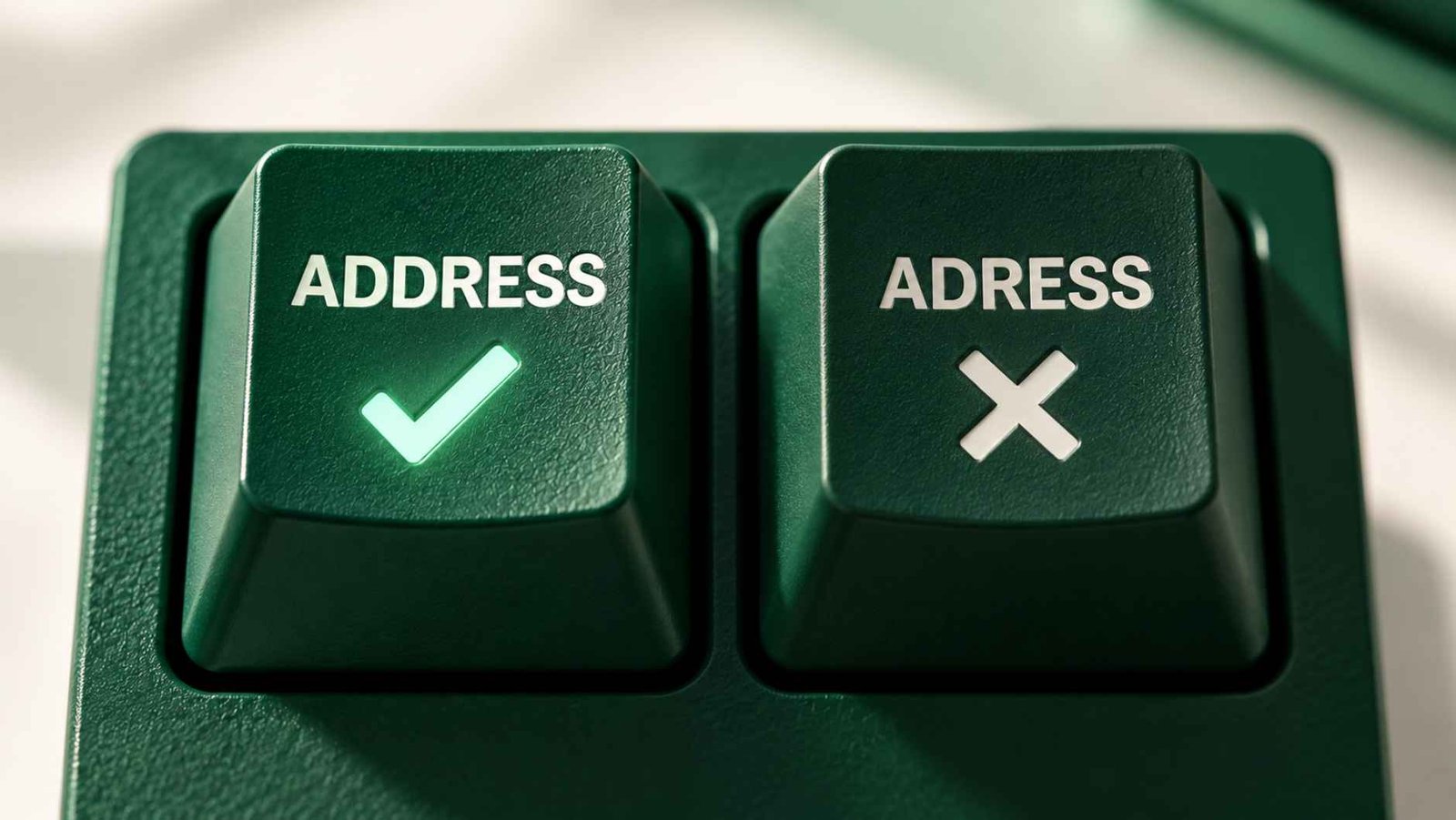
People rarely misspell this word on purpose, and the four patterns below explain almost every case, from rushed typing to bad autocorrect suggestions.
Missing a Letter
- Wrong: adress
- Correct: address
- The missing letter is almost always the first d or the second s.
Confusing Pronunciation
- The word sounds close to “a-dress,” so writers mentally hear one d.
- Pronunciation hides the second d, which is why the rule matters more than the sound.
Typing Fast
- Quick typing on a phone keyboard often skips repeated letters.
- Double letters are the first thing lost when someone types without looking.
Auto-correct Errors
- Some keyboards don’t flag adress as wrong, especially in casual apps.
- Never assume autocorrect caught the mistake; check the word yourself.
Correct Spelling of Address in Resumes, Forms, and Official Documents
A misspelled word rarely sinks a resume by itself, but reviewers notice patterns, and a basic word like address spelled wrong raises a quiet red flag fast.
Official documents carry more weight than casual writing, so the correct spelling of address matters even more in these settings than it does in a text.
- Resumes: your own contact address needs to be flawless.
- Cover letters: repeated use means repeated risk if it’s wrong.
- Job applications: online forms often reject unusual spelling automatically.
- Legal documents: address fields tie directly to identity verification.
- Shipping labels: a wrong spelling doesn’t break delivery, but it looks careless.
- Email signatures: your listed address should match your actual usage exactly.
Example in chat:
Friend 1: can u proofread my resume before I send it
Friend 2: yeah, fixed one typo, you wrote adress instead of address up top
Address or Adress in Everyday Examples
Seeing the word inside real sentences, across different formats, helps the spelling settle into memory faster than any rule on its own.
Emails
Please confirm your address before we ship the order.
News
The company announced a new headquarters address this week.
Social Media
Drop your email address in the comments to enter.
Formal Writing
Kindly update your mailing address in our official records.
In every one of these formats, only address is correct. Context never changes the spelling.
When Should You Double-Check Your Address Spelling?
Some moments carry more risk than others, and knowing when to slow down and verify the spelling saves you from the most damaging mistakes.
- Job applications: double-check before you hit submit.
- Shipping and delivery forms: a typo can delay a package.
- Legal and government paperwork: accuracy matters for identity matching.
- First emails to new contacts: first impressions stick.
- Public posts or bios: visible mistakes get noticed and shared.
- Business cards and letterheads: printed errors are expensive to fix.
Adress ki Spelling: Clearing Up the Confusion for English Learners
Learners often search this word phonetically, mixing English spelling with their first language’s rules, and that habit explains a lot of the confusion around this specific word.
For English learners, adress ki spelling searches usually mean one simple question: how do you spell “address” correctly in English. The answer stays the same no matter what language you’re translating from.
- Sound it out: the English pronunciation hides the double letters.
- Write the base word: address, then check both doubled pairs.
- Practice in sentences: repetition builds spelling memory faster than isolated drills.
- Use flashcards: pairing the word with its meaning helps retention.
- Avoid phonetic spelling: English spelling rarely matches sound one to one.
Example in texting:
Friend 1: how do you spell adress, is it one d or two
Friend 2: two d’s and two s’s, add + dress
Address or Adress – Google Trends & Usage Data
Search interest around this word stays high year-round, and the pattern behind those searches tells you a lot about who’s asking and why.
Why do people search this?
People search this pairing mainly to confirm they’re not making a mistake, not because the rule is genuinely unclear once explained.
- Spelling confusion: the most common reason by far.
- Students learning English: verifying grammar and vocabulary basics.
- Professionals: checking correctness before sending formal documents.
- Content writers: confirming spelling before publishing.
Popular Regions
- United States
- United Kingdom
- India
- Pakistan
- Philippines
Usage Context
- Writing emails and business correspondence.
- Filling out online and paper forms.
- Academic writing and coursework.
- Blogging, SEO content, and web copy.
Adress shows up often in search data, but almost always because people are checking whether it’s wrong, not because it’s an accepted spelling.
Address or Adress in Spell Check and Grammar Tools
Modern writing tools catch most spelling errors automatically, but relying on them completely still leaves gaps, especially with fast typing or casual messaging apps.
| Tool type | Catches “adress”? | Notes |
| Word processors (Word, Docs) | Yes | Flags it immediately with a red underline |
| Browser spell check | Usually | Depends on browser settings and language pack |
| Texting apps | Sometimes | Casual apps often skip minor spelling checks |
| Grammar checkers (Grammarly, etc.) | Yes | Also explains why the word is wrong |
| Search engine autofill | Yes | Suggests “address” even when you type “adress” |
- Word processors: reliable for catching this error every time.
- Texting apps: least reliable, so proofread manually before sending.
- Grammar checkers: useful for learners who want the reasoning explained.
- Browser tools: check your language settings if errors slip through.
Comparison Table – Address vs Adress
| Feature | Address | Adress |
| Correct spelling | Yes | No |
| Used in standard English | Yes | No |
| Accepted in formal writing | Yes | No |
| Accepted in casual writing | Yes | No |
| Recognized by dictionaries | Yes | No |
| Common misspelling | No | Yes |
FAQs
1. Is “adress” ever correct?
No, adress is never correct in standard English. Address is the only accepted spelling everywhere.
2. Why does “address” have double letters?
It comes from Old French roots, where the doubled d and s carried over into modern spelling.
3. Is “address” spelled differently in the UK?
No, the UK and the US use the identical spelling: address, with no regional variation.
4. How can I remember the correct spelling?
Split it into add plus dress. That gives you two d’s and two s’s automatically.
5. Is “address” a noun or a verb?
It’s both. As a noun it means location; as a verb it means to speak to or deal with something.
6. Why do people misspell it?
Fast typing, pronunciation that hides the second d, and unreliable autocorrect all contribute to the mistake.
7. Will using “adress” affect my writing?
Yes, it can make writing look careless, especially in resumes, emails, and other formal documents.
Conclusion
The confusion between address and adress comes down to one simple rule: two d’s, two s’s, no exceptions. Address stays identical across American, British, and every other regional form of English, so there’s no version to memorize by country.
Once you tie the spelling to “add” plus “dress,” the mistake mostly disappears. The word shows up constantly, in emails, forms, resumes, and casual chats, so getting the address spelling right pays off in nearly everything you write. Next time you type it, say it slow, check both doubled letters, and send it with confidence.
For readers working through other easily confused pairs in English, the breakdown of when to use e.g. versus i.e. in a sentence tackles a similar kind of mix-up that trips up even careful writers.

Daniel Parker is an English language writer sharing clear grammar lessons, practical tips, and helpful examples for learners.










1 thought on “Address or Adress – Which Spelling Is Correct?”