
You typed it fast, hit send, then paused. Was it amount or ammount? That tiny half second of doubt over one single letter can make you feel silly, especially once the email has already left your outbox.
This guide clears up the amount or ammount mix-up for good, walking through the real meaning, the origin, and simple memory tricks so you never second guess ammount again. By the end, spelling it right will feel automatic. Keep reading, the answer is easier than you think.
Amount or Ammount – Quick Answer
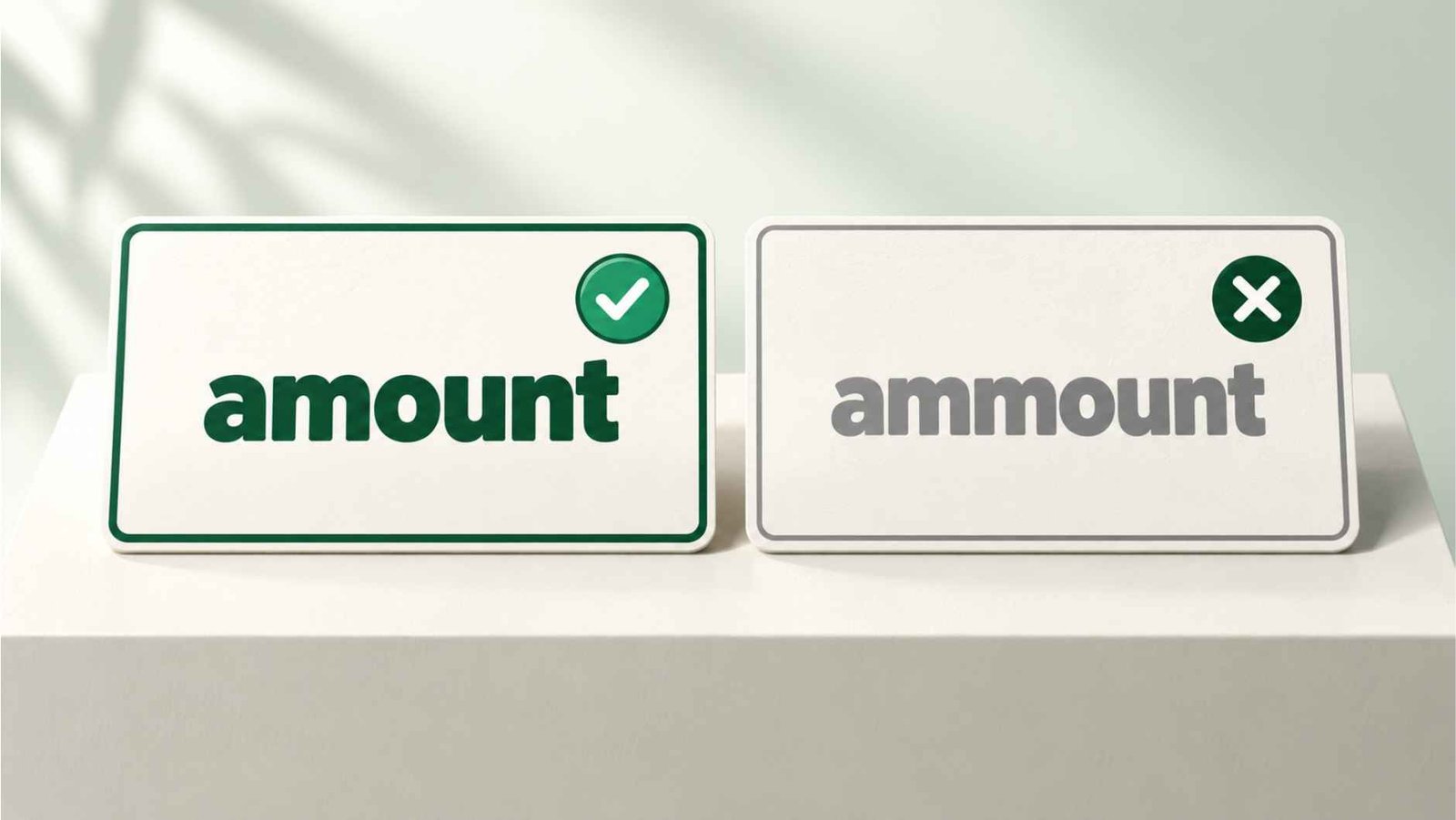
Right up front: the correct spelling is amount, and ammount is never correct in any dictionary, style guide, or grammar rule, no matter how natural it sounds when you type it fast.
- Correct: Amount is the only accepted English spelling.
- Incorrect: Ammount is always a spelling mistake.
- Meaning: Amount refers to a quantity, sum, or total.
- Pronunciation: Amount is said as uh-MOWNT, two syllables.
- Usage: Amount pairs naturally with uncountable nouns like money or time.
- Memory tip: Just one “m,” the same way “mountain” has one.
Ammount or Amount meaning
Amount is a noun, and sometimes a verb, that describes how much of something exists, whether that’s money, time, effort, or rainfall. Ammount carries no meaning of its own because it isn’t a real word; it’s simply amount with an extra letter added by accident. When the two sit side by side, remember that only one of them belongs in any dictionary: amount.
Example in writing: Friend 1: Can you tell me the amount I owe you? Friend 2: Sure, just don’t spell it ammount on the invoice!
The Origin of Amount or Ammount
Long before spellcheck existed, amount was already a settled word with a clear history, while ammount never appeared at any stage of the English language, not in Old French, Middle English, or modern dictionaries.
Where Does the Word Amount Come From?
- Root: Amount traces back to the Old French word amonter.
- Original meaning: Amonter meant to ascend, rise, or add up.
- Middle English stage: The word became amounten before settling.
- No double letter: Ammount never existed at any historical point.
- Pattern confusion: Words like common and summit mislead modern writers.
- Modern spelling: Amount has stayed unchanged for several centuries.
Example in writing: Friend 1: Why do people even spell it ammount? Friend 2: Probably because words like “common” have double letters, so it feels natural.
How to Spell Amount Correctly Every Time
Once you understand why amount only needs one “m,” spelling it correctly stops being a guessing game, even under pressure, in exams, emails, or fast group chats.
What’s the Easiest Way to Remember Amount’s Spelling?
- Break it down: Think a plus mount, one “m,” like mountain.
- Say it slow: Sound out each syllable before typing the word.
- Visualize it: Picture one mountain, never two, when you write it.
- Compare words: Link amount to total, another single-consonant word.
- Practice by hand: Write the correct word a few times daily.
- Trust your tools: Most spellcheckers flag ammount right away.
Example in chat: Friend 1: I always mess up amount, is it one m or two? Friend 2: Just one, think “a mount,” like climbing a mountain.
British English vs American English Spelling
Some words change completely between British and American English, but amount is not one of them, and neither is the amount or ammount confusion, since both regions reject ammount equally.
Comparison Table
| Variant | British English | American English |
| Correct spelling | Amount | Amount |
| Incorrect spelling | Ammount | Ammount |
| Regional difference | None | None |
- No split: Unlike colour and color, amount never changes.
- Global standard: Every English-speaking country accepts only amount.
- Formal writing: Amount works in UK and US documents alike.
- Style guides: APA, MLA, and Chicago all use amount consistently.
- One rule everywhere: A single spelling works across every dialect.
Example in writing: Friend 1: Is amount spelled differently in British English? Friend 2: Nope, same everywhere, just one m, no exceptions at all.
Which Spelling Should You Use?
If you’ve ever hesitated before submitting an assignment or invoice, wondering whether amount or ammount looks more correct, the decision is refreshingly simple: always choose amount.
When Is It Safe to Use Amount?
- Always: Amount works correctly in every writing context.
- Emails: Use amount when confirming totals or payments due.
- Essays: Amount fits formal and academic writing equally well.
- Texting: Even casual chats deserve the correct spelling, amount.
- Resumes: Recruiters notice small spelling errors like ammount quickly.
- Legal documents: Amount is the only spelling accepted legally.
Example in texting: Friend 1: Do I still need to spell it amount even in a text? Friend 2: Yes, ammount looks like a typo everywhere, even in casual chats.
Common Mistakes with Amount or Ammount

Even careful writers slip up here, mixing up ammount with extra letters or second-guessing amount vs ammount entirely, especially when typing quickly on a phone keyboard.
What Are the Most Common Amount Spelling Errors?
| Mistake | Why It Happens | Correct Form |
| Ammount | Extra “m” added out of habit | Amount |
| Amout | A letter dropped while typing fast | Amount |
| Amownt | A phonetic spelling attempt | Amount |
| Ammounts | The same error carried into plural form | Amounts |
- Double letter habit: Writers copy patterns from words like summit.
- Autocorrect gaps: Some keyboards fail to flag ammount automatically.
- Fast typing: Rushed messages skip proper spelling checks entirely.
- Non-native confusion: Learners sometimes assume phonetic spelling applies.
- Ignoring red underlines: Writers dismiss spellcheck warnings too casually.
Example in chat: Friend 1: I just sent ammount instead of amount again. Friend 2: Happens to everyone, just fix it before they notice.
What Does Ammount Mean in English?
Here’s the honest answer: ammount has no meaning in English at all, because it isn’t a recognized word, unlike its correctly spelled twin, amount.
Is Ammount Ever Listed in a Dictionary?
- No entry: Ammount doesn’t appear in Merriam-Webster or Oxford.
- Not slang either: Ammount isn’t accepted casual or informal usage.
- Pure error: It only exists as a common typing mistake.
- Search behavior: People type it while unsure of the spelling.
- Simple fix: Every instance should be replaced with amount.
Example in writing: Friend 1: Does ammount actually mean something different? Friend 2: No, it’s just a misspelling, the real word is amount.
Grammar Rules for Using Amount in a Sentence
Getting the spelling right is only half the job, because amount also follows grammar rules that differ from the word number, especially with countable and uncountable nouns.
Should You Use Amount With Countable or Uncountable Nouns?
| Noun Type | Correct Word | Example |
| Uncountable | Amount | A large amount of water |
| Countable | Number | A large number of bottles |
| Money (uncountable) | Amount | The amount of money saved |
| People (countable) | Number | The number of people attending |
- Uncountable nouns: Use amount with water, time, or money.
- Countable nouns: Use number with people, items, or bottles.
- Common error: Writers often say “amount of people” by mistake.
- Verb form: Amount can also mean to total, as in amounts to.
- Preposition rule: Amount usually pairs with “of” before a noun.
Example in writing: Friend 1: Is it “amount of people” or “number of people”? Friend 2: Number of people, amount is for things you can’t count.
Amount or Ammount in Everyday Examples
From invoices to casual texts, amount shows up everywhere, and every time the ammount or amount debate comes up, it ends the same way, with amount as the only right choice.
Where Do You See Amount Used Most Often?
- Finance: Amount appears on invoices, receipts, and bank statements.
- Emails: Professionals confirm the amount due before processing payment.
- News: Reporters describe a large amount of rainfall or damage.
- Social media: Users mention the amount of hype around events.
- Texting: Friends casually discuss the amount owed for dinner.
Spelling isn’t the only thing people search for mid conversation. Sometimes it’s meaning itself that trips readers up, the same way group chats get confused over what a certain symbol means, like this breakdown of the happy emoji’s meme meaning that keeps popping up in texts.
Example in texting: Friend 1: What’s the total amount for dinner tonight? Friend 2: $42, I’ll send the exact amount over Venmo.
Why Do People Misspell Amount as Ammount?
The psychology behind this mistake is simple: our brains expect symmetry, and ammount just feels balanced, even though amount vs ammount was never really a fair fight.
What Causes the Ammount Spelling Mistake?
- Pattern matching: Double letters appear in many similar-sounding words.
- Speed typing: Fast typing skips proper spelling verification steps.
- Pronunciation confusion: Stressed syllables can suggest doubled letters exist.
- Learned habit: Repeated errors slowly become automatic muscle memory.
- Lack of feedback: Casual writing rarely gets corrected right away.
Example in chat: Friend 1: Why do I always want to add an extra m? Friend 2: Your brain is copying words like “summit,” it’s a common habit.
Amount vs Number: What’s the Real Difference?
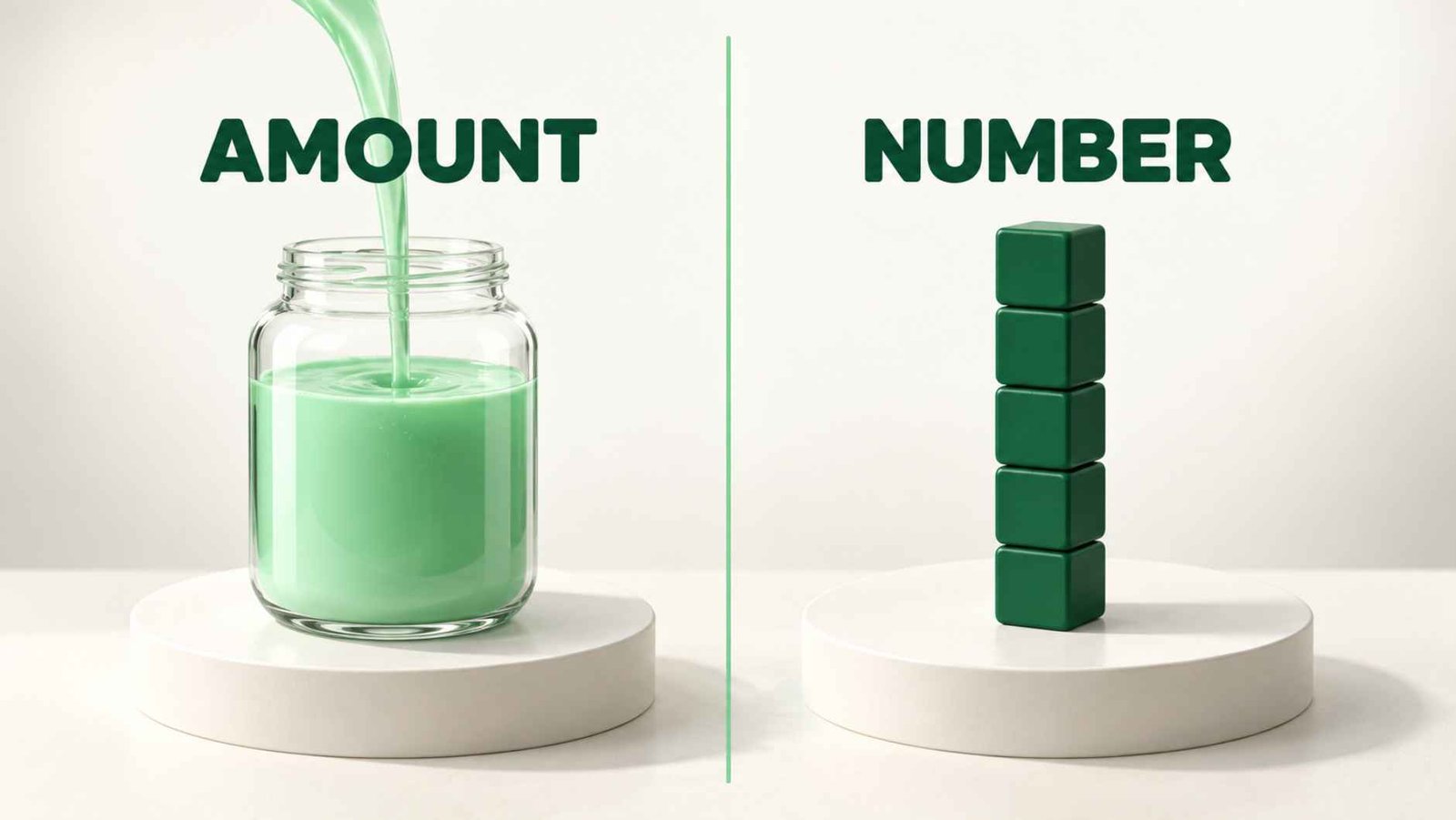
Many writers who search amount vs ammount are actually facing a second, sneakier problem: knowing when amount should be swapped for the word number instead.
How Do You Know Whether to Use Amount or Number?
| Word | Used For | Example |
| Amount | Uncountable things | A small amount of sugar |
| Number | Countable things | A small number of cookies |
| Amount | Money, time, effort | The amount of effort required |
| Number | People, items, events | The number of events scheduled |
- Amount: Reserved for things you can’t count one by one.
- Number: Reserved for things you can count individually.
- Quick test: Ask if you can count “one, two, three” of it.
- Money rule: Amount always applies, since money isn’t counted item by item.
- People rule: Number applies, since people are counted individually.
Example in writing: Friend 1: Should I say amount of tasks or number of tasks? Friend 2: Number, tasks are countable, amount is for things like time.
Synonyms and Related Words for Amount
Once you’re confident with the spelling, expanding your vocabulary around amount makes your writing sound more polished, and keeps you far away from ever typing ammount again.
What Are the Best Synonyms for Amount?
| Synonym | Best Used For |
| Quantity | General measurable totals |
| Sum | Money or financial totals |
| Total | Combined final figures |
| Volume | Liquids or large-scale measurements |
| Extent | Degree or scope of something |
- Quantity: A neutral, general replacement for amount.
- Sum: Best suited for money-related contexts and totals.
- Total: Useful when combining several smaller figures together.
- Volume: Fits liquids, sound levels, or large-scale measurements.
- Extent: Works when describing degree rather than pure quantity.
- Aggregate: A more formal, academic alternative to amount.
If you ever need the opposite idea, words like shortage or deficiency work well in place of amount, since amount itself has no single direct antonym.
Example in writing: Friend 1: Can I use “quantity” instead of amount here? Friend 2: Yes, quantity works great as a synonym in most sentences.
How Can You Remember the Correct Spelling of Amount?
If ammount or amount still trips you up occasionally, a few simple memory tricks can lock in the correct spelling permanently, even during timed exams or quick replies.
What Memory Tricks Actually Work for Amount?
- One mountain rule: Picture a single mountain, a single “m.”
- Rhyme it: Amount rhymes with mount, never with “ammount.”
- Spell aloud: Say each letter slowly before writing the word.
- Use flashcards: Repetition builds long-term spelling memory naturally.
- Read more often: Regular reading reinforces correct spelling over time.
Example in chat: Friend 1: Got any trick for remembering amount’s spelling? Friend 2: Just think “a mount,” one mountain, one m, done.
Amount or Ammount – Google Trends & Usage Data
Search data tells its own story about amount or ammount, showing that most people typing ammount are actually double-checking themselves, not confidently using the wrong word.
What Do Search Trends Reveal About This Spelling Mistake?
| Search Term | Typical Search Intent | Search Volume Trend |
| amount or ammount | Checking the correct spelling | High |
| ammount or amount | Checking the correct spelling | High |
| amount vs ammount | Comparing both spellings directly | Moderate |
| how to spell amount | Learning the correct spelling | Low but steady |
| ammount | Accidental typo while searching | Very high |
- High volume: Ammount is searched hundreds of times monthly.
- Self-correcting users: Most searchers already suspect it’s wrong.
- Global pattern: Searches come from students and professionals worldwide.
- Non-native speakers: Many searches originate from English language learners.
- Consistent trend: Amount always outperforms ammount in actual written use.
Amount or Ammount Comparison Table
For a quick side by side reference, this table sums up everything worth knowing about amount and why ammount never makes the cut.
| Feature | Amount | Ammount |
| Correct spelling | Yes | No |
| Found in dictionaries | Yes | No |
| Accepted in exams | Yes | No |
| Accepted in professional writing | Yes | No |
| Recognized by spellcheck | Yes | Flagged as an error |
- Dictionary status: Amount is listed, ammount is not.
- Professional use: Amount is safe for any formal document.
- Spellcheck result: Ammount gets flagged in nearly every tool.
- Consistency: Amount never changes across regions or contexts.
- Final verdict: Choose amount, always, without exception.
FAQs About Amount or Ammount
Is ammount a real word?
No, ammount is not a real word in English. The correct and only accepted spelling is amount.
Why do people write ammount instead of amount?
Many writers add an extra “m” out of habit, confusing ammount with double-letter words like common or summit. It’s a spelling slip, not a grammar rule.
Is amount or ammount correct in British English?
Amount is correct everywhere, including British English. Ammount is incorrect in every English-speaking country, with no regional exception.
Does autocorrect always catch ammount?
Most modern spellcheckers flag ammount immediately as an error. Some basic text fields or older systems may still miss it occasionally.
What is a good synonym for amount?
Common synonyms include quantity, sum, and total. None of these should ever be replaced with the incorrect spelling ammount.
Can ammount ever be used informally?
No, ammount isn’t acceptable even in casual texting or on social media. Using amount consistently keeps your writing clear and credible.
How can I stop writing ammount by mistake?
Practice the “one mountain” memory trick and proofread before sending. Over time, avoiding ammount becomes second nature.
Conclusion
The debate between amount and ammount really has one simple resolution: amount wins, every single time. There’s no British versus American split, no situation where the extra letter sneaks in correctly, and no dictionary that lists ammount as valid. The confusion mostly comes from how the word sounds, plus a natural tendency to copy double-letter patterns from words like summit or common. Once you understand the origin, the meaning, and the simple “one mountain” trick, amount or ammount stops being a guessing game.
Whether you’re writing an invoice, a text message, or a college essay, choosing amount protects your credibility and keeps your writing polished. Small spelling details like this genuinely shape how readers see you. Next time your fingers reach for that extra “m,” pause, picture one mountain, and type it right.

Daniel Parker is an English language writer sharing clear grammar lessons, practical tips, and helpful examples for learners.










1 thought on “Ammount Meaning Revealed: Is It Amount or Ammount?”