
You typed it fast, hit send, and then that little itch showed up: did you just write studing instead of studying? Almost everyone has felt that half-second panic after firing off a text or an email, wondering if a tiny missing letter just made them look careless.
Here’s the good part. This guide clears up studying or studing for good, with the real meaning, the exact rule behind it, easy examples, and a memory trick that actually sticks. You’ll walk away knowing exactly which one to use every single time, so keep reading.
Quick Answer: Studying vs Studing
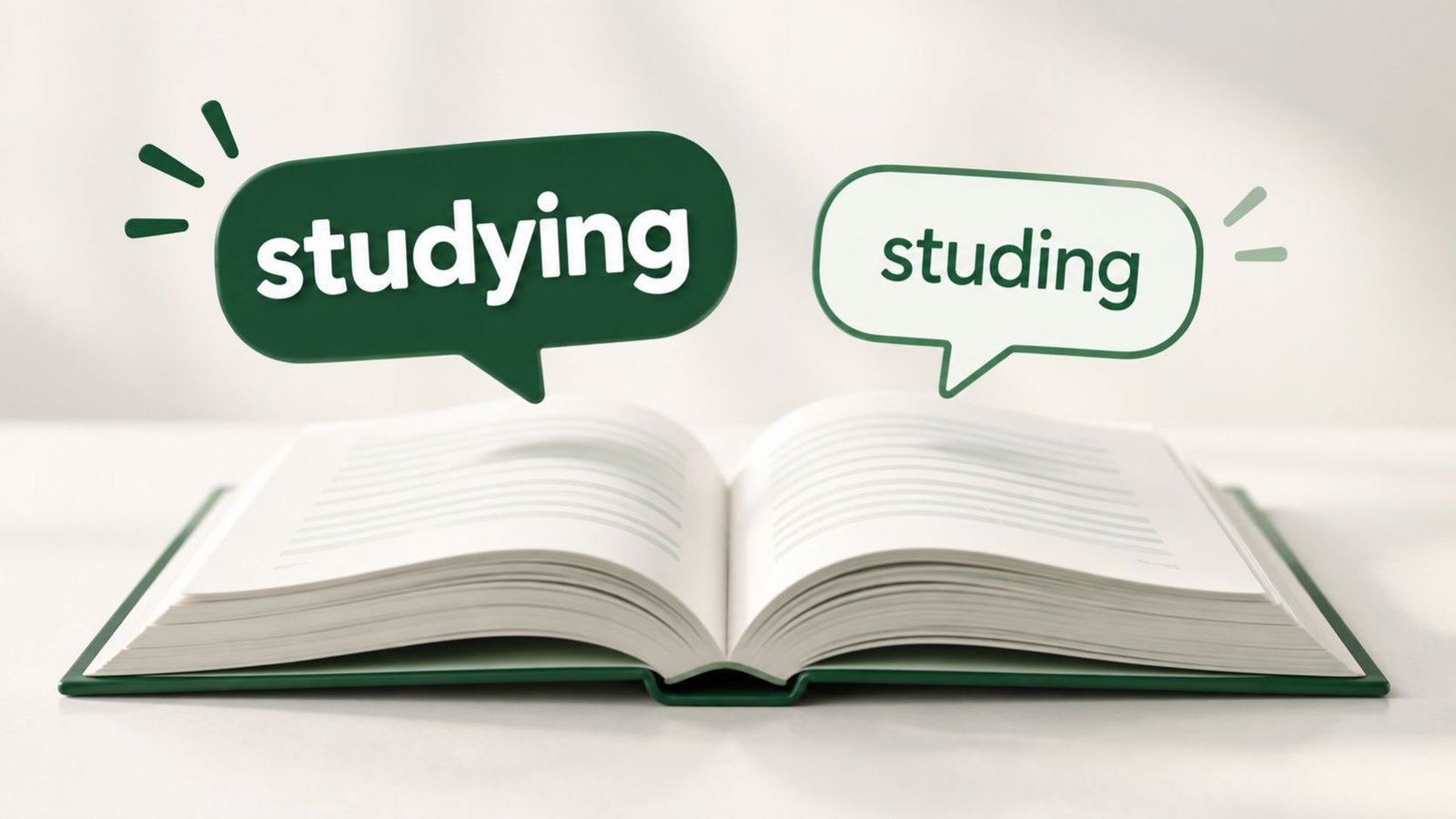
Short on time? Here’s the fast version so you can stop second-guessing your sentence and get back to whatever you were writing in the first place.
- Correct spelling: studying — the present participle of “study.”
- Incorrect spelling: studing — not a real English word.
- The rule is simple: study keeps its y and just adds -ing.
- Studing shows up mostly from typos or rushed typing, not a real grammar rule.
- Dictionaries, spell-checkers, and style guides all confirm studying as standard.
| Feature | Studying ✅ | Studing ❌ |
| Recognized spelling | Yes | No |
| Meaning | Learning, reading, focusing on a subject | No meaning, misspelling |
| Grammar rule followed | “vowel + y” + ing rule | Breaks the rule |
| Dictionary status | Standard English word | Not listed |
| Common usage | Formal & informal writing | Typing error only |
Example in texting: Friend 1: is it studying or studing for the essay deadline thing Friend 2: studying, always keep the y before ing
What Does “Studying” Mean?
If you’ve ever wondered about the real studying meaning, it’s simpler than it looks: it’s just the present participle of “study,” describing the act of learning something on purpose.
Simple Definitions:
- The act of learning or gaining new knowledge on purpose.
- Focusing closely on a subject, book, or topic.
- Preparing for a test, exam, or presentation.
- Researching a topic in depth over time.
- Reviewing material to remember it better later.
Examples in Sentences:
- She is studying for her final exams tonight.
- He enjoys studying new languages during his commute.
- They are studying the effects of climate change.
- We’ve been studying grammar rules like studying or studing all week.
- I started studying earlier than usual this semester.
What Does “Studying” Really Mean in Grammar?
Grammar-wise, studying does one specific job: it’s the -ing form of “study,” used for ongoing actions and continuous tenses that native speakers rely on constantly.
- It functions as a present participle after “am/is/are.”
- It works as a gerund when it acts like a noun, as in “Studying helps memory.”
- It pairs with “was/were” to describe past continuous actions.
- It never drops the y, unlike the past tense “studied.”
- It follows the same pattern as play → playing and enjoy → enjoying.
How Is “Studying” Used in Everyday Conversations?
- People text friends about cramming the night before a test.
- Students describe their routines using “I’m studying right now.”
- Coworkers mention studying for certifications or licenses casually.
- Parents ask kids if they’ve finished studying for the day.
- Online learners post about studying courses on social media.
Example in chat: Friend 1: what are you up to tonight Friend 2: just studying for chemistry, ask me tomorrow
Why Do People Write “Studing”?
The incorrect spelling studing usually pops up not because someone misunderstands English, but because typing fast and skipping a rule can quietly override good instincts.
Common Reasons:
- Dropping a letter by accident while typing quickly.
- Not knowing the specific “vowel + y” spelling rule.
- Rushing through texts, emails, or comments without proofreading.
- Confusing it with words that do drop letters, like “write → writing.”
- Autocorrect occasionally failing to flag the error on mobile keyboards.
Because “study” ends in a “y,” people sometimes assume every “y” behaves the same way when a suffix gets added, and that small assumption is exactly where studing sneaks in.
Why Do People Confuse Studying and Studing?
This mix-up isn’t really about weak spelling skills. It happens because English has several y-related rules, and studying quietly breaks the pattern people expect.
- English learners generalize the “y changes to i” rule too broadly.
- Fast typing on phones increases the chance of dropped letters.
- Spell-check tools sometimes miss context-based mistakes like this one.
- Some people assume “study” behaves like “studied” in every form.
- Repetition of the wrong spelling in casual chats reinforces the habit.
Example in texting: Friend 1: wait is studing even a word Friend 2: nope, it’s studying, the y just stays put
Understanding the Correct Spelling Rule

The correct form studying isn’t random. It follows one clean, predictable rule that applies to a whole family of English verbs ending in a vowel plus y.
The Rule:
👉 When a verb ends in a vowel + y, you simply add -ing without touching the y at all.
Examples:
- Study → Studying
- Play → Playing
- Enjoy → Enjoying
- Stay → Staying
- Buy → Buying
Key Insight:
👉 The y stays exactly where it is. You just tack on -ing, nothing more.
This explains the whole studying or studing debate in one line: Studying ✅, Studing ❌.
Is “Studying” a Noun or a Verb?
This little grammar question trips people up constantly, because studying can wear two different hats depending on where it sits in a sentence.
- As a verb, it shows continuous action: “She is studying.”
- As a gerund (a noun-like form), it can be a subject: “Studying improves memory.”
- It can follow prepositions, as in “good at studying.”
- It never changes spelling regardless of which job it’s doing.
- Context, not spelling, decides its grammatical role in a sentence.
| Sentence | Role of “Studying” |
| Studying takes discipline. | Gerund (noun-like) |
| She is studying tonight. | Verb (present participle) |
| I’m tired of studying. | Gerund after preposition |
| Studying hard paid off. | Gerund as subject |
Example in chat: Friend 1: is studying a verb here “studying is exhausting” Friend 2: technically a gerund, but honestly nobody checks that while texting
Studying vs Studing: Comparison Table
| Feature | Studying ✅ | Studing ❌ |
| Correct spelling | Yes | No |
| Meaning | Learning or focusing | No meaning |
| Grammar rule | Follows “-y + ing” rule | Incorrect formation |
| Dictionary status | Recognized | Not recognized |
| Usage | Formal & informal | Incorrect |
| Search intent | studying or studing, studying meaning | Typo variant |
Common Mistakes to Avoid
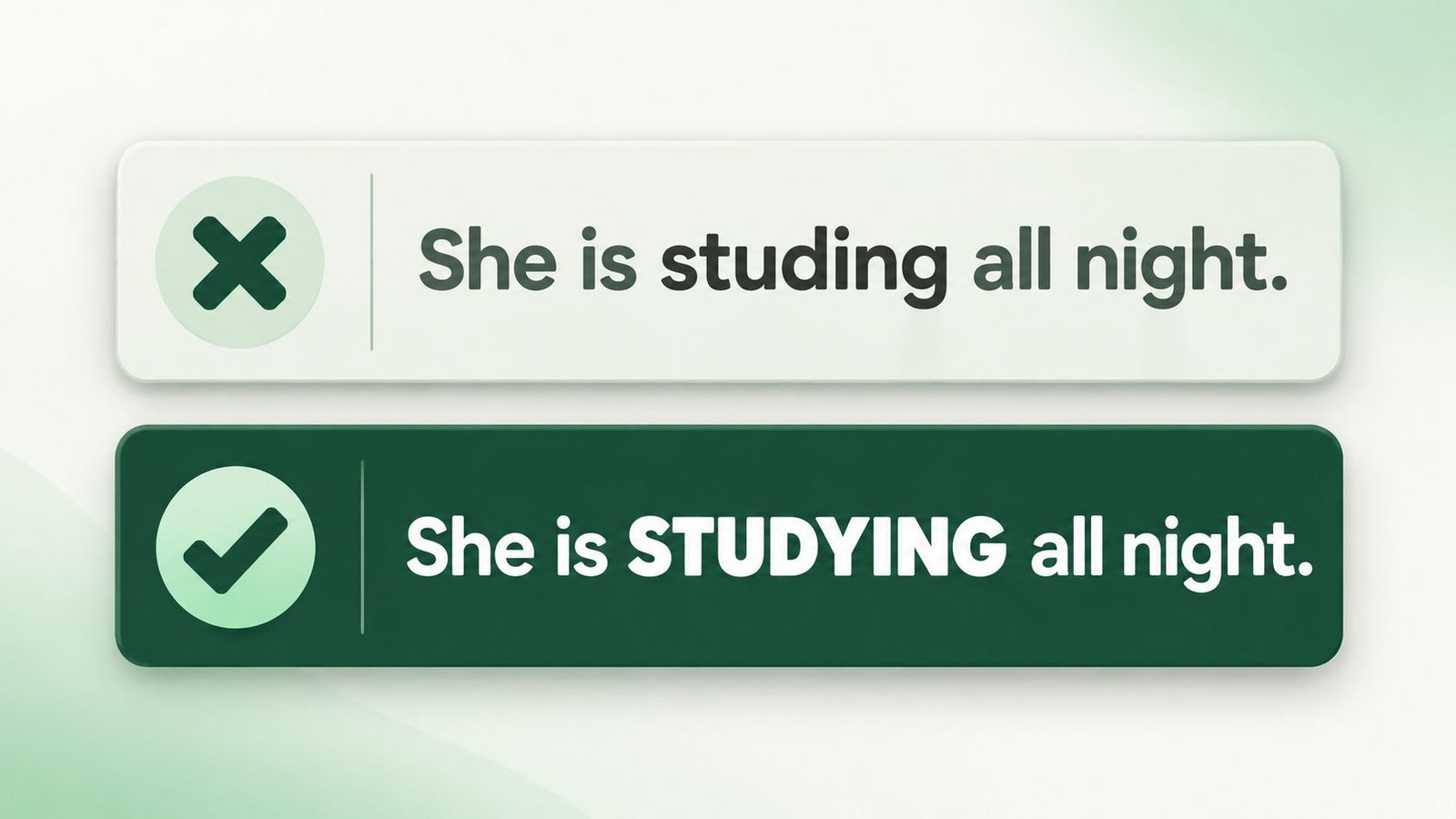
Even confident writers slip up here occasionally, usually because habit, autocorrect, and rushed typing all collide at the worst possible moment.
1. Dropping the “Y”
❌ She is studing all night. ✅ She is studying all night.
2. Confusing with Other “Y” Rules
Some words change y to i when adding a suffix, like “study → studied,” but that shift never happens with -ing.
3. Typing Too Fast
Quick typing on a small keyboard often leads to a missing letter slipping through unnoticed.
4. Mixing Verb Forms
- Study → Studied (past tense)
- Study → Studying (present participle)
- Study → Studies (third person singular)
This same kind of tense mix-up shows up in other tricky English verbs too, like the irregular pair covered in ridden vs rode, where picking the wrong form can make writing look rushed even when the meaning stays clear.
How to Use “Studying” Correctly in a Sentence
Using studying correctly comes down to placement: it almost always follows a form of “be” or sits as a gerund doing the job of a noun.
- Pair it with am/is/are for present continuous tense.
- Pair it with was/were for past continuous tense.
- Use it right after prepositions like “for,” “about,” or “on.”
- Place it as the subject of a sentence when discussing habits.
- Avoid pairing it with has/have alone; that needs “studied” instead.
Example in texting: Friend 1: is “she has studying” correct Friend 2: no, “she has studied” or “she is studying,” never mix those
More Examples of “Studying” in Context
In Academic Life:
- Students are studying hard for exams.
- She spends hours studying every day before finals.
In Everyday Use:
- He is studying the instructions carefully.
- They are studying the map before traveling.
In Professional Context:
- Researchers are studying new technologies in the lab.
- Analysts have spent months studying market trends.
Words That Follow the Same “-Y + ING” Rule as Studying

Studying isn’t a lone exception. A whole cluster of common English verbs follow the exact same “vowel + y” pattern, which makes the rule worth memorizing once and reusing forever.
- Play → Playing, never “playing” loses the y.
- Stay → Staying, follows the identical vowel-plus-y logic.
- Enjoy → Enjoying, a frequent verb in casual speech.
- Destroy → Destroying, used often in news and writing.
- Employ → Employing, common in professional contexts.
- Annoy → Annoying, shows up constantly in everyday chat.
| Base Verb | Correct “-ing” Form |
| Study | Studying |
| Play | Playing |
| Stay | Staying |
| Enjoy | Enjoying |
| Destroy | Destroying |
Example in chat: Friend 1: does the same rule apply to enjoy and stay Friend 2: yep, same pattern, vowel plus y just keeps the y
American vs British English Differences

There is no difference between American and British English for this word, which makes studying or studing one of the rare spelling questions with a universal answer.
- 🇺🇸 American English: studying
- 🇬🇧 British English: studying
Both regions follow the exact same “vowel + y” rule, so there’s no regional spelling variant to memorize separately, unlike words that genuinely shift between -ize and -ise endings.
Why Correct Spelling Matters
Using the correct spelling of studying improves your writing clarity and makes you look more careful, especially in emails, resumes, and school assignments.
Key Benefits:
- Enhances readability for anyone reading your message.
- Builds trust with readers, teachers, or clients.
- Prevents confusion in formal and academic writing.
- Improves communication in fast-paced group chats.
- Signals attention to detail in professional settings.
Even a small slip like studing can make otherwise solid writing look rushed or unpolished to a careful reader.
When Should You Use “Studying” Instead of “Studied”?
This is one of the most searched grammar questions tied to this topic, and the answer depends entirely on whether the action is ongoing or already finished.
- Use studying for actions happening right now.
- Use studying after “am/is/are/was/were” for continuous tense.
- Use studied for actions that are already completed.
- Use studied after “have/has/had” for perfect tenses.
- Test it by asking: is this action finished or still happening?
| Situation | Correct Form |
| Action happening now | I am studying |
| Action already finished | I studied |
| Perfect tense with “have” | I have studied |
| Ongoing past action | I was studying |
Example in texting: Friend 1: is it “I studying” or “I am studying” Friend 2: always add “am,” just “I studying” isn’t a full sentence
Studying Meaning in Different Contexts
The core studying meaning stays the same everywhere, but the tone and setting shift depending on where the word shows up in real conversation.
- In school, it means preparing for tests or homework.
- In work, it means researching data, trends, or reports.
- In casual chat, it often means quick, last-minute review.
- In academic writing, it can describe formal research methods.
- In hobbies, it can mean learning a new skill or language.
Example in chat: Friend 1: what does studying even mean when you’re not in school anymore Friend 2: same thing honestly, just learning something on purpose
Synonyms and Related Words
Using similar words keeps your writing varied and more engaging, especially when discussing academic or research-related topics.
Synonyms of “Studying”:
- Learning
- Reading
- Reviewing
- Analyzing
- Practicing
- Researching
Easy Memory Trick
Here’s a simple way to remember which one is right, so you never have to second-guess studying or studing again.
👉 “Study keeps its ‘y’ when adding ‘-ing,’ just add and go.”
Picture the y as a stubborn letter that refuses to leave its spot, no matter how fast you’re typing.
FAQs About Studying vs Studing
Is “studing” ever correct?
No, studing is always incorrect. It has no meaning and doesn’t appear in standard English dictionaries.
What is the correct spelling?
The correct spelling is studying, following the “vowel + y” plus “-ing” rule used across English.
Why doesn’t “study” change to “studiing”?
Because the rule only adds “-ing” directly onto verbs like studying, without changing or doubling the “y.”
When does “y” change to “i”?
That shift happens in forms like “studied,” but never when you’re forming studying with “-ing.”
Is there a British vs American difference?
No, both regions use studying, so studying or studing has one universal answer worldwide.
Can “studying” be used in formal writing?
Yes, studying is completely standard in essays, reports, resumes, and any formal or academic writing.
How can I remember the correct spelling?
Just remember: keep the “y” when adding “-ing,” and you’ll always land on studying correctly.
Summary: Studying vs Studing
The difference in studying or studing comes down to one simple, memorable rule. Studying is the correct spelling and follows the standard “vowel + y” pattern, while studing is a common slip caused by dropping a letter under pressure.
Once that rule clicks, you’ll never second-guess studying again, whether you’re texting a friend, writing an essay, or sending a work email. Small details like the true studying meaning and its spelling shape how clearly your writing comes across to other people.
Final Thoughts
Spelling may look like a minor detail, but it quietly shapes how your writing gets perceived by teachers, coworkers, and readers everywhere. By consistently choosing studying over studing, you keep your message clear, professional, and easy to trust.
Next time your fingers move faster than your brain, pause for half a second and remember: the y stays, the “-ing” just joins it. That’s the whole rule behind studying or studing, settled for good.

Daniel Parker is an English language writer sharing clear grammar lessons, practical tips, and helpful examples for learners.










1 thought on “Studying or Studing: The Ultimate Meaning Guide”