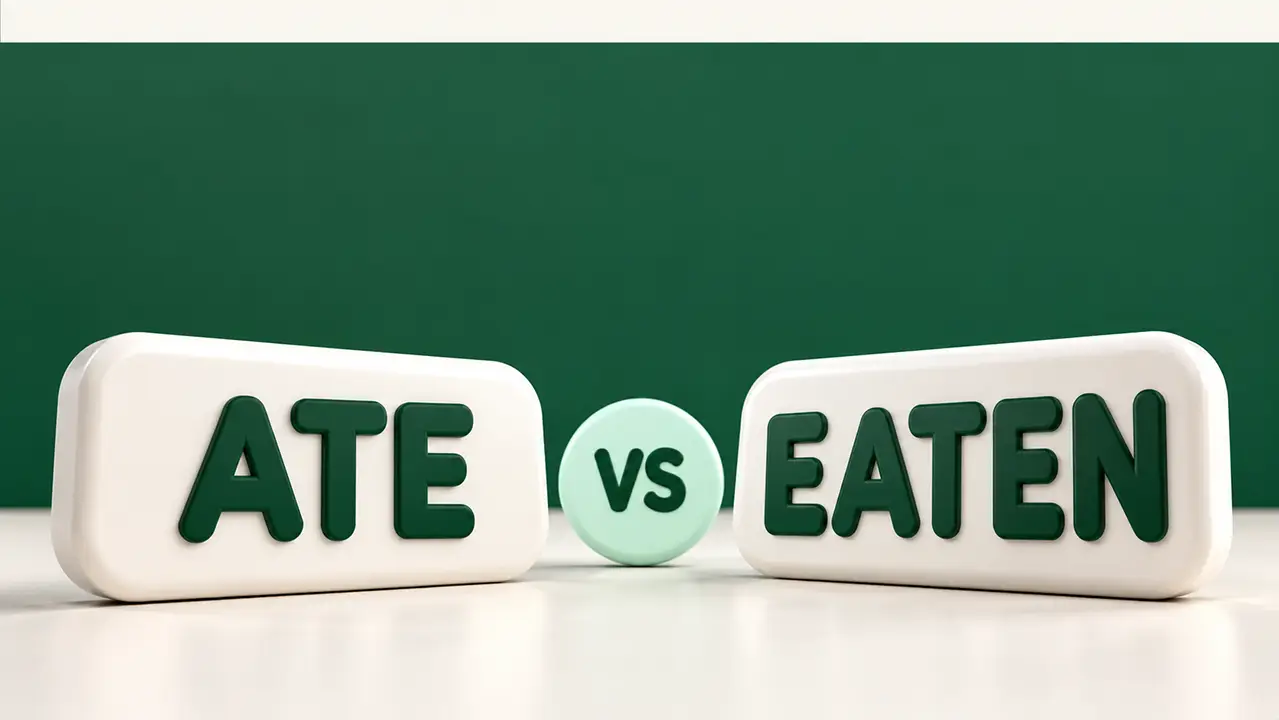
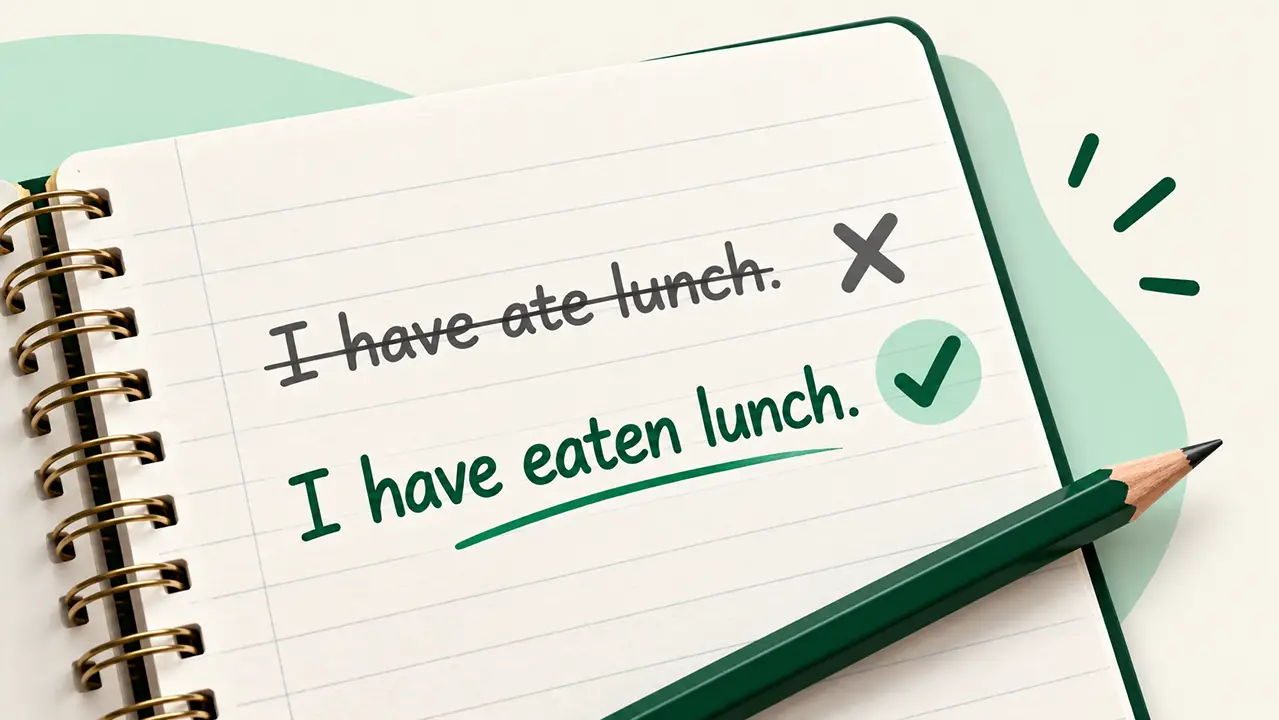
Ate or eaten? Ate is the simple past tense of eat, used alone: I ate lunch at noon. Eaten is the past participle, used after have, has, had, or a form of be: I have eaten, the cake was eaten. If a helper verb comes before it, choose eaten.
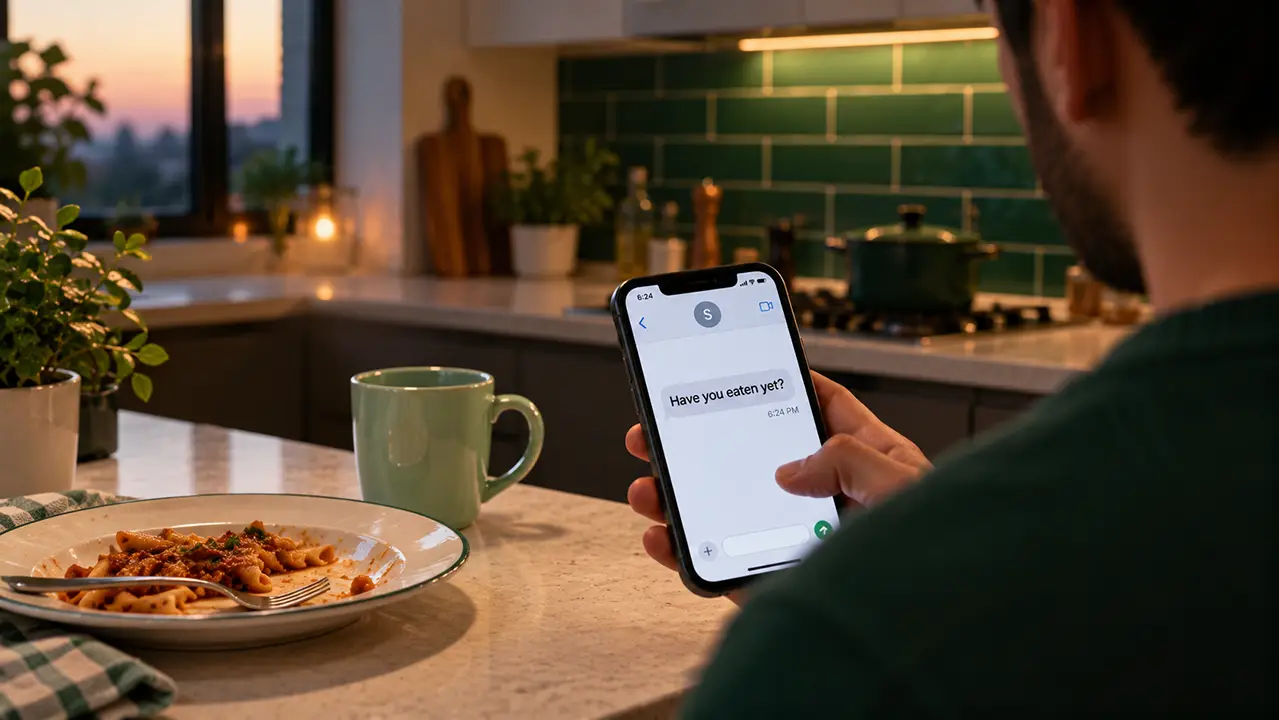
Ate is the past tense and eaten is the past participle
Eat is an irregular verb, so it doesn’t add -ed to make its past forms. Merriam-Webster and the Oxford Advanced Learner’s Dictionary both list ate as the past tense and eaten as the past participle. Merriam-Webster traces the verb to Old English etan, and its first known use is dated before the 12th century.
Regular verbs hide this split because one form does both jobs. You walk today, you walked yesterday, and you have walked a mile. Eat divides the work. Ate covers the simple past. Eaten covers every spot where a helper verb comes first. Ride splits the same way, and the pair rode and ridden follows the same rule you’re about to use for eat.
| Form | Name | Example |
|---|---|---|
| eat | base form | I eat breakfast every day. |
| eats | third person singular | She eats breakfast every day. |
| ate | simple past | I ate breakfast an hour ago. |
| eaten | past participle | I have eaten breakfast already. |
| eating | present participle | I am eating breakfast now. |
A past participle is the verb form that follows have, has, had, or be. It also works as an adjective, as in half-eaten. The form “eated” doesn’t exist in standard English.
I think the mix-up comes from two places. Regular verbs train us to expect one past form, and in fast speech the helper verb shrinks to a contraction (I’ve, he’s, we’d), so the participle sounds like it’s standing alone.
When to use ate
Use ate when the action is finished and the verb has no helper in front of it. Time words usually give it away: yesterday, last night, at 6, when I was a kid.
Example: I ate breakfast at 7:30. (A past time is stated and nothing comes before the verb.)
Example: She ate the last slice before anyone noticed. (The action is complete and the sentence tells a sequence of events.)
Example: We ate at that restaurant last June. (A specific past time, no helper.)
Example: When I was little, I ate cereal every morning. (A past habit that has ended.)
Questions and negatives need one extra step. After did or didn’t, the verb goes back to its base form, because did already carries the past tense.
Example: Did you eat yet? (Not “Did you ate,” which marks the past twice.)
Example: I didn’t eat lunch today. (Didn’t carries the past, so the verb is eat.)
When to use eaten
Eaten never works alone as the main verb. It needs a helper (have, has, had, will have, be, get) or it has to describe a noun.
Eaten in perfect tenses
The perfect tenses are built from have plus the past participle. That means every one of them uses eaten.
- Present perfect: I have eaten, she has eaten.
- Past perfect: We had eaten before the movie started.
- Future perfect: By Friday, they will have eaten here three times.
- Modal perfect: You should have eaten something. He might have eaten already.
Example: I’ve eaten at that café twice this month. (I’ve is I have, so the participle follows.)
Example: She had eaten by the time we got there. (Had plus the participle shows one past event happening before another.)
Eaten in the passive voice

In the passive voice, the thing being eaten becomes the subject. The pattern is a form of be plus eaten.
Example: The last cookie was eaten before I got home. (Was plus the participle.)
Example: Most of the fruit is eaten fresh. (Is plus the participle.)
Example: The seedlings are being eaten by snails. (Are being plus the participle.)
Get works the same way in casual speech: the picnic got eaten by ants.
Eaten as an adjective
Eaten also describes nouns, usually inside a compound: half-eaten, uneaten, moth-eaten. A bare “an eaten apple” sounds odd, so most writers pick a compound or rewrite the sentence.
Example: A half-eaten sandwich sat on the desk.
Example: The uneaten vegetables went back in the fridge.
Merriam-Webster also shows “eaten away” for gradual damage, as in cars eaten away by rust.
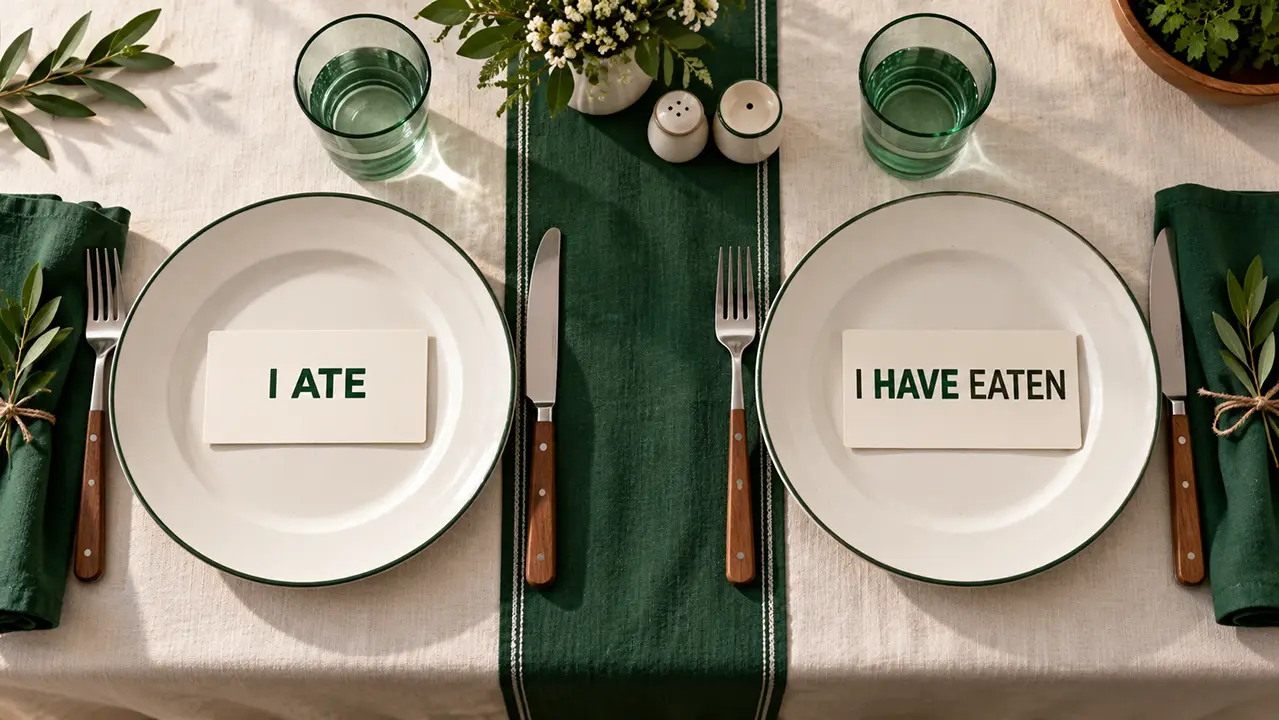
Ate and eaten side by side
| Question | Ate | Eaten |
|---|---|---|
| What is it? | Simple past tense | Past participle |
| Does it need a helper verb? | No | Yes (have, has, had, be, get) |
| Can it stand alone as the main verb? | Yes | No |
| Typical clue words | yesterday, last night, at noon | already, yet, ever, by the time, was, were |
| Sample | I ate dinner. | I have eaten dinner. |
| Sample in passive voice | Not possible | Dinner was eaten. |
A two-step test for choosing the right form

The helper test. Look at the word right before the verb. If it’s have, has, had, has been, was, were, or being, write eaten. If nothing sits there and the action is finished, write ate.
The swap test. Replace the verb with give. If “gave” fits the sentence, use ate. If “given” fits, use eaten. Dictionary.com points out that eat follows the same pattern as give (gave, given), so the swap works every time.
Example: She (gave/given) me a sandwich, so she (ate/eaten) with us. “Gave” fits, so ate fits.
Example: She has (gave/given) me a sandwich, so she has (ate/eaten) with us. “Given” fits, so eaten fits.
Common mistakes and how to fix them
These are typical forms of the error, not a measured tally.
“I eaten breakfast.”
The helper is missing. Add have (I have eaten breakfast) or switch to the simple past (I ate breakfast). In casual speech, “I’ve eaten” can sound like “I eaten,” which is probably why the shortened version slips into writing.
“I have ate lunch.”
Have needs the participle. Write “I have eaten lunch.” Or drop have and write “I ate lunch.”
“Did you ate?”
Did already shows the past, so the verb returns to its base form. Write “Did you eat?”
“She has ate.”
Has is a present perfect helper, so it takes eaten: “She has eaten.” This is the same fix as “I have ate.”
“They had ate before us.”
Had builds the past perfect, which takes the participle. Write “They had eaten before us.”
“I would have ate more.”
Would have is a modal perfect, so the participle follows. Write “I would have eaten more.” The same applies to should have, could have, might have, and must have.
“The cake was ate.”
Passive voice needs the participle after was. Write “The cake was eaten.”
“Have you eaten?” or “Did you eat?”
Searchers type this question in many shapes: have you ate or eaten, have you eaten or have you ate, did you eat vs have you eaten. The grammatical answer is the same each time. After have, the form is eaten.
- “Have you eaten?” is correct.
- “Have you ate?” is not.
- “Did you eat?” is correct.
- “Did you ate?” is not.
The two correct questions ask for slightly different things. “Did you eat?” asks about a past event, usually with a time attached: Did you eat before the meeting? “Have you eaten?” asks about the present result of that past event: are you full, or should we get food now? That is why “Have you eaten yet?” feels natural and “Did you eat yet?” is also common in everyday American speech.
In some communities and languages, “Have you eaten?” works as a friendly greeting. English speakers use it that way too, often with family or close friends.
Replies follow the same rules:
- “Yes, I’ve eaten.” (Have plus the participle.)
- “I ate an hour ago.” (Simple past with a time.)
- “Not yet.” (No verb needed.)
- “I already ate.” (Common in informal American English. “I’ve already eaten” is the form most style guides would prefer in formal writing.)
For “what did you eat or ate,” the answer is eat: “What did you eat?” Did carries the past, so the verb stays in its base form.
Verbs that follow the same pattern
Eat belongs to a group of irregular verbs whose past tense and past participle are different words. Once you learn the group, the choice gets automatic.
| Base | Past tense | Past participle |
|---|---|---|
| eat | ate | eaten |
| give | gave | given |
| take | took | taken |
| write | wrote | written |
| ride | rode | ridden |
| drive | drove | driven |
| fall | fell | fallen |
| break | broke | broken |
| speak | spoke | spoken |
| see | saw | seen |
Forgetting and forgiving work the same way. The forms forgot, forgotten, forgave, and forgiven split exactly like ate and eaten, and the helper-verb test settles them too.
Ate or eaten in everyday writing
Emails
Email tends to mix both forms in a single message. A status update might read: “I ate with the client yesterday. I’ve eaten at that restaurant before, so I knew the menu.” Each form sits where its rule says it should.
News
News writing uses the simple past for events and the passive for subjects that receive the action.
Example: Residents ate at long tables set up along the street.
Example: Most of the catch is eaten locally.
Social media
Short posts shrink the helper verb or skip it. “Just ate” is fine, because ate stands alone and the subject is understood. “Just eaten” is the clipped form of “I’ve just eaten,” and some readers find it less natural.
Formal writing
Formal prose favors the full forms: “had eaten,” “was eaten,” “has not eaten.” Avoid “I already ate” in an academic paper and write “I had already eaten” instead.
School work
Teachers usually test this with fill-in-the-blank sentences. The helper test and the swap test above work on any of them.
Ate or eaten in casual speech and texting
Contractions hide the helper verb, which is where most slips happen.
- I’ve eaten = I have eaten.
- He’s eaten = He has eaten. (‘s here means has, so the participle follows.)
- We’d eaten = We had eaten.
The wrong versions look like “He’s ate” and “We’d ate.”
Texts also drop the first words of a question. “Eaten yet?” is the short form of “Have you eaten yet?” and “Eat yet?” is the short form of “Did you eat yet?” Each short form keeps the verb that would have followed the missing helper. “Ate yet?” has no matching full question, so skip it.
Spelling shortcuts such as “u” for you work with either form: “have u eaten?” Whether a shortcut is acceptable depends on who you’re writing to. Friends will accept it. A teacher or manager might not.
How American and British English treat ate and eaten
Both varieties use ate for the past tense and eaten for the participle. The spelling is the same on both sides of the Atlantic.
Pronunciation differs. Merriam-Webster gives the usual American sound as “ayt” and marks “et” as dialectal or British. In most American speech, ate sounds the same as the number eight. Some speakers in Britain say “et,” and that sound doesn’t change the spelling.
You may hear “I’ve ate” in certain regional speech. I think standard written English in both countries uses “I’ve eaten,” but check a current style guide for your audience before relying on that. Dictionary.com also lists “eat” as an archaic past form, which you may spot in older books, such as “I eat my dinner yesterday.” Modern writing uses ate.
Spelling differences between the two varieties show up in other words, such as the -ize and -ise endings, but ate and eaten are not affected.
Practice sentences to test yourself
These items are generated drafts. Answers follow each one.
- Yesterday I (ate/eaten) three tacos. Answer: ate
- Have you (ate/eaten) yet? Answer: eaten
- She had already (ate/eaten) when we arrived. Answer: eaten
- They (ate/eaten) at noon. Answer: ate
- The last cookie was (ate/eaten) before I got home. Answer: eaten
- Did you (eat/ate/eaten) the leftovers? Answer: eat
- By Friday we will have (ate/eaten) every meal there. Answer: eaten
- He (ate/eaten) so fast he got hiccups. Answer: ate
- I should have (ate/eaten) earlier. Answer: eaten
- What did you (eat/ate/eaten) for lunch? Answer: eat
- The sandwich sat there half-(ate/eaten). Answer: eaten
- We (ate/eaten) pizza last night, and we have (ate/eaten) pizza twice this week. Answer: ate; eaten
Other word pairs that cause the same trouble
The past tense and participle of many verbs are mixed up in the same way:
- ran and run: “I have ran” should be “I have run.”
- did and done: “I have did it” should be “I have done it.”
- went and gone: “She has went” should be “She has gone.”
- saw and seen: “We have saw it” should be “We have seen it.”
- began and begun: “It has began” should be “It has begun.”
The fix is the helper test each time: after have, has, or had, use the participle.
Other pairs mix up look-alike words and not verb forms. For example, biennial and biannual differ in meaning, not in tense.
FAQs
Is “eated” ever correct?
No. Eat is irregular, and neither of its past forms ends in -ed. Use ate or eaten.
Is ate the same as eight?
They sound the same in most American speech, but they’re different words. Ate is the verb. Eight is the number. Check the spelling before sending.
Does “ate” end other words too?
Yes. The -ate ending in create, celebrate, and similar words is unrelated to the verb eat. Those words follow their own pronunciation rules.
Is “I ate already” acceptable?
It’s common and fine in casual speech. In careful or formal writing, “I had already eaten” or “I’ve already eaten” is the safer choice.
Conclusion
Look at the word before the verb. If it’s have, has, had, or a form of be, write eaten. If the verb stands alone and the action is over, write ate. Test your own sentences with the swap test: if “given” fits, use eaten, and if “gave” fits, use ate.

Daniel Parker is an English language writer sharing clear grammar lessons, practical tips, and helpful examples for learners.