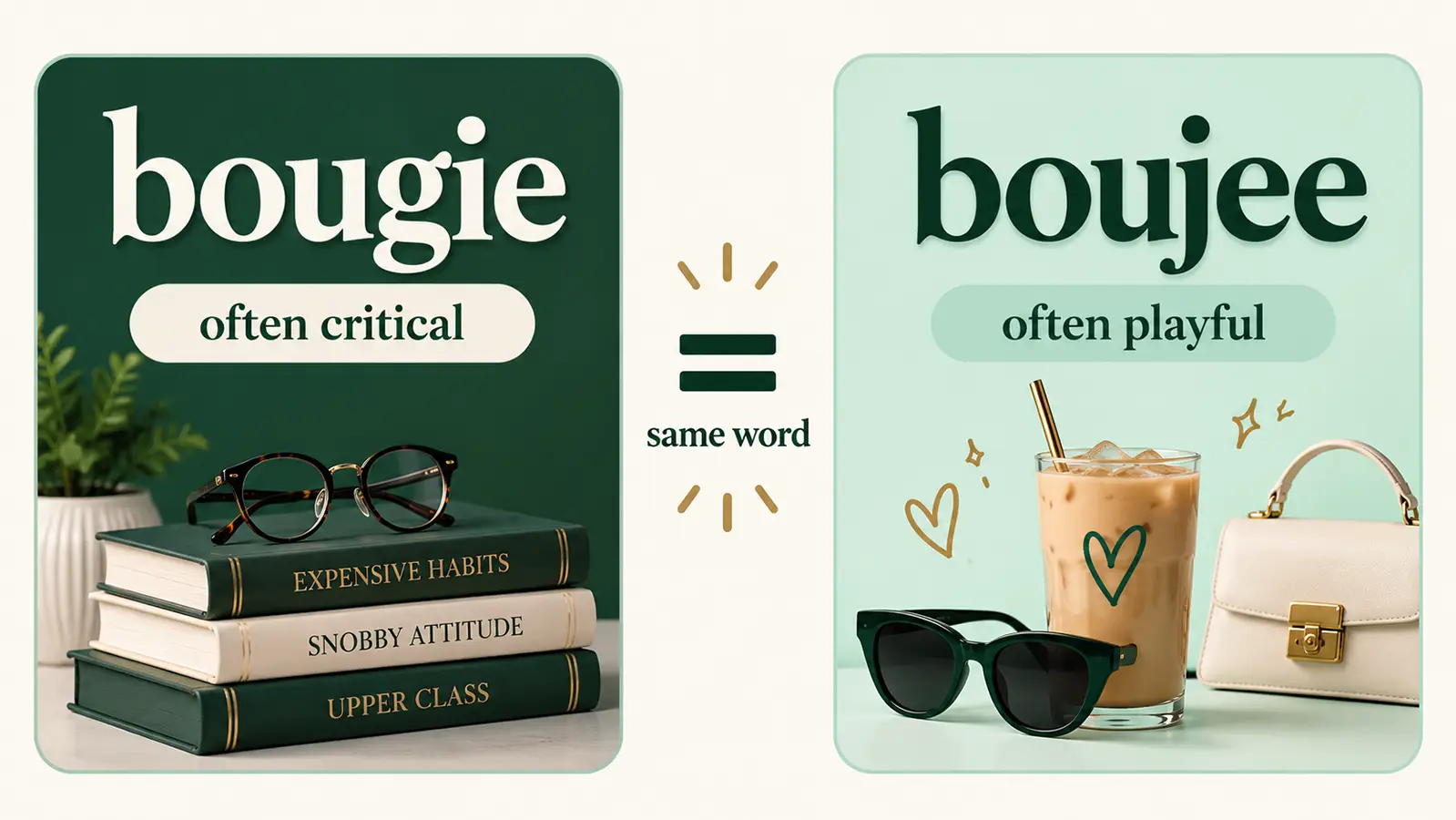
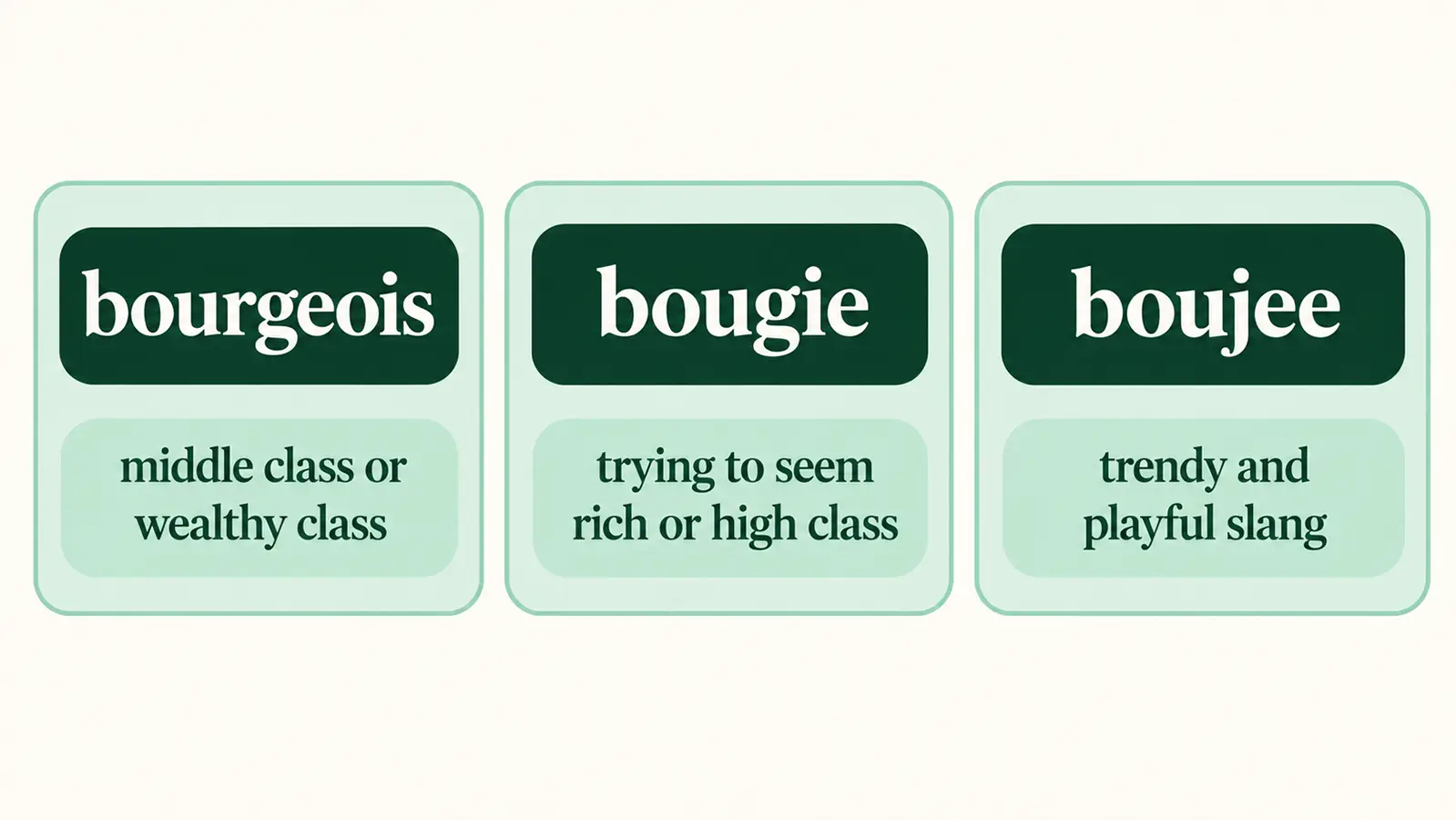
Short answer: Boujee and bougie are two spellings of the same slang adjective. Both come from bourgeois, both mean “fancy, luxurious, or high-class,” and major dictionaries list both. The one real difference is tone: bougie often sounds more critical, while boujee (the spelling made famous by the 2016 Migos song “Bad and Boujee”) often sounds more playful or admiring. Neither is a typo.
Bougie or Boujee: Which Spelling Should You Use?
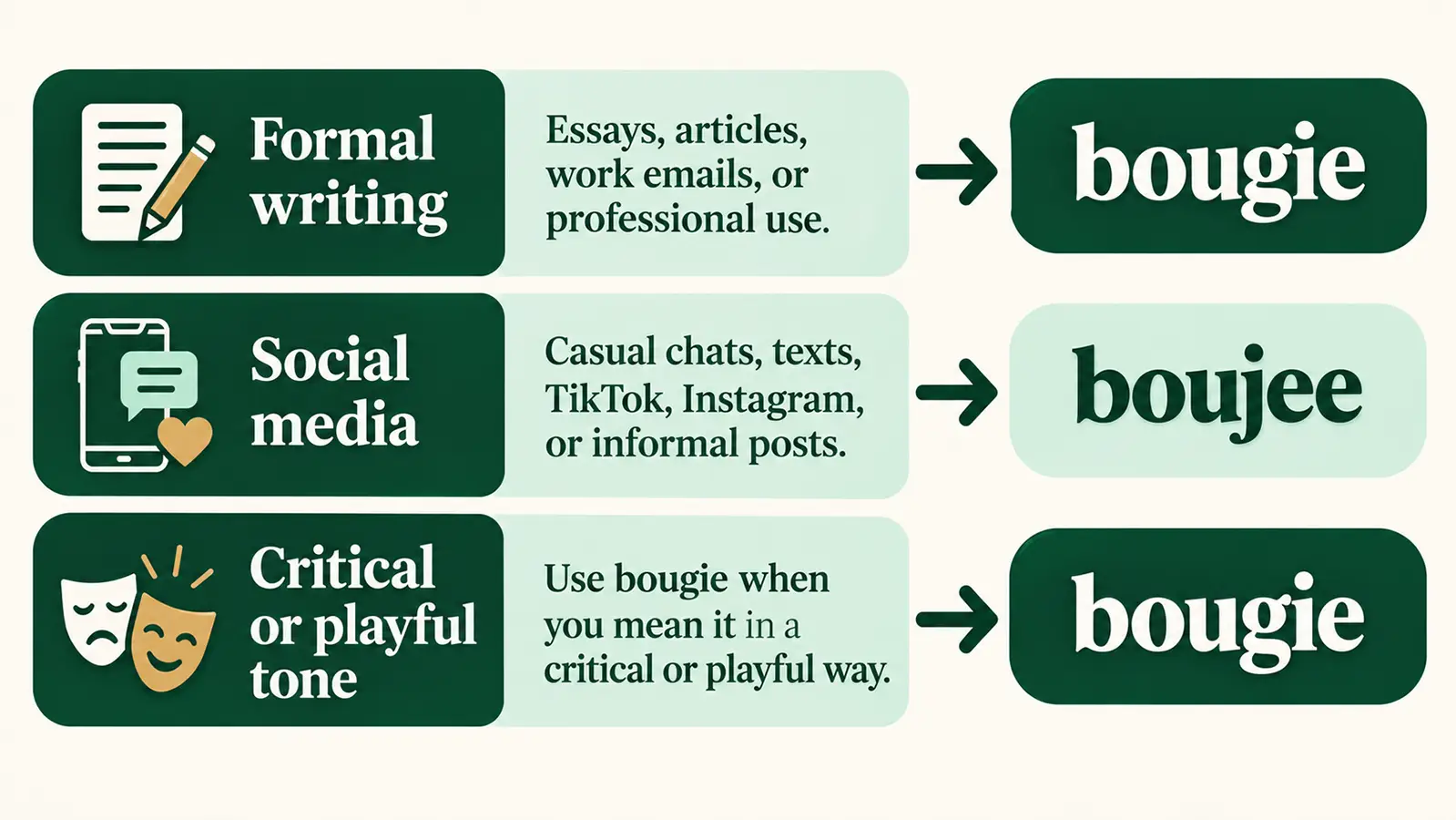
If you are asking which spelling is “correct,” the answer is that both are. That makes this different from word pairs where one version is simply wrong. Some pairs, like the optimize and optimise spelling pair, are both correct and differ mostly by region. Bougie and boujee are different again: they are not regional. They are two ways of writing the same sound, and the choice comes down to style and audience.
Here is a practical way to choose:
| Situation | Better choice | Why |
| Blog post, article, or school-style writing | bougie | Looks closer to bourgeois, so it reads as the more conventional spelling |
| Social media, captions, texts, song-related content | boujee | Matches how most people write it informally, and links to the hip-hop usage |
| You want a mocking or critical tone | bougie | The spelling often carries a more pointed, judgmental edge |
| You want a fun, “treat yourself” tone | boujee | Often reads as lighter and more celebratory |
| Not sure | bougie | Safe default in most writing; pick one spelling and stay consistent in the same piece |
The most important rule is consistency. Do not write bougie in one paragraph and boujee in the next unless you are comparing them.
What Does Boujee Mean?
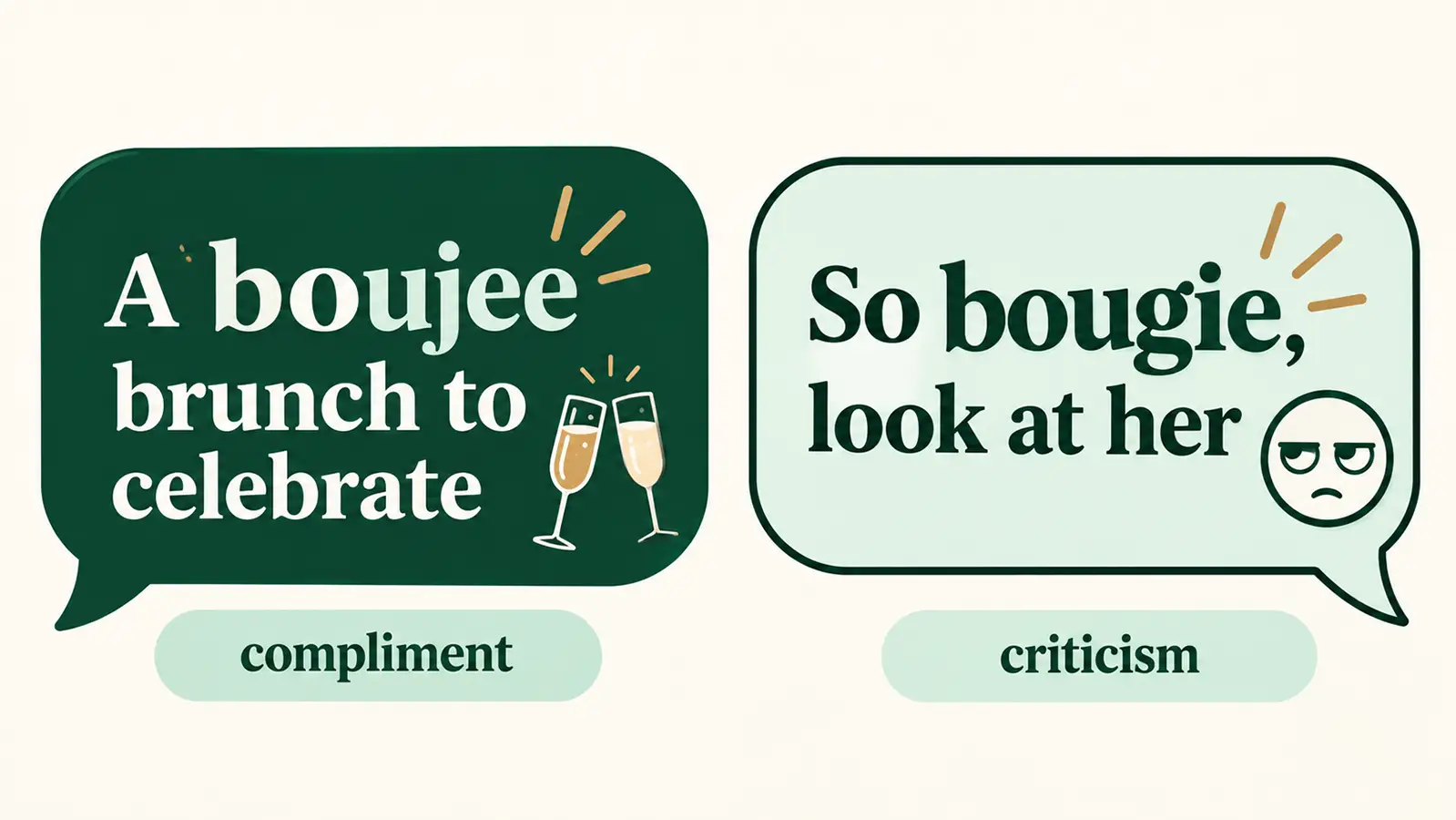
Boujee (also written bougie) describes someone or something as fancy, luxurious, or associated with wealth and indulgence. Depending on who is speaking and how, it can be a compliment or a put-down.
Boujee as a compliment
In everyday modern use, boujee is usually light and positive. It describes treating yourself to something a little nicer than usual: a good dinner, a spa day, a nice hotel, a splurge on something you enjoy.
- “We went all out for a boujee brunch to celebrate her promotion.”
- “I’m on a budget, but I still like a boujee candle in the bathroom.”
Boujee as a criticism
The older, sharper sense has not disappeared. Calling someone bougie or boujee can mean they are acting above their social status, or being snobbish and showy about taste.
- “He won’t eat anywhere without a wine list. So bougie.”
- “Their house looks like a showroom, and they never let anyone sit down.”
How to tell which meaning is intended: look at the tone and the speaker. If the person is describing their own treat, it is almost always positive. If someone is describing another person’s attitude, especially with an eye-roll, it is usually critical.
Is There Any Real Difference Between Bougie and Boujee?
Some online guides teach a neat split: bougie means pretending to be rich (“old money” attitude without the money), while boujee means actually being upwardly mobile (“new money”). It is a memorable rule, but it is not a formal dictionary distinction. Merriam-Webster, for example, treats boujee simply as an alternative spelling of bougie, and Dictionary.com lists the two together.
A more accurate way to put it is that there are tendencies, not rules:
- Bougie more often appears in critical or mocking contexts, and in writing that sounds closer to the original word bourgeois.
- Boujee more often appears in positive, playful, or celebratory contexts, and is tied to hip-hop culture, where it came to mean enjoying hard-earned success while staying connected to your roots.
If you are writing for a reader who might be confused, you can always clarify with a word or two (“a boujee, treat-yourself kind of weekend” or “a bougie, look-at-me kind of party”). The surrounding words do more work than the spelling does.
One more note on usage: the word has deep roots in African American English, so it helps to be thoughtful about tone, particularly when a phrase could read as mocking a group of people rather than describing a style or a purchase.
How to Pronounce Boujee and Bougie
Both words are usually pronounced BOO-zhee or BOO-jee. Dictionaries vary on which ending they show, and speakers use both, so do not treat either pronunciation as wrong.
The spelling does not reliably tell you how someone will say it. The -g- in bougie can sound like the s in “measure” (zh) or like a j. The same goes for boujee.
Where Do Bougie and Boujee Come From?
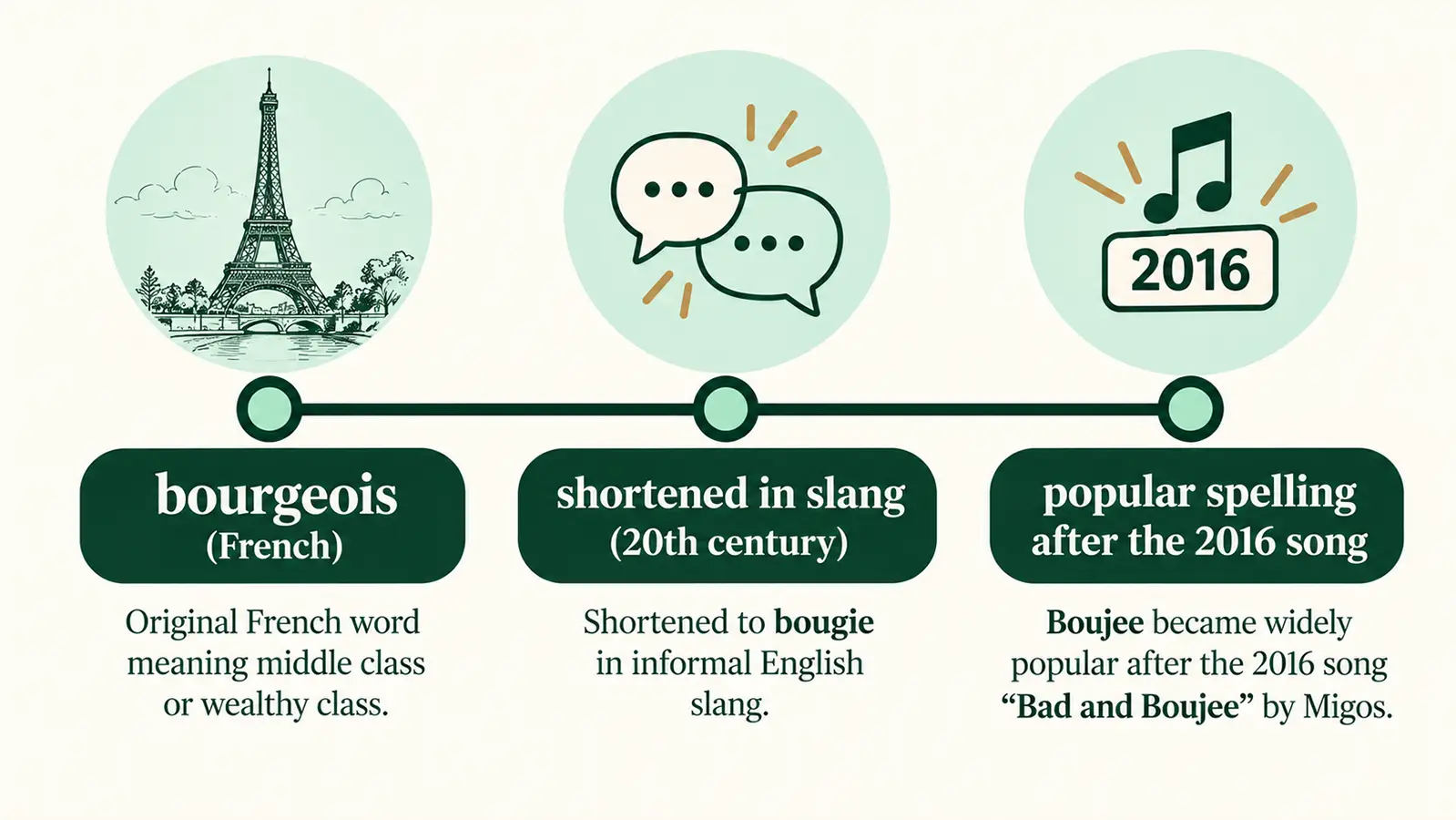
Both words trace back to bourgeois, a French word for the middle class. In the 20th century, English speakers shortened it to bougie in slang, and the new sense first appeared in African American English as a way to criticize people seen as middle-class or striving for status. Over time it widened to mean “pretentious” or “overly lavish” more generally.
Boujee became widely popular after “Bad and Boujee” by the hip-hop group Migos was released in late 2016. The song reached No. 1 on the Billboard Hot 100 in early 2017 and pushed the -ujee spelling into everyday use. It also helped shift the word’s tone for many speakers: from a snarky label for social climbers to a casual way to describe a luxury lifestyle.
Three related words are worth keeping straight:
- Bourgeois (adjective or noun): the formal term for the middle class, or for conventional, materialistic values.
- Bourgeoisie (noun): the middle class as a group. It is not a slang word.
- Bourgie: another informal spelling of the same slang word.
Boujee and Bougie in Example Sentences
Bougie
- “Look at you with your bougie avocado toast.”
- “I don’t want to go to another bougie rooftop bar where a cocktail costs twenty dollars.”
- “Her bougie accent only appears when she’s around her new coworkers.”
Boujee
- “That diamond necklace makes you look so boujee.”
- “We planned a boujee night out to celebrate finishing exams.”
- “He’s boujee on a budget: thrifted blazers and a very good coffee order.”
Notice that you can swap the spelling in any of these sentences without changing the grammar. Only the feel changes slightly.
Boujie, Bourgie, Boojie, and Other Spellings
Because slang is spelled by ear, you will see several other forms. Here is how to treat them:
- Boujie: a common variation of boujee. Understood everywhere, but less standard than bougie or boujee.
- Bourgie: an informal spelling that sits closest to the word bourgeois.
- Boojie or booshie: phonetic guesses at the sound. Readers will understand them, but they look like errors in careful writing.
These are variant spellings, not mistakes in the same sense as a typo like writing “inportant” for the word covered in our important vs inportant guide. The line is simple: bougie and boujee are the two safest forms. Everything else is informal.
Look-Alike Words That Are Easy to Mix Up
- Bougie (medical): a thin, flexible instrument doctors use to examine or widen a passage in the body. The word comes from the French word for candle, and it is unrelated to the slang. Context makes the meaning clear: “the surgeon asked for the bougie” is medical, “that restaurant is so bougie” is slang.
- Boogie: a dance or to dance (“let’s boogie”). Different word, different meaning.
- Bourgeois is not interchangeable with bougie in formal writing. In a sociology or history essay, use bourgeois. Save bougie for informal tone.
If you enjoy untangling words that sound or look similar, our guide to accept vs except is another useful one to keep handy.
Quick Practice: Test Yourself
- Which spellings of the slang word are accepted by major dictionaries? (a) bougie only (b) boujee only (c) both
- A friend says, “We had a boujee weekend at the spa.” Is this likely a compliment or a criticism? (a) compliment (b) criticism
- Which word is the formal noun for the middle class? (a) bougie (b) bourgeoisie (c) boujee
- “The doctor used a bougie.” Is this slang? (a) yes (b) no
- You are writing a formal essay on class in 19th-century France. Which word fits best? (a) boujee (b) bougie (c) bourgeois
Answers: 1-c, 2-a, 3-b, 4-b, 5-c.
If you like short practice sets like this, you may also enjoy our spelling check on quizzes or quizes.
Frequently Asked Questions
Is boujee a bad word?
No. It is informal slang, not profanity. It can be an insult depending on tone, but it is more often used lightly or positively today.
Is bougie or boujee more correct?
Neither. Both are accepted spellings. Bougie is slightly more conventional in writing, and boujee is slightly more associated with hip-hop and casual online use.
Can I use bougie or boujee in formal writing?
Usually not. Both are slang. In formal writing, use bourgeois when you mean the middle class, or choose a plain word such as luxurious, upscale, or pretentious.
How do I spell boujee, boujie, or bougie?
Standard options are bougie and boujee. Boujie and bourgie are common informal variations.
Does boujee mean rich?
Not exactly. It suggests wealth, luxury, or a taste for nice things, but someone can be called boujee for a small, affordable splurge. It describes style and attitude more than bank balance.
Key Takeaways
- Bougie and boujee are two spellings of the same slang word, both derived from bourgeois.
- Both mean fancy, luxurious, or high-class, and both can be positive or negative.
- Bougie leans critical and conventional; boujee leans playful and informal. This is a tendency, not a rule.
- Pick one spelling per piece of writing and keep it consistent.

Daniel Parker is an English language writer sharing clear grammar lessons, practical tips, and helpful examples for learners.










1 thought on “Boujee vs Bougie: Meaning, Spelling, and Which One to Use”