Eg vs ie: it’s one of those small mix-ups that nags at you the moment you hit send. You type “for example” in an email, then second-guess yourself and swap it for e.g., then wonder if you actually meant i.e. the whole time.
You type “for example” in an email, then second-guess yourself and swap it for e.g., then wonder if you actually meant i.e. the whole time. It’s a small thing, but it nags at you, especially when the email is already sent.
Here’s the good news: the e.g. vs i.e. meaning confusion has a simple fix, and once it clicks, it stays clicked. This guide walks through the difference between i.e. and e.g., where each one came from, the punctuation rules that trip people up, and a memory trick that actually works. Keep reading and you’ll never have to pause mid-sentence again.
i.e. or e.g. – Quick Answer
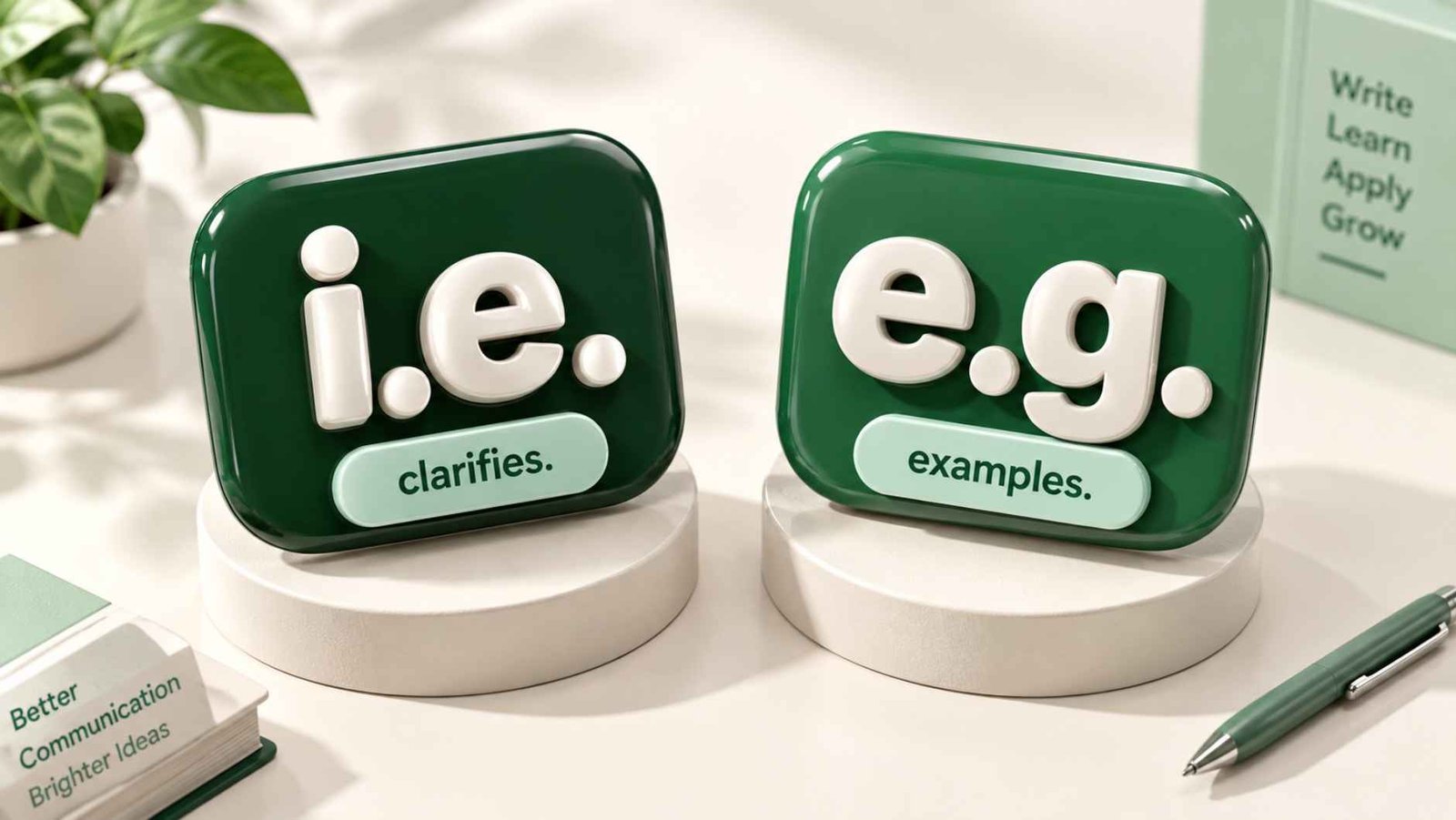
Here’s the short version, for anyone who needs the answer before the coffee kicks in. I.e. clarifies. E.g. gives examples. Everything else in this guide just backs that up with proof.
| Abbreviation | Meaning | Use | Example |
| i.e. | That is | Clarification | She works remotely, i.e., from home. |
| e.g. | For example | Giving examples | Bring snacks, e.g., chips and pretzels. |
Simple rule:
- Use i.e. when you’re restating or narrowing down what you just said.
- Use e.g. when you’re listing a few options out of many.
The Origin of i.e. or e.g.

Both terms started life as Latin phrases, borrowed by English writers centuries ago because they were shorter than spelling out the full explanation every time. Knowing where they came from makes the difference easier to remember for good.
Origin of i.e.
I.e. comes from id est, which translates to “that is.” Writers use it to restate something in clearer or narrower terms, not to add options.
- She is bilingual, i.e., she speaks two languages.
- The meeting starts at 9 a.m., i.e., right after the morning briefing.
Because id est points to one specific thing, i.e. always introduces a complete, exact match, not a sample from a longer list.
Origin of e.g.
E.g. comes from exempli gratia, meaning “for the sake of an example.” It signals that what follows is just one option among several possible ones.
- Outdoor activities, e.g., hiking and cycling, are popular here.
- The store sells tropical fruit, e.g., mangoes and pineapples.
Since exempli gratia literally means “for example,” anything after e.g. is a partial list, never the whole picture.
What Does IE Mean in Writing?
Writers ask this constantly, and the honest answer is one word: clarification. I.e. means you’re about to restate, define, or narrow down whatever you just wrote, not add more options to it.
- Restates the previous phrase in plainer terms.
- Narrows a broad statement down to one specific meaning.
- Signals a closed, complete list, not a sample.
- Replaces phrases like “in other words” or “namely.”
- Appears most often in explanatory or technical writing.
Example in chat:
Friend 1: The trip is self-funded, i.e., no company card this time.
Friend 2: Got it, I’ll bring my own wallet then.
British English vs American English Spelling
There’s no spelling difference between British and American English here. Both use i.e. and e.g. exactly the same way. The real gap shows up in punctuation, not spelling.
| Style | British English | American English |
| i.e. punctuation | i.e. | i.e., |
| e.g. punctuation | e.g. | e.g., |
| Meaning | Same | Same |
- British writing often skips the comma after i.e. and e.g.
- American writing almost always adds a comma after both.
- Both regions keep the periods after each letter.
- Style guides in the US recommend the comma more consistently.
- UK publishers treat the comma as optional, not required.
British Style Example
- Bring warm clothes e.g. jackets and coats.
American Style Example
- Bring warm clothes, e.g., jackets and coats.
Neither version is wrong. Pick one and stay consistent across the whole document.
Which Spelling Should You Use?
The choice between i.e. and e.g. isn’t about region or personal taste. It comes down to what your sentence is doing: explaining something or listing examples of it.
Use i.e. When:
- Explaining what a term or phrase actually means.
- Clarifying a statement that could be read two ways.
- Restating information in simpler words.
- Narrowing a category down to its exact members.
- Replacing the phrase “in other words.”
Example:
- The meeting is virtual, i.e., online only.
Use e.g. When:
- Listing a few options out of many possible ones.
- Introducing examples without claiming the list is complete.
- Suggesting items the reader can add to.
- Replacing the phrase “for example” or “such as.”
- Avoiding words like “etc.” right after your examples.
Example:
- We sell tropical fruit, e.g., mangoes and pineapples.
Audience-Based Advice
| Audience | Recommended style |
| US readers | Use commas with i.e. and e.g. |
| UK readers | Comma is optional |
| Academic writing | Follow your assigned style guide |
| Global audience | Pick one punctuation style and stay consistent |
Punctuation Rules for i.e. and e.g. You Need to Know
Punctuation is where most eg vs ie questions actually come from, not meaning. Get the comma, period, and capitalization rules straight and the rest takes care of itself.
- Periods go after every letter: i.e. and e.g., never “ie” or “eg” alone.
- Commas come before i.e. and e.g. almost every time.
- US style adds a second comma right after the abbreviation.
- Semicolons work before i.e. or e.g. when joining two full sentences.
- Parentheses don’t need an extra comma before the abbreviation inside them.
- Italics aren’t necessary. Both terms are treated as standard English now.
- Capital letters are fine if the abbreviation opens a sentence, though rewording is usually cleaner.
| Style guide | Comma after i.e./e.g.? | Italicize? |
| APA | Yes | No |
| MLA | Usually yes | No |
| Chicago | Yes | No |
| AP | No | No |
Example in texting:
Friend 1: Pack layers, e.g. a hoodie and a light jacket.
Friend 2: No comma? Living dangerously today.
Common Mistakes with i.e. or e.g.
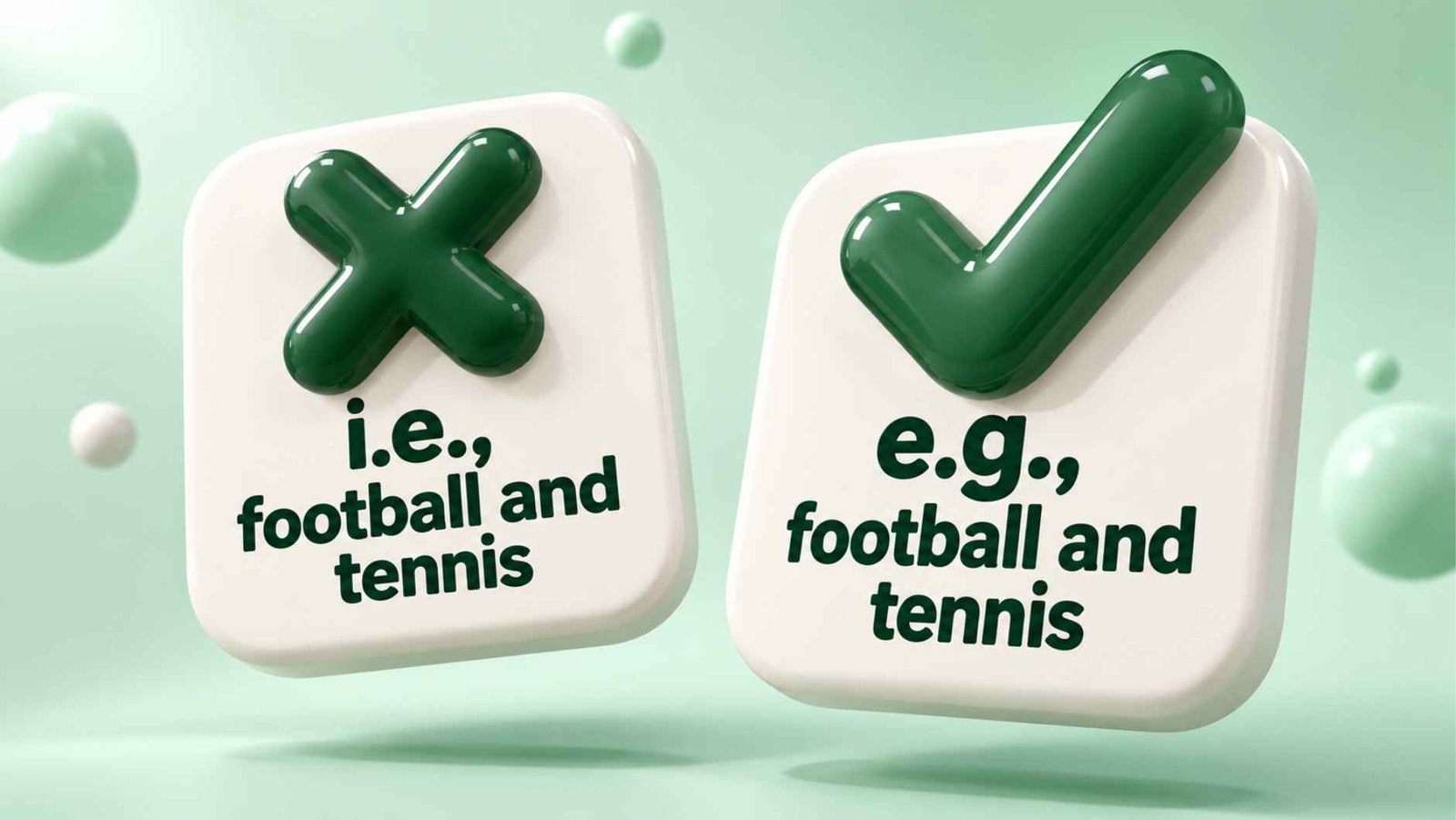
Most i.e. or e.g. mix-ups happen because both feel interchangeable in casual speech, even though they aren’t in writing. These three mistakes cover almost every error people make.
Mistake 1: Using i.e. for Examples
Incorrect: I enjoy sports, i.e., football and tennis.
Correct: I enjoy sports, e.g., football and tennis.
Football and tennis are examples, not a full explanation of what “sports” means.
Mistake 2: Using e.g. for Clarification
Incorrect: He is nocturnal, e.g., active at night.
Correct: He is nocturnal, i.e., active at night.
The second phrase restates the word “nocturnal,” so it needs i.e., not e.g.
Mistake 3: Forgetting Punctuation
Incorrect: Bring tools eg hammer screwdriver.
Correct: Bring tools, e.g., hammer and screwdriver.
Why Do People Mix Up i.e. and e.g. So Often?
Both are short, both use periods, and both usually sit inside a comma right before a list. Add the fact that neither one gets taught much past middle school, and the mix-up makes sense.
- Visual similarity makes the two letters easy to swap without noticing.
- Rare correction means mistakes go unnoticed for years.
- Latin origin hides the actual meaning from most readers.
- Autocorrect doesn’t flag either one as wrong.
- Casual speech treats “like” and “meaning” as interchangeable, which they aren’t here.
Example in chat:
Friend 1: wait is it ie or eg here, “bring snacks ___ chips”
Friend 2: eg, you’re giving examples not explaining “snacks”
i.e. or e.g. in Everyday Examples
Seeing these abbreviations in context makes the rule stick faster than any definition. Here’s how i.e. and e.g. actually show up across different types of writing.
Emails
- Please submit digital files, e.g., PDFs or Word documents.
- The office will stay closed Monday, i.e., no in-person meetings.
News Writing
- Severe weather, e.g., flooding and high winds, hit the coast.
- The law was repealed, i.e., officially removed from the books.
Social Media
- I love comfort food, e.g., pizza and pasta.
- She’s vegan, i.e., she skips all animal products.
Social platforms lean casual, so most people just skip the abbreviations altogether and write “like” or “meaning” instead. If you’re curious about the shorthand that actually thrives in that space, our guide to what CBFW means in texting and DMs covers a completely different kind of abbreviation than the formal Latin ones covered here.
Formal Writing
- Certain mammals, e.g., dolphins and whales, show high intelligence.
- The project was delayed indefinitely, i.e., no new date was set.
i.e. vs e.g. in Academic and Business Writing
Academic papers and business documents are where getting this wrong actually costs you credibility. Editors and reviewers notice a swapped i.e./e.g. faster than almost any other grammar slip.
| Setting | More common | Why |
| Academic papers | Both, heavily | Precision matters in citations and definitions |
| Business emails | e.g. | Lists of options come up constantly |
| Technical manuals | i.e. | Clarifying exact specifications is the priority |
| Legal contracts | i.e. | Ambiguity creates real liability |
- Journal editors flag i.e./e.g. errors as a clarity issue, not just style.
- Business writers lean on e.g. to soften requests into suggestions.
- Technical teams use i.e. to lock down one exact meaning.
- Style guides like APA and Chicago expect the comma every time.
- Peer reviewers notice a misused i.e. faster than most typos.
i.e. or e.g. – Google Trends & Usage Data
Search data shows this confusion isn’t rare. People look up the difference between i.e. and e.g. constantly, across nearly every English-speaking country.
Common searches include:
- “i.e. meaning”
- “e.g. meaning”
- “difference between i.e. and e.g.”
- “what does ie stand for”
- “what does e.g. mean”
Why People Confuse Them
- Both are Latin abbreviations most people never studied.
- Both use periods, which visually blur together.
- Both sit inside commas before a phrase.
- Both show up constantly in formal writing.
Popular Search Regions
- United States
- United Kingdom
- India
- Pakistan
- Canada
Common Usage Contexts
| Context | More common |
| Academic writing | Both i.e. and e.g. |
| Business emails | e.g. |
| Technical writing | i.e. |
| Essays and reports | Both |
Grammar Checkers, Autocorrect, and i.e./e.g. Mistakes
Most grammar software won’t catch a swapped i.e. or e.g., because both are grammatically valid abbreviations. The checker sees correct punctuation and moves on, even if the meaning is backward.
- Spell checkers flag missing periods but ignore meaning entirely.
- Autocorrect sometimes strips the comma US writers expect.
- AI writing tools catch the error only when context is unclear.
- Manual proofreading still beats software for this specific mistake.
- Reading the sentence aloud exposes a misused i.e. or e.g. fast.
Example in texting:
Friend 1: My grammar checker didn’t catch my ie/eg mix-up at all
Friend 2: yeah those things check commas, not logic
Comparison Table: i.e. vs e.g.
| Feature | i.e. | e.g. |
| Full Latin phrase | id est | exempli gratia |
| Meaning | That is | For example |
| Purpose | Clarification | Examples |
| List type | Complete | Partial |
| Example | He is nocturnal, i.e., active at night. | I like desserts, e.g., cake and ice cream. |
When Should You Use i.e. Instead of e.g.?
Use i.e. the moment you’re restating something rather than adding to it. If you could swap in the phrase “in other words” and the sentence still makes sense, i.e. is the right call.
- Restating a term you just used in different words.
- Defining exactly what a category includes, with nothing left out.
- Narrowing a vague statement down to one specific meaning.
- Correcting a possible misread of the previous phrase.
- Closing the list completely, unlike e.g., which stays open-ended.
i.e. and e.g. in Legal and Formal Documents
Contracts and legal filings can’t afford ambiguity, which is exactly why i.e. shows up far more often than e.g. in that world. A misused e.g. in a contract can leave a list open to disputes nobody intended.
- Contracts favor i.e. because it closes a list completely.
- Policy documents use e.g. sparingly, only for illustrative, non-binding examples.
- Court filings avoid ambiguity that a loose e.g. list can create.
- Compliance teams double-check every i.e./e.g. before a document ships.
- One wrong abbreviation can shift what a clause is legally understood to cover.
Easy Memory Trick
Remember This:
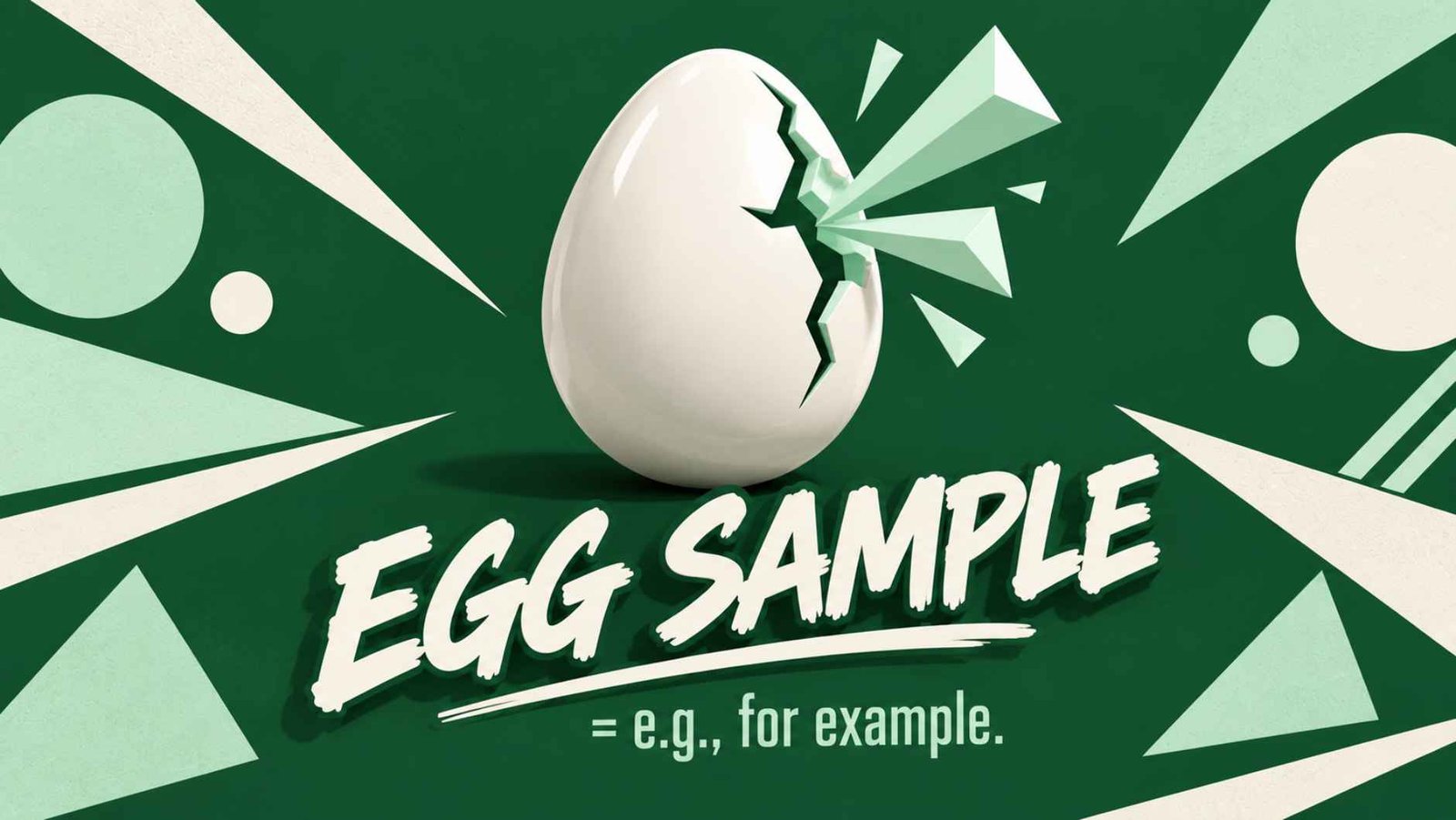
- I.e. = in essence
- E.g. = egg sample (sounds like “example,” and yes, it’s silly on purpose)
This trick sticks because it’s a little ridiculous, and ridiculous things are hard to forget.
FAQs
1. What does i.e. mean?
I.e. means “that is” or “in other words.” It clarifies or restates whatever came right before it.
2. What does e.g. mean?
E.g. means “for example.” It introduces one or more examples from a larger group.
3. Can i.e. and e.g. be used interchangeably?
No. Confusing e.g. vs i.e. changes the meaning of a sentence, so they should never be swapped.
4. Is e.g. formal or informal?
E.g. works in both formal and informal writing, though the i.e. or e.g. comma rules still apply either way.
5. Should I use commas after i.e. and e.g.?
American English usually adds a comma after both. British English often leaves it out.
6. Which is better in academic writing?
Both are fine in academic writing when the difference between i.e. and e.g. is respected and applied correctly.
7. How can I remember the difference easily?
Think “i.e. = in essence” and “e.g. = egg sample.” That one image usually settles the eg vs ie debate for good.
8. Is it wrong to spell out “for example” instead?
Not at all. Spelling it out is often clearer than the abbreviation, especially in casual writing.
Conclusion
The eg vs ie meaning mix-up trips up even experienced writers, but the fix is genuinely simple once it clicks. Use i.e. to explain or restate something. Use e.g. to introduce examples from a longer list. That’s the entire rule.
Punctuation adds a small wrinkle: American English usually wants a comma after both, while British English treats it as optional. Stay consistent within one document and you’re covered either way.
Next time you catch yourself hesitating over i.e. vs e.g., run the quick test: are you restating, or are you listing? Get that one question right, and the abbreviation picks itself.

Daniel Parker is an English language writer sharing clear grammar lessons, practical tips, and helpful examples for learners.










1 thought on “E.g. vs I.e. Meaning: Finally Explained (2026 Guide)”