
You type the word fast, hit send, and then that little itch shows up. Was it repour, repore, or rapport? Almost everyone has felt that half-second panic right after sending a message, wondering if one wrong letter just made them look careless.
Here is the good part. This guide settles the repour vs rapport debate for good, along with every close cousin of the mistake, good repor, repore spelling, and apport vs repoire. You will walk away knowing exactly which word to use, so keep reading.
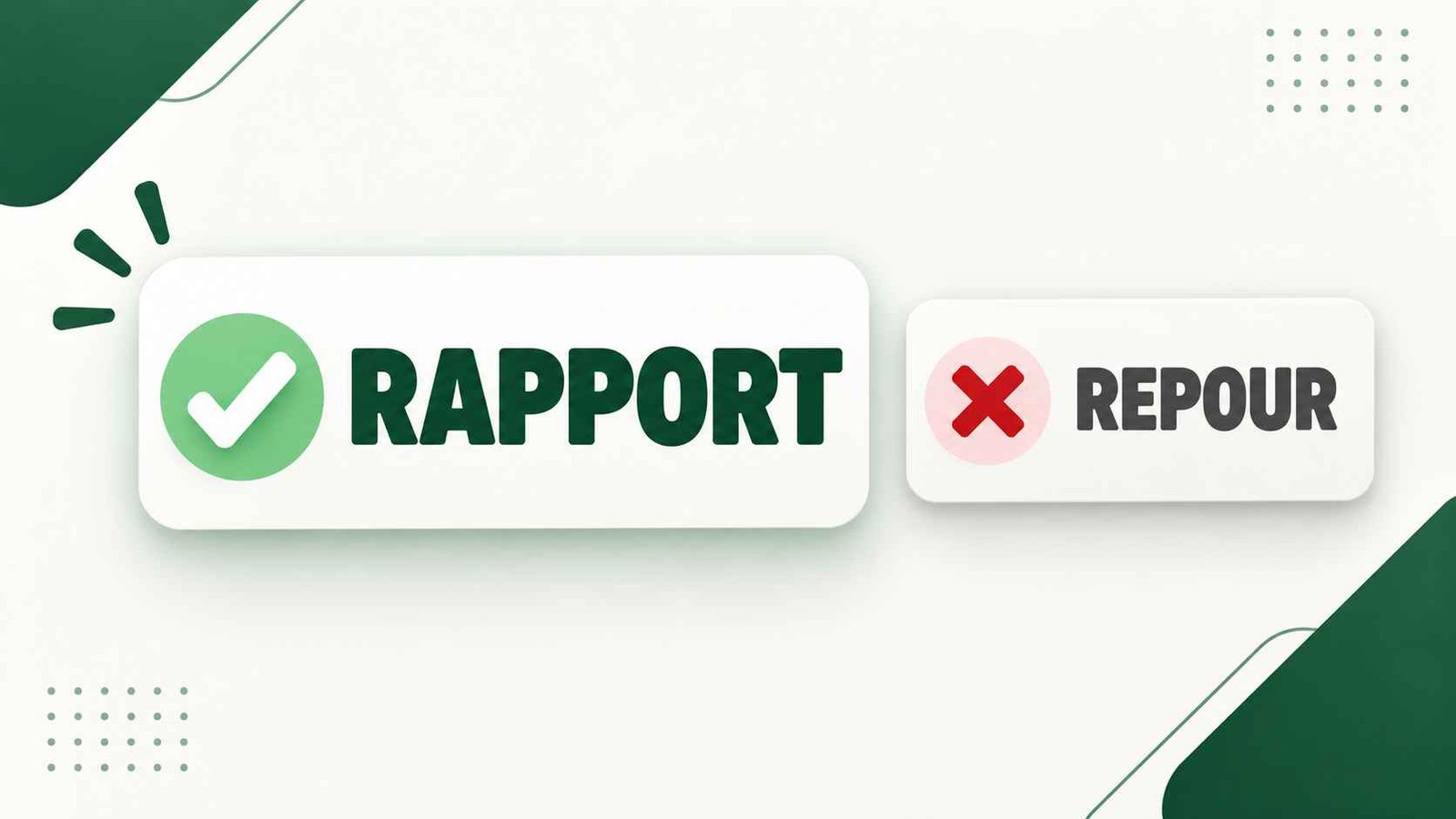
Repore or Rapport – Quick Answer
Rapport is the only correct spelling, and every other version, including repour vs rapport and good repor, is simply a misspelling. This section sets the record straight in one glance before you read further.
| Term | Correct? | Meaning | Where It Comes From |
| Rapport | ✅ Yes | trust, connection, mutual understanding | French, rapporter |
| Repour | ❌ No | none | phonetic guess |
| Repore | ❌ No | none | phonetic guess |
| Repoire | ❌ No | none | phonetic guess |
| Good repor | ❌ No | none | truncated typo |
What Is the Fastest Way to Check Rapport Spelling?
- Say the word slowly and notice it sounds nothing like it is spelled.
- Type it into a search bar and let autocomplete correct you.
- Compare it against the table above before you hit send.
- Remember the French root instead of the English sound.
- Trust your spellchecker when it underlines any repour or repore variant.
Example in texting: Friend 1: is it repour or rapport for the intro email Friend 2: rapport, always rapport, the other one isn’t a word
The Origin of Repore or Rapport
Every mix-up around repour vs rapport starts with history, not carelessness. Knowing where rapport came from makes the good repor mistake disappear almost instantly and for good.
The word rapport came directly from French, where it means relationship, harmony, or connection. It comes from the verb rapporter, meaning to bring back or to relate. When English absorbed the word in the early 1800s, it kept the original French spelling intact rather than reshaping it to match English sound patterns.
Why Did English Keep the French Spelling of Rapport?
- Borrowed words often keep their original spelling even after pronunciation shifts.
- Rapport entered through psychology and diplomacy circles first.
- Silent letters and unusual vowel sounds are common in French loanwords.
- Counseling and therapy fields spread the word into everyday English.
- Business and leadership writing adopted it soon after.
Because rapport is pronounced ra-POUR, plenty of writers assume the spelling should match, which is exactly how repour and repore spelling mistakes are born.
Example in chat: Friend 1: why does rapport even look like that Friend 2: it’s French, that’s the whole answer honestly
British English vs American English Spelling
Unlike many English words that split by region, this one does not, and that single fact quietly resolves half of every repour vs rapport debate online.
| Word | British English | American English | Correct |
| Rapport | Yes | Yes | ✅ |
| Repour | No | No | ❌ |
| Repore | No | No | ❌ |
| Repoire | No | No | ❌ |
Does Rapport Change Between UK and US English?
- Spelling stays identical whether you write for London or New York.
- Pronunciation stays the same across both major English dialects.
- Dictionaries on both sides list only one accepted spelling.
- Style guides never flag a regional variant for this word.
- Confusion comes from sound, not from geography.
Example in texting: Friend 1: is rapport spelled differently in British English Friend 2: nope, same everywhere, that’s the easy part
Which Spelling Should You Use?
If you have ever hesitated between repour vs rapport mid sentence, this section removes the guesswork completely so you never pause over it again.
The rule is simple and universal. Rapport is correct for a US audience, a UK audience, academic writing, professional writing, and casual writing. There is no context, formal or informal, where repour, repore, repoire, or good repor becomes acceptable.
Is Rapport Ever Optional in Professional Writing?
- Resumes should always use rapport, never a phonetic guess.
- Cover letters benefit from correctly spelled soft skills like rapport.
- Client emails lose credibility fast when spelling slips happen.
- Academic papers are graded partly on precise vocabulary use.
- Social posts still reflect on your personal brand, so spell it right.
If you want an internal link opportunity here, this same letter-slip pattern shows up in other common English mix-ups too, similar to the confusion covered in studying or studing, where one missing letter changes a word from correct to incorrect instantly.
Example in chat: Friend 1: should I use rapport or repour in this pitch deck Friend 2: rapport, 100 percent, repour will get flagged instantly
Repour vs Rapport in Professional Writing (Emails, Resumes & Reports)

Nowhere does the repour vs rapport mistake cost more than at work, where one misspelled word can quietly undercut an otherwise strong, well-written message.
Hiring managers, clients, and professors read fast, and a spelling slip like repore spelling or good repor stands out immediately against otherwise polished writing. Because rapport itself signals trust and connection, misspelling it creates an odd contradiction that sharp readers notice right away.
How Does Misspelling Rapport Affect Your Credibility?
- Recruiters often screen resumes for small, telling errors like this.
- Clients may quietly question your attention to detail.
- Professors frequently deduct marks for repeated spelling slips.
- Colleagues notice when written communication looks rushed.
- First impressions in emails are shaped by tiny details like this.
| Context | Correct Word | Risk of Wrong Spelling |
| Resume | Rapport | High, screened by recruiters |
| Client Email | Rapport | High, affects trust |
| Academic Paper | Rapport | Medium, graded writing |
| Casual Text | Rapport | Low, but still noticeable |
Example in texting: Friend 1: does spelling rapport wrong on a resume actually matter Friend 2: yes, recruiters absolutely notice small stuff like that
Common Mistakes with Repore or Rapport
Most people repeat the repour vs rapport error without realizing it, and this section breaks down exactly why the mistake keeps sneaking back into everyday writing.
- ❌ We need to build repore with clients. ✅ We need to build rapport with clients.
- ❌ She has excellent repour skills. ✅ She has excellent rapport skills.
- ❌ The teacher created good repor with students. ✅ The teacher created good rapport with students.
- ❌ Let’s establish repoire early in the call. ✅ Let’s establish rapport early in the call.
- ❌ Apport vs repoire confuses more people than expected. ✅ Only rapport is a real English word here.
What Causes People to Keep Misspelling Rapport?
- Phonetic spelling habits override memorized dictionary forms.
- Autocorrect sometimes fails on less common loanwords.
- Non-native speakers naturally spell words the way they sound.
- Muscle memory repeats an old typo without a second thought.
- Rushed typing skips the mental spellcheck most writers rely on.
Example in chat: Friend 1: why do I keep typing repour instead of rapport Friend 2: honestly it’s just muscle memory, retrain it once and you’re set
What Does Rapport Really Mean in a Relationship?
Beyond spelling, the real question behind repour vs rapport searches is meaning, because most people actually want to understand the emotional weight this word carries.
Rapport describes a close, positive connection built on trust, mutual understanding, and comfortable communication between two or more people. It is not a one-time event but something built gradually through shared attention, honesty, and genuine listening.
How Do You Know You Have Built Real Rapport?
- Conversation flows naturally without long, awkward pauses.
- Trust grows quickly once rapport is genuinely established.
- Body language relaxes and mirrors the other person’s.
- Listening feels mutual rather than one-sided.
- Follow-up conversations feel easier and more open.
Example in texting: Friend 1: how do you know if you have rapport with someone Friend 2: honestly you can just feel it, talking gets easy
Repore or Rapport in Everyday Examples
Seeing rapport used correctly across different settings helps the repour vs rapport rule stick permanently instead of fading after one read.
- Emails: I look forward to building strong rapport with the new team.
- Sales: Successful salespeople focus on creating rapport before ever pitching.
- Counseling: Therapists work hard to establish rapport with every client.
- Media: The candidate built instant rapport with the audience.
- Social media: Great energy, great conversation, instant rapport.
Where Does Rapport Show Up Most in Daily Life?
- Workplace meetings rely on quick rapport to keep collaboration smooth.
- Interviews often hinge on rapport built in the first minute.
- Teaching improves dramatically once a teacher builds rapport with a class.
- Customer service calls go better when rapport is established early.
- Dating and friendships depend heavily on natural, growing rapport.
Example in chat: Friend 1: what’s an easy way to build rapport on a first call Friend 2: ask real questions and actually listen, that’s basically it
Why Do People Misspell Rapport as Repore, Repour, or Repoire?

This question drives a huge share of repour vs rapport searches, because the answer explains a pattern seen across dozens of borrowed English words.
- Sound dominates spelling instinct far more than most people realize.
- French loanwords rarely match English spelling logic at all.
- Repetition of a wrong spelling reinforces it over time.
- Keyboard speed increases the odds of a dropped or swapped letter.
- Assumption that every word is spelled the way it sounds.
Is Repoire a Real Alternate Spelling Anywhere?
- Dictionaries list no entry for repoire in any English variant.
- Style guides never accept repoire as a formal alternative.
- Search data shows repoire used only in typos, never in edited text.
- Editors always correct repoire to rapport without exception.
- Spellcheckers flag repoire the same way they flag repour.
Example in texting: Friend 1: is repoire an old spelling or something Friend 2: nope, just a typo, rapport is the only real one
How to Remember the Correct Spelling of Rapport Forever
A simple memory trick ends the repour vs rapport confusion faster than any grammar rule ever could, especially for fast typists and non-native speakers.
- Picture the French flag every time you write rapport.
- Repeat the phrase “rapport, not repour” out loud once.
- Link rapport to “report” visually since both share letters.
- Practice typing rapport five times until it feels automatic.
- Bookmark this page for a quick spelling check later.
What Is the Easiest Memory Trick for Rapport Spelling?
- Say the sound out loud, then intentionally spell against it.
- Notice the double “p” and single “t” pattern each time.
- Compare rapport to “support,” which shares a similar rhythm.
- Write the correct version three times after any mistake.
- Trust the French origin instead of the English sound.
Example in chat: Friend 1: got any trick for remembering rapport spelling Friend 2: think of the French flag, weirdly it works every time
Repore or Rapport – Google Trends & Usage Data
Search behavior around repour vs rapport reveals a surprisingly consistent pattern worldwide, and understanding it explains why this confusion never fully disappears.
Most searches for this topic come from students, job seekers, professionals drafting emails, and non-native English speakers double-checking their writing. In books, journals, and professional websites, rapport appears constantly, especially in HR, psychology, education, and leadership fields, while repour, repore, and repoire appear only inside drafts, forums, or informal posts.
Who Searches for Repour vs Rapport the Most?
- Students writing essays or personal statements search it often.
- Job seekers double-check spelling before submitting resumes.
- Non-native speakers search it more than native speakers overall.
- Content writers verify spelling before publishing professional material.
- Managers search it when drafting performance reviews or feedback.
Example in texting: Friend 1: is repour vs rapport actually a common search Friend 2: way more than you’d think, it’s a classic mix-up
When Should You Use the Word Rapport in a Sentence?
Knowing exactly when to use rapport, rather than second-guessing between repour vs rapport, makes your writing feel confident and instantly more polished.
- After meeting someone new, describe the connection as rapport.
- Before a sales pitch, mention building rapport with the prospect.
- During therapy or coaching, rapport describes the working relationship.
- In leadership writing, rapport explains trust between managers and teams.
- In teaching contexts, rapport describes teacher-student connection and trust.
Can Rapport Be Used in Casual Conversation Too?
- Yes, rapport fits naturally into casual texts and chats.
- Friends can say they have great rapport without sounding formal.
- Dating conversations often use rapport to describe early chemistry.
- Group chats use it when describing team or friend group energy.
- Social captions use rapport to describe strong group dynamics.
Example in chat: Friend 1: can I even use rapport in a normal text Friend 2: totally, it doesn’t have to sound formal at all
Rapport Building Skills: Why Getting the Spelling Right Matters

Rapport is not just a word people misspell as repour vs rapport, it is also a real, learnable skill that shapes careers, friendships, and everyday communication.
- Active listening is the foundation of every strong rapport.
- Eye contact signals genuine attention during conversation.
- Mirroring tone and pace naturally builds comfort quickly.
- Curiosity about the other person deepens connection fast.
- Consistency over time turns quick rapport into lasting trust.
| Skill | Builds Rapport By |
| Active listening | Showing genuine attention |
| Mirroring | Creating natural comfort |
| Asking questions | Signaling real curiosity |
| Follow-up | Turning contact into trust |
Example in texting: Friend 1: any actual tips for building rapport fast Friend 2: ask questions and actually remember the answers, works every time
Comparison Table: Keyword Variations
Every variation people type instead of the real word deserves one clear, side-by-side answer, so here is the full repour vs rapport picture at a glance.
| Term | Correct | Meaning | Use Case |
| Rapport | ✅ Yes | trust, connection | formal and informal |
| Repour | ❌ No | none | never |
| Repore | ❌ No | none | never |
| Repoire | ❌ No | none | never |
| Good repor | ❌ No | none | never |
Repore Spelling and Other Misspellings You Should Avoid
Beyond the main repour vs rapport confusion, several closely related typos circulate online, including apport vs repoire, repoire vs rapport, and plain repore spelling errors.
- Apport is an unrelated word tied to old paranormal terminology, not rapport.
- Repoire has no dictionary listing in any English variant.
- Repore spelling appears almost exclusively in unedited drafts.
- Good repor is simply a truncated, incomplete misspelling of rapport.
- None of these variants ever appear in published, edited English.
Are Any of These Repore Variants Ever Acceptable?
- No, not in formal writing of any kind.
- No, not in casual texting either, despite common use.
- No, dictionaries and spellcheckers consistently reject every variant.
- No, style guides never list an approved alternative spelling.
- Yes, only as an example of what to avoid, nothing more.
Example in chat: Friend 1: I saw someone write apport vs repoire online, is that real Friend 2: nope, still just rapport, people are just guessing at this point
FAQs
Is repore a real word?
No, repore is always incorrect and never appears in any English dictionary.
What is the difference between repour vs rapport?
There is no real difference. Only rapport is correct; repour is simply a common misspelling.
Why does rapport look so unusual to spell?
Because English kept the original French spelling instead of adapting it phonetically for repour vs rapport searchers.
How do you pronounce rapport correctly?
It sounds like ra-POUR, which is exactly why the repour vs rapport mix-up happens so often.
Is repoire vs rapport ever a fair comparison?
Not really, since repoire has no dictionary meaning while rapport is a fully recognized English word.
What does good repor actually mean?
Good repor is simply a truncated misspelling of “good rapport,” meaning a positive, trusting connection.
Will spellcheck catch repour, repore, or repoire?
Yes, most modern spellcheckers flag all three, confirming that only rapport survives every repour vs rapport check.
Conclusion
The repour vs rapport debate becomes easy once the facts are clear. Rapport is the only correct spelling, while repour, repore, repoire, and good repor are simply phonetic slips caused by the word’s French origin. There is no regional variation and no professional or casual context where any alternative spelling works.
Getting repour vs rapport right matters because rapport itself is about trust and connection, and misspelling it can quietly undercut the very message you are sending, especially in emails, resumes, and client conversations. Keep this simple rule close: if you mean trust, understanding, or a genuine bond between people, the word is always rapport. Once that clicks, you will never hesitate over repour vs rapport again.

Daniel Parker is an English language writer sharing clear grammar lessons, practical tips, and helpful examples for learners.










1 thought on “Repore or Rapport: Which Spelling Is Correct ? (guide 2026)”