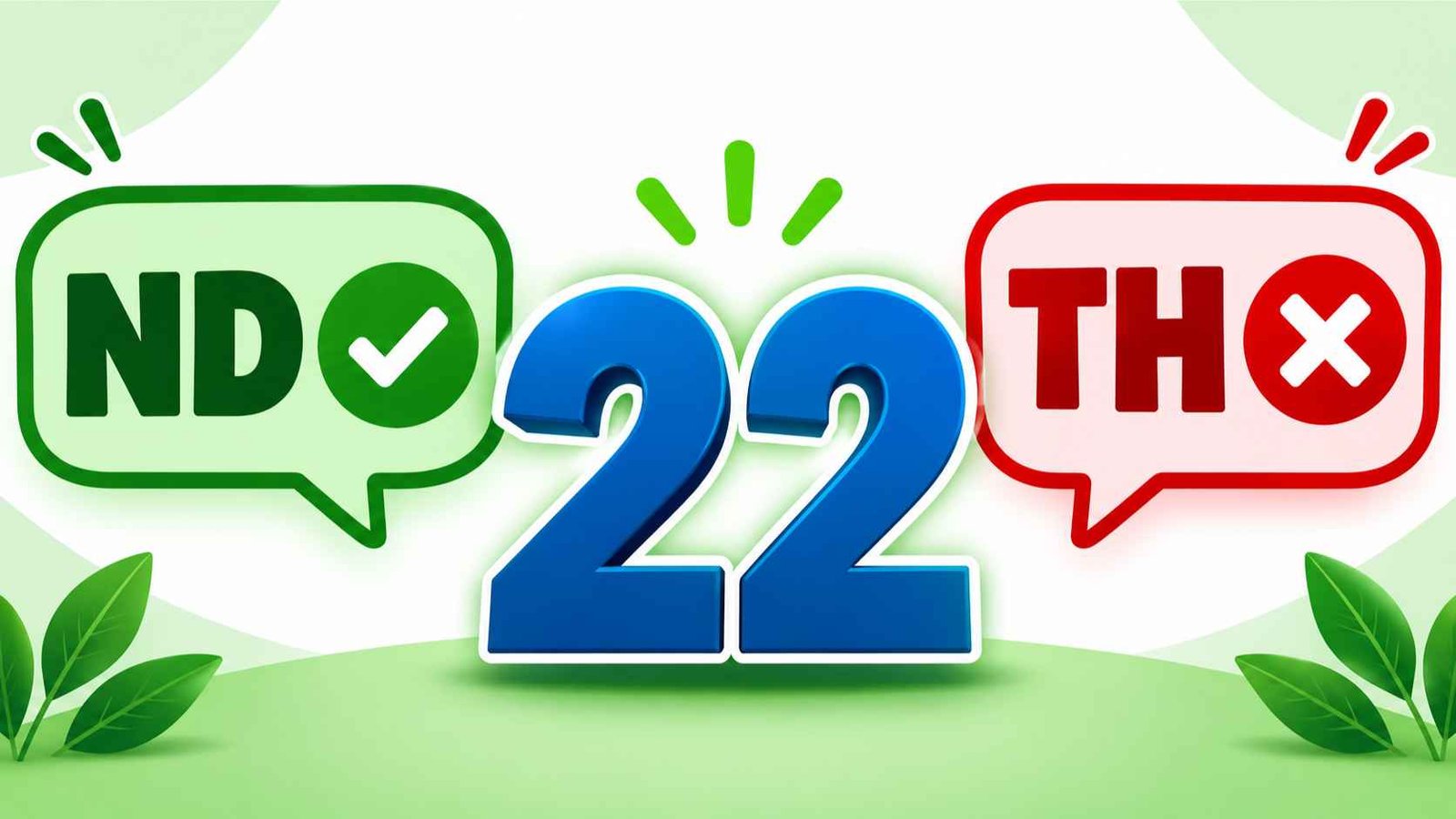

You typed “22th,” stared at it, and something felt off. That gut check was right English quietly swaps the ending on this number, and most people never learn why.
“22nd” is the only correct form. “22th” doesn’t exist in standard English. The rule hinges on the last digit of the number: 22 ends in 2, and numbers ending in 2 take “nd,” borrowed straight from the word “second.” Write “her 22nd birthday,” not “her 22th birthday.”
Quick Takeaways
- 22nd is correct in every dialect of English; 22th is never correct, formal or informal.
- The ending comes from the last digit: 1→st, 2→nd, 3→rd, everything else→th.
- 11th, 12th, and 13th are the one group that ignores this rule and always take “th.”
- In strict AP-style date lines, the suffix is often dropped entirely (“May 22”), not swapped for “th.”
22th or 22nd – Quick Answer
The short version: 22nd is right, 22th is a spelling error that comes from over-applying the “th” pattern.
Correct: My appointment is on the 22nd. / She turns 22 on March 22nd. Incorrect: 22th anniversary, 22th birthday, June 22th.
Simple Rule
Match the ending to the last digit of the number:
| Last digit | Ending | Example |
| 1 | st | 21st |
| 2 | nd | 22nd |
| 3 | rd | 23rd |
| 4–0 | th | 24th, 20th |
22 ends in 2, so it’s 22ndno exceptions for this particular number.
The Origin of 22th or 22nd
Ordinal numbers mark position or sequence first place, second floor, third chapter. The “nd” in 22nd isn’t random; it’s inherited from “second” itself.
| Number | Word form | Short form |
| 1 | first | 1st |
| 2 | second | 2nd |
| 22 | twenty-second | 22nd |
The confusion happens because “th” is the default ending4th, 5th, 10th, 100thso people assume it covers everything. It doesn’t. Numbers ending in 1, 2, or 3 keep their own historical endings, and 22 is one of them.
Is “22th or 22nd Birthday” Correct?
Only “22nd birthday” is correct. Because “22nd” is a whole unit built from “twenty-second,” it stays intact no matter what noun follows itbirthday, anniversary, floor, or day. Writing “her 22th birthday” applies the wrong suffix to the wrong number, the same way writing “22th floor” or “22th of July” would be wrong.
This matters more than it seems, because birthday and anniversary posts are where “22th” shows up most often onlinecards, captions, and quick texts where people type fast and don’t double-check.
British English vs American English Spelling
There’s no regional split here. Both varieties of English follow the identical last-digit rule.
Comparison Table
| Form | British English | American English |
| 22nd | ✅ Correct | ✅ Correct |
| 22th | ❌ Incorrect | ❌ Incorrect |
This is a grammar rule, not a spelling variant like “colour” vs “color.”
Which Spelling Should You Use?
Use 22nd everywhereschool writing, business documents, invitations, and casual messages all follow the same standard.
Audience-Based Usage
| Audience | Correct form |
| US readers | 22nd |
| UK readers | 22nd |
| ESL learners | 22nd |
| Global/international audience | 22nd |
Is 22nd Formal or Casual in Writing?
22nd itself isn’t tied to a registerit’s correct everywhere. What changes by register is whether you use the ordinal at all. Style guides used in journalism and reports often drop the suffix in date lines and write the bare numeral instead, saving “22nd” for running prose.
| Context | Typical style | Example |
| News/AP-style date line | Numeral only, suffix dropped | “The event is May 22.” |
| Everyday prose, emails, invitations | Full ordinal | “The event is on May 22nd.” |
| Legal/academic body text | Full ordinal | “…on the 22nd day of July.” |
| Texting/social captions | Full ordinal, often abbreviated further | “22nd bday tonight 🎉” |
So if a formal report seems to “drop” the ordinal, it’s a style choice about numerals, not a sign that “22th” is acceptable in formal writing. It never is.
What Does 22nd Mean in Texting?
In texts and captions, “22nd” almost always marks a date or a birthday, and people frequently shorten the surrounding words rather than the ordinal itself”22nd bday,” “turning 22 on the 22nd,” and similar phrasing are common. The ordinal spelling doesn’t loosen in casual writing; only the words around it get compressed.
Example in Chat: Alex: omg it’s finally my 22nd bday next week Sam: STOP it’s already the 22nd?? time is flying 😭
Common Mistakes with 22th or 22nd
The most common cause is habit: people memorize “th” from words like 4th, 5th, and 6th, then apply it everywhere without checking the last digit.
Common Errors and Fixes
| Incorrect | Correct |
| 22th birthday | 22nd birthday |
| January 22th | January 22nd |
| 22th anniversary | 22nd anniversary |
| 22th floor | 22nd floor |
Incorrect Example
The event will happen on May 22th.
Correct Example
The event will happen on May 22nd.
Why the Mistake Happens
“th” feels like the safe, universal default because it covers most numbers (4th–20th, 24th–30th, and so on). The brain generalizes that pattern to every number, including the ones that follow a different rule.
Easy Rule for Ordinal Numbers

| Last digit | Ending | Example |
| 1 | st | 21st |
| 2 | nd | 22nd |
| 3 | rd | 23rd |
| 4–0 | th | 24th |
Exceptions
11th, 12th, and 13th always use “th,” even though they end in 1, 2, and 3. This isn’t random either: these three numbers belong to the “teen” family, and English historically treats the teens as their own unit rather than as “ten-plus-one,” “ten-plus-two,” and so on. Because they’re grouped by that “teen” identity rather than by their final digit, the usual last-digit rule never applies to them which is also why 111th and 112th still take “th,” not “st” or “nd,” despite ending in 1 and 2.
22th or 22nd in Everyday Examples

Emails
Our meeting is scheduled for the 22nd.
News
The company will launch its product on the 22nd of August.
Social Media
Can’t wait for my 22nd birthday!
Formal Writing
The conference begins on the 22nd day of July.
Invitations
You are invited to our 22nd anniversary celebration.
22th or 22nd – Search & Usage Patterns
People land on this question for a fairly narrow set of reasons, and they tend to repeat across ages and regions.
Why People Search This Keyword
- Uncertainty about which ordinal ending is correct
- Double-checking spelling before sending an invitation or caption
- General English learning and ordinal number practice
- School or workplace writing where accuracy matters
Popular Countries
This kind of ordinal-number question comes up most in English-speaking and ESL-heavy regions, including the US, UK, India, Pakistan, and Canada.
Usage Contexts
Dates, birthdays, anniversaries, invitations, and academic or business writing are the most common places the mistake surfaces.
Comparison Table: 22th vs 22nd
| Feature | 22nd | 22th |
| Grammatically correct | ✅ Yes | ❌ No |
| Accepted in dictionaries | ✅ Yes | ❌ No |
| Used in academic writing | ✅ Yes | ❌ No |
| Used in professional writing | ✅ Yes | ❌ No |
| Appears in casual texting | ✅ Yes | ❌ Only as a typo |
Ordinal Numbers Similar to 22nd
| Correct | Incorrect |
| 21st | 21th |
| 22nd | 22th |
| 23rd | 23th |
| 31st | 31th |
| 42nd | 42th |
Once the last-digit pattern clicks for one of these, it holds for all of them.
Memory Trick to Remember 22nd
Anchor it to the word it borrows from: second → nd. Since 22 ends in 2, it takes the same ending as “second”:
2nd → 22nd → 32nd → 42nd
If you can spell “second,” you already know how to spell “22nd.”
FAQs
Is 22th ever correct?
No. “22th” isn’t correct in any context, formal or informal, in any English dialect.
What’s the correct ordinal form of 22?
22nd is correct. In words, it’s “twenty-second.”
Why is it 22nd and not 22th?
Because the rule follows the last digit of the number, and numbers ending in 2 use “nd,” the same ending as “second.”
Is 22nd used in British English too?
Yes. British and American English follow the exact same rule here there’s no regional variant to choose between.
Why do so many people write 22th by mistake?
They over-apply the “th” ending, which is genuinely the most common ordinal suffix, without checking whether the number ends in 1, 2, or 3.
Do style guides ever drop the “nd” from 22nd?
Some do, in date lines specifically writing “May 22” instead of “May 22nd”but that’s a numeral-formatting choice, not permission to write “22th.”
Why do 11th, 12th, and 13th break the last-digit rule?
Because they belong to the “teen” number family rather than being treated as “ten-plus-one/two/three,” so they keep “th” regardless of their final digit.
“Curious about another tricky exception? Check out our full guide on 13th or 13rd.”
Final Thoughts on 22nd
Once the last-digit rule is in place, “22th” stops being a trap. Numbers ending in 2 take “nd” because that ending comes directly from “second,” and that holds true across birthdays, anniversaries, dates, and formal documents alike. The only real wrinkle is the teens11th, 12th, and 13thwhich sit outside the pattern entirely, and the fact that some date-line styles drop the suffix altogether rather than swapping it.
Keep the anchor word in mindsecond, 22ndand the spelling takes care of itself every time you write a date, a birthday message, or an anniversary invitation.

Daniel Parker is an English language writer sharing clear grammar lessons, practical tips, and helpful examples for learners.










1 thought on “22th or 22nd: Which One Is Correct? Grammar Guide (2026)”