
Forgiveness and forgetting are often treated as the same thing, especially when someone tells you to “forgive and forget.” Yet the difference between forgiveness and forgetting matters when you are dealing with betrayal, disappointment, broken trust, or emotional pain.
You can work toward forgiveness while remembering what happened. Understanding emotional forgiveness, personal boundaries, and the meaning of the phrase “forgive and forget” can help you decide what healing looks like for you.

Key Takeaways:
- Forgiveness involves changing how you respond to someone who hurt you.
- Forgetting involves losing access to a memory or allowing its details to fade.
- Forgiveness does not require reconciliation. You can forgive someone without restoring the relationship.
- Remembering can protect you. Past experiences can help you recognize unhealthy behavior and establish boundaries.
- Emotional healing takes time. Nobody should be forced to forgive before they feel ready.
- Accountability still matters. Forgiveness does not remove another person’s responsibility for their actions.
Quick Comparison:
| Aspect | Forgiveness | Forgetting |
| Meaning | Releasing or reducing resentment toward someone who caused harm | Losing or being unable to recall some details of an event |
| Memory | The incident can remain clear | Some details may fade naturally |
| Emotions | Anger and resentment may gradually become less intense | Emotional reactions may remain even when details fade |
| Personal boundaries | Can coexist with firm boundaries | Does not automatically create healthier boundaries |
| Reconciliation | Does not require restoring a relationship | Does not automatically repair a relationship |
| Accountability | Allows you to acknowledge wrongdoing | Does not determine whether wrongdoing has been addressed |
| Time | Can develop gradually | May occur naturally over time |
How Forgiveness Works and Why It Helps
Forgiveness can change how you respond to a painful experience without requiring you to deny what happened. It may involve working through anger, disappointment, or resentment until these feelings have less control over your daily life.
The American Psychological Association describes forgiveness as a voluntary change in how someone relates to a person who caused harm. It distinguishes forgiveness from excusing the wrongdoing or automatically reconciling with the person who committed it.
Forgiveness can involve several stages, and people do not necessarily experience them in the same order. Your response depends on what happened, how deeply it affected you, and whether the other person continues to cause harm.
When discussing forgiveness, clear wording also matters. GrammarTimely’s explanation of the difference between accept and except covers a common language distinction. Accepting that an event occurred does not mean approving the behavior or agreeing that it was acceptable.
The Mental Process of Forgiveness

The process often begins with acknowledging the harm. You may need to recognize your anger, sadness, fear, or disappointment before you can decide how you want to respond.
You do not need to pretend that the person acted fairly. Being honest about the incident allows you to consider what you need next.
The process may involve:
- Acknowledging what happened without minimizing its impact.
- Naming the emotions connected to the experience.
- Considering what you need to feel safe and respected.
- Choosing whether forgiveness fits your values and circumstances.
- Practicing ways to respond without being consumed by resentment.
- Maintaining boundaries if the person’s behavior remains harmful.
These steps are possibilities, not a fixed formula. Some people reach a decision to forgive relatively quickly, while others need time, support, or professional help.
Forgiveness also does not require you to contact the person who hurt you. In some situations, working through your feelings privately is safer than reopening communication.
Choosing to Forgive vs. Feeling Forgiveness
Psychology distinguishes between decisional forgiveness and emotional forgiveness.
Decisional forgiveness involves making a conscious decision to respond differently toward the person who caused harm. You might decide that revenge does not fit your values, even though you still feel angry.
Emotional forgiveness involves a deeper change in your feelings toward the person. Resentment may gradually ease, and you may find that remembering the incident causes less distress than it once did.
These two experiences do not always happen together.
For example, you might decide to forgive a friend who shared something private about you. You may still feel uncomfortable when you remember the incident, even after you have made that decision.
Research published in PLOS ONE in 2015 examined the relationship between decisional forgiveness, emotional forgiveness, and memory. Its findings suggest that emotional forgiveness can affect the later incidental forgetting of information associated with an offense. This does not mean everyone who forgives will forget what happened.
The distinction matters because deciding to forgive does not require your emotions to change immediately. You can acknowledge your decision while allowing yourself time to process the remaining feelings.
How Forgiveness Helps Emotional Healing
Forgiveness may reduce the emotional burden associated with a painful experience for some people. Research discussed by the American Psychological Association connects forgiveness with potential benefits for emotional well-being, although the effects vary by individual and situation.
Forgiveness may help you:
- Reduce rumination: Spend less time repeatedly thinking about the incident.
- Understand your feelings: Identify why the event remains painful.
- Respond thoughtfully: Make decisions without acting solely from anger.
- Set boundaries: Decide which behavior you will and will not accept.
- Focus on your needs: Give attention to your own recovery rather than the other person’s reaction.
Forgiveness does not guarantee relief from anxiety, depression, grief, or trauma. Serious or persistent distress may require support from a qualified mental health professional.
It is also possible to experience emotional relief while still believing that the other person acted wrongly. Forgiveness does not require you to change your judgment about the facts of the incident or abandon accountability.
What Forgetting Means and Why It Has Limits
Forgetting involves losing access to some details of an experience or being unable to recall them clearly. Memories can change over time, and the emotional response associated with a memory may also change. These processes do not always happen together.
When people say “forgive and forget,” they may be asking the injured person to stop feeling angry and stop thinking about what happened. That expectation can be difficult, particularly when the event involved betrayal, repeated mistreatment, or a serious breach of trust.
What It Means to Forget Emotional Pain

Emotional pain can remain associated with a memory even when some details become unclear. You might remember that a person betrayed your confidence without remembering the exact words used during the conversation.
You may also remember the incident clearly while feeling less upset about it than you did initially. Neither experience determines whether you have forgiven the person.
Memory and emotional response are related, but they are not identical. Forgetting a detail does not prove that you have resolved your feelings, and remembering a detail does not prove that you remain resentful.
For instance, a person may forget the exact date of an argument with a sibling while remembering that their sibling disclosed private information. That remaining memory may still matter when deciding what to share in the future.
Why You Don’t Need to Forget to Heal
Healing can involve accepting that an event occurred, processing its impact, and deciding how to protect your well-being in the future. None of these steps requires you to erase the memory.
Remembering can provide useful information. It may help you recognize a repeated pattern, explain why a boundary is necessary, or make a more informed decision about a relationship.
You can remember an incident without thinking about it constantly. You can also stop seeking revenge while recognizing that the person who hurt you remains responsible for what they did.
The Greater Good Science Center at the University of California, Berkeley, discussed research published in 2025 suggesting that people who had forgiven an offense could recall its details while experiencing less negative emotion when remembering it. That research supports a useful distinction between remembering an event and continuing to suffer from it in the present.
The findings do not mean every memory becomes painless after forgiveness. They show why remembering and emotional recovery should be considered separately.
The Problems with Trying to Forget
Trying to force yourself to forget can create frustration, especially when memories return unexpectedly. You may blame yourself for still remembering the incident or assume that continued sadness means you have failed to forgive.
A more useful approach is to allow yourself to acknowledge the memory without judging yourself for having it.
Consider these common difficulties:
- Self-blame: You criticize yourself for remembering something painful.
- Emotional avoidance: You avoid discussing a problem that still needs attention.
- Missed warning signs: You overlook repeated behavior because you want to move forward quickly.
- Unclear boundaries: You restore access or trust before deciding what you need.
- Unrealistic expectations: You expect painful memories to disappear on a schedule.
These outcomes are not inevitable. People respond differently to painful experiences, and memories may fade naturally without any deliberate effort.
The practical lesson is to focus on your response to the memory, your present needs, and the choices available to you. You do not need to measure progress by whether you can remember the incident.
Main Differences Between Forgiveness and Forgetting
The main difference between forgiveness and forgetting is what changes after someone hurts you. Forgiveness concerns your response to the wrongdoing and the resentment connected to it. Forgetting concerns your ability to recall the event. Both can change over time, and neither guarantees that a relationship will return to its previous state.
Side-by-Side Comparison of Forgiveness vs. Forgetting
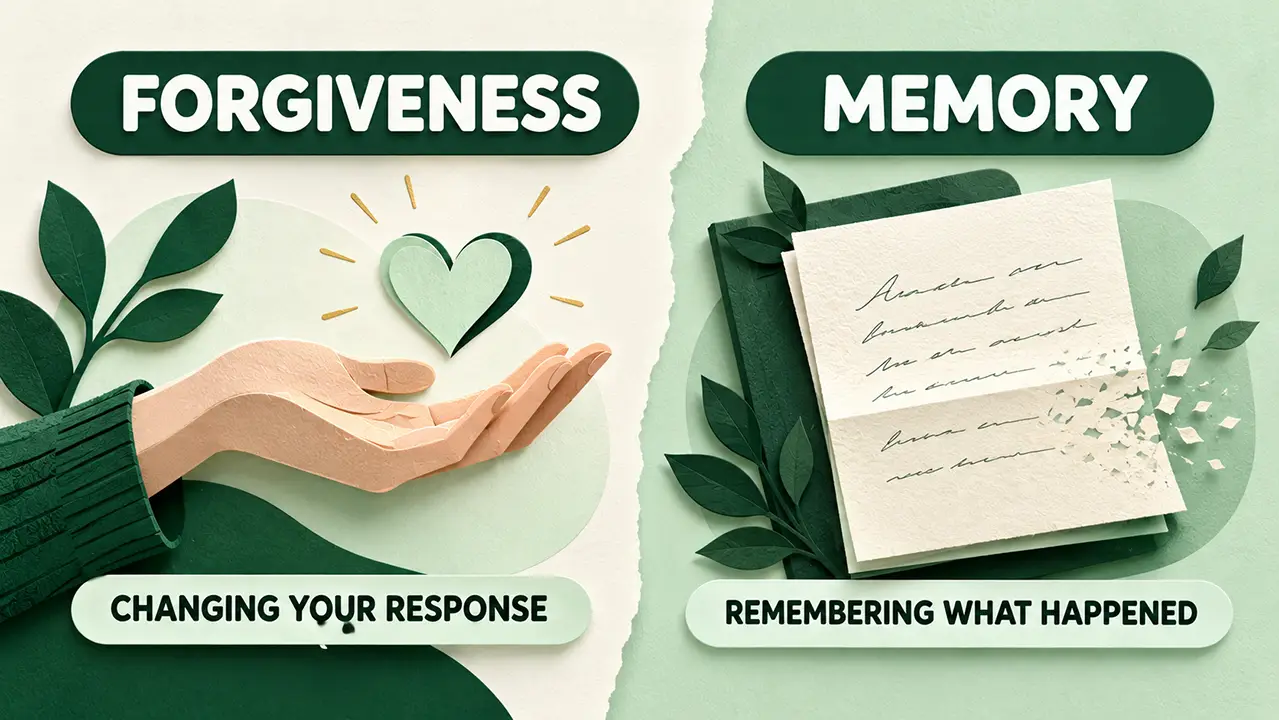
The comparison below shows how the two concepts differ in everyday situations.
| Situation | Forgiveness | Forgetting |
| A friend betrays your confidence | You work through your anger and decide how to respond | You may eventually forget some details of the conversation |
| A partner breaks a promise | You may release resentment while deciding whether trust can be rebuilt | You may forget when the promise was made |
| A family member says something hurtful | You may forgive while keeping a necessary boundary | You may remember the words for years |
| A colleague treats you unfairly | You can move forward without seeking revenge | The details may become less clear over time |
| Someone apologizes sincerely | You may consider forgiveness and whether reconciliation is appropriate | You may continue remembering the original incident |
These examples are illustrative. People do not all respond to the same experience in the same way.
The table also shows why forgive but don’t forget can be a reasonable personal principle. You can work through resentment and still remember information that matters for future decisions.
Forgiveness Relies on Memory but Changes Its Emotional Impact
To forgive someone, you generally need some awareness of what happened and how it affected you. That awareness allows you to recognize the harm, consider your feelings, and decide what response you want to choose.
Remembering the incident does not mean you must remain angry forever. It also does not mean you have to excuse the other person’s behavior.
For example, suppose your closest friend shared private information without your permission. You might eventually forgive your friend, while choosing to share less sensitive information until trust has been rebuilt.
That decision recognizes two separate facts: you are willing to work through the resentment, and you still need to protect your privacy.
A similar distinction applies to cheating, repeated dishonesty, and broken promises. Forgiveness may change your emotional response, while the other person’s future behavior determines whether rebuilding trust is appropriate.
Why Forgiveness Works Better Than Forgetting
Forgiveness can be a useful way to process emotional pain when it fits your circumstances and personal values. It may reduce resentment and change how you respond when painful memories return. Trying to forget the incident alone does not necessarily address the feelings or relationship problems associated with it.
However, forgiveness is not automatically the best or necessary choice for every person or every situation. Nobody should be pressured into forgiving someone who has harmed them.
The Mental Health Benefits of Forgiveness
Research on forgiveness has examined its relationship with emotional well-being, stress, and other aspects of health. Some findings suggest that forgiveness can reduce negative emotional responses, although benefits depend on the individual, the nature of the offense, and the process used.
Possible benefits include:
- Less resentment: You may spend less time dwelling on revenge or retaliation.
- Improved emotional awareness: You can better understand the feelings associated with the experience.
- Greater self-direction: You can make choices based on your needs and values.
- More deliberate relationships: You can decide whether continued contact is healthy.
- Reduced emotional burden: Memories may become less distressing over time.
These are potential benefits, not guaranteed outcomes. Forgiveness is not a substitute for treatment when someone is experiencing significant trauma, depression, anxiety, or other mental health concerns.
It also does not guarantee that another person will apologize, accept responsibility, or change their behavior. Your healing remains important even when the other person refuses to acknowledge the harm.
The Downsides of Trying to Forget
Forgetting may happen naturally as time passes, and that is a normal part of life. Problems can arise when you pressure yourself to stop remembering a painful event or use avoidance to escape feelings that still need attention.
You might tell yourself that the incident no longer matters because you do not want to experience the same pain again. Yet a similar situation may bring those feelings back.
Common difficulties include:
- Ignoring unresolved concerns: You may avoid discussing the problem even when clarification is needed.
- Overlooking repeated behavior: You may dismiss warning signs because you want to believe everything is fine.
- Rushing reconciliation: You may restore trust before the other person has demonstrated change.
- Suppressing emotions: You may feel ashamed whenever anger or sadness returns.
- Expecting a quick recovery: You may treat normal emotional responses as personal failures.
Remembering a harmful experience can help you recognize what you need to avoid in the future. The aim is to make decisions with a clearer understanding of what occurred, rather than forcing yourself to erase the memory.
How ATX Counseling Helps with Forgiveness
The ATX Counseling reference article discusses forgiveness as a process involving the acknowledgment of harm, deliberate choices, emotional responses, and personal boundaries. These concepts can help explain why forgiveness may take time.
Professional counseling can provide a structured setting to discuss painful experiences, recognize recurring thoughts, and consider appropriate ways to respond. A qualified therapist may help someone understand their emotions without requiring forgiveness or reconciliation as the final outcome.
Counseling may be especially useful when the incident continues to affect daily functioning, relationships, or a person’s sense of safety.
A few points are worth remembering:
- Personal readiness matters: You should not be pressured into forgiving.
- Accountability matters: The harm can be acknowledged directly.
- Boundaries matter: You can limit or end contact when necessary.
- Progress varies: Emotional responses do not follow a fixed schedule.
- Support is available: A qualified professional can help when the process feels overwhelming.
GrammarTimely provides educational content rather than clinical treatment. Anyone who needs mental health support should seek an appropriately qualified professional in their location.
Can You Truly Forgive Without Forgetting?
Yes. You can forgive someone while remembering what happened, including the details of the incident and the reasons it hurt you.
Forgiveness and forgetting do not have to occur together. A person may remember an offense clearly while experiencing less anger or distress when thinking about it. Another person may forgive and gradually find that the incident occupies less of their attention.
Consider a situation in which a sibling makes a hurtful remark during an argument. You may decide to forgive them, understand that people sometimes say things they regret, and choose to maintain the relationship. You might still remember the remark and ask for more respectful communication in the future.
The memory provides context for your decision. It does not automatically mean that you are refusing to forgive.
What does “forgive but don’t forget” mean?
The phrase forgive but don’t forget generally means that you are willing to release resentment while retaining the lesson learned from an experience.
It may communicate that you accept an apology but need time before trusting someone again. It can also mean that you will avoid revenge while remaining alert to repeated behavior.
The phrase can be useful when it reflects thoughtful boundaries. It can be less helpful when it becomes a reason to keep punishing someone indefinitely after a genuine resolution.
Ask yourself what remembering the incident is doing for you. If it helps you recognize a risk or communicate a boundary, that memory may have a practical purpose. If you repeatedly revisit the incident and experience intense distress, support may help you process it.
Can you forgive someone who has not apologized?
Yes, some people choose to forgive without receiving an apology. They may do so because forgiveness reflects their values or because they wish to reduce the emotional burden associated with the experience.
However, forgiveness does not remove the need for accountability. The other person remains responsible for their actions, even when you choose to stop seeking revenge.
You also have no obligation to restore the relationship. Forgiving someone who refuses to apologize can coexist with distance, clear boundaries, and a decision to move on without further contact.
Is It Biblical to Say “Forgive and Forget”?

The phrase “forgive and forget” is often associated with Christian teachings about forgiveness. However, the commonly cited Bible passages about forgiveness should not be treated as a simple instruction that every person must erase memories of wrongdoing.
For example, Ephesians 4:32 encourages kindness, compassion, and forgiveness. Colossians 3:13 also encourages people to forgive one another. These passages place forgiveness within a broader discussion of how people treat one another.
The passages do not directly state that a person must lose the memory of an offense before they can forgive.
What does the Bible say about forgetting and forgiving?
Christian interpretations of forgiveness often stress mercy, repentance, compassion, and the importance of treating others with kindness. Different Christian traditions may explain the relationship between forgiveness, reconciliation, justice, and memory in different ways.
A careful reading distinguishes God’s forgiveness in biblical descriptions from a human person’s ability to remember an event. Biblical passages about God no longer remembering sins are often interpreted in terms of forgiveness and no longer holding sins against the person. They should not automatically be treated as a requirement for human beings to erase memories.
For readers asking whether forgive and forget is biblical, the important distinction is that biblical teachings encourage forgiveness, while the exact phrase is a popular saying used to summarize that teaching.
Forgiveness also does not necessarily remove the need to address harmful behavior. A person can seek peace while recognizing wrongdoing, protecting others, and maintaining appropriate boundaries.
If you are making a decision based on your faith, consider discussing the relevant passages with a trusted and knowledgeable religious leader. The interpretation may depend on the larger passage, the translation, and your tradition.
Is It Better to Forget or Forgive?
There is no single answer that fits every situation. Forgiveness may help when you want to work through resentment, while forgetting may happen naturally as memories become less accessible over time.
You do not need to force either outcome.
In situations involving an ordinary disagreement or an isolated mistake, forgiveness may help you repair a relationship if both people are willing to address the problem. When someone repeatedly lies, threatens you, or violates your boundaries, protecting yourself may need to come first.
Consider these factors before deciding how to respond:
- The seriousness of the harm: A small misunderstanding differs from repeated abuse or deliberate betrayal.
- The other person’s response: A sincere apology differs from denial or blame.
- The pattern of behavior: One mistake differs from recurring misconduct.
- Your emotional readiness: You may need time before deciding whether forgiveness is appropriate.
- Your safety: You have a right to protect yourself, regardless of whether you forgive.
Sometimes people remember an event and gradually stop feeling distressed by it. Sometimes they forgive while continuing to feel sadness. Sometimes they decide that forgiveness is not a goal they want to pursue.
Your decision should reflect your circumstances, not pressure from someone who wants the problem to disappear.
How to Forgive Without Ignoring Red Flags

Forgiveness can coexist with practical steps to protect your well-being. You can work through resentment while deciding what behavior you will accept in the future and whether the relationship remains healthy.
Start by identifying what happened and whether the problem has stopped. Consider whether the other person acknowledges the harm, respects your boundaries, and shows meaningful change over time.
You may find the following approach helpful:
- Name the harm. Be honest about what happened and why it affected you.
- Allow your feelings. Give yourself room to experience anger, sadness, disappointment, or confusion.
- Decide what forgiveness means to you. It may mean releasing resentment, without making any commitment to reconnect.
- Set clear boundaries. Explain what needs to change, or limit contact when necessary.
- Observe behavior. Look for consistent actions rather than relying on promises alone.
- Get support when needed. A trusted person or qualified professional can help you think through difficult choices.
Example: A friend repeatedly shares your private information. You may eventually forgive them, yet decide to stop discussing confidential matters until they demonstrate that they can respect your privacy.
This is a practical example, not a report of a real reader’s experience.
[HUMAN ELEMENT NEEDED: Before publishing, add a genuine, anonymized example supplied by your team or a GrammarTimely-created reflection exercise that has been reviewed by a person. Place the material here. Do not present a fictional example as a real case.]
When should you avoid rushing forgiveness?
You should never feel required to forgive before you are ready. Pressure to forgive can be especially damaging when someone is still being harmed or is expected to resume a relationship that feels unsafe.
If the behavior continues, focus on safety, support, and appropriate boundaries. You can revisit the question of forgiveness later, or decide that it is not something you wish to pursue.
Forgiveness also does not mean withdrawing a legitimate complaint, giving up legal rights, or pretending that consequences are unnecessary. Personal healing and accountability can exist together.
Conclusion: The Main Differences Between Forgiveness and Forgetting
The difference between forgiveness and forgetting comes down to emotional response and memory. Forgiveness involves changing how you respond to someone who caused harm, while forgetting involves losing access to some or all details of an event. These processes can occur separately.
You can forgive someone without forgetting what happened, restoring the relationship, or removing necessary boundaries. You can also remember an experience without remaining consumed by anger.
The phrase “forgive and forget” may encourage people to seek peace, but it should not become pressure to ignore serious harm or rush recovery. Emotional forgiveness can take time, and no one should be forced into it.
When deciding whether to forgive or forget, consider what happened, whether the behavior has changed, and what you need to feel safe. Choose an approach that respects your well-being, values, and boundaries.
FAQs
How can I know if I’ve truly forgiven someone instead of just burying my feelings?
You may notice that the memory causes less resentment or that you feel less desire for revenge. Continued sadness does not automatically mean you have failed to forgive.
What are some practical ways to work on emotional forgiveness?
Start by acknowledging the harm and identifying your feelings. Give yourself time, maintain appropriate boundaries, and seek professional support if needed.
Why is it better to process painful memories instead of trying to forget them?
Processing a painful experience can help you understand your emotions and recognize important boundaries. Forgetting does not automatically resolve the feelings associated with an incident.
Can you forgive and forget at the same time?
Yes, some people forgive and later find that the memory becomes less prominent. Forgetting is not a required outcome of forgiveness.
Is it healthy to forgive but not forget?
It can be healthy to forgive while remembering the experience and maintaining boundaries. The important question is whether the memory helps you make sound decisions or keeps causing distress.
Does forgiveness mean you have to trust someone again?
No. Trust can take time to rebuild and depends on behavior, honesty, and accountability. You can forgive someone while keeping your distance.
What is the opposite of forgive and forget?
There is no single fixed opposite phrase. Depending on the context, people may describe the alternative as holding a grudge, refusing forgiveness, or remembering a wrong without reconciling.










